Categories
UPSETTING DAY

Upsetting Day: Peachtree Carnivore 🌭

Explaining what I do here at 1-900 HOT DOG has proven difficult lately. Telling less online friends, prospective romantic partners, and cab drivers that I write about “uh, like old stuff? But funny. Like it’s weird, you know? Snailiens, haha. That one stupid Olympics mascot?” is getting tiresome. I’m pivoting: from now on, no more hemming or hawing. I’m a literary critic.

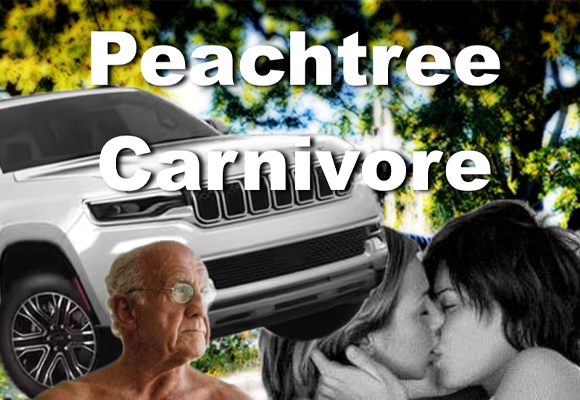
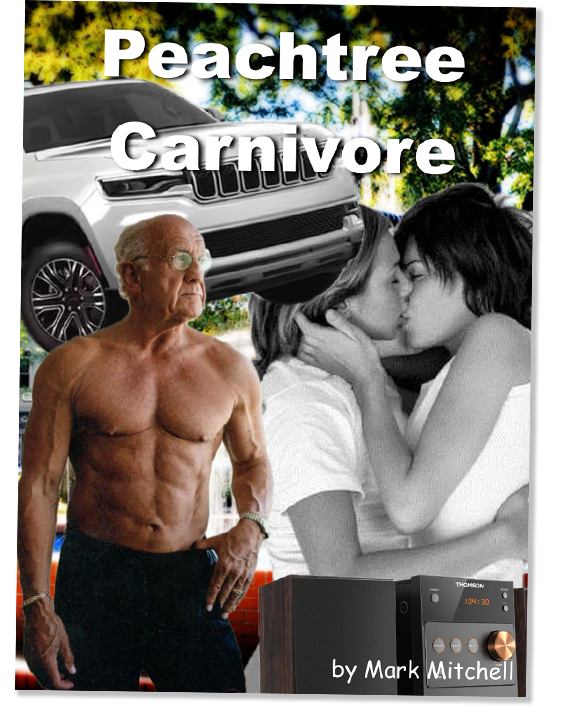
It sounds important. Not The New York Times Book Review important — the New York Review of Books important. But what work to discuss for my first column? I’ve recently read and enjoyed one new and one upcoming title from my Hot Dog colleagues, but I would hate to be accused of bias. (It’s about ethics in literary criticism.) Instead, I’ll consider Peachtree Carnivore, a text brought to my attention by esteemed community member Agent of Fortune. It is available exclusively in PDF format and doesn’t have a cover, but I’ve taken the liberty of creating one based on the image that graces the first page of the file.

Many of the great works of literature deploy narrative in service of a social argument. Madame Bovary rails against the romantic delusions of the bourgeoisie. Brave New World warns against a future where humanity is enslaved by means more insidious than punitive repression. And Ready Player One passionately urges us to never, ever forget Ghostbusters.

Peachtree Carnivore by Mark Mitchell is such a work. Its argument? That the all-meat diet which put Jordan Peterson into a coma is not only healthy, but indeed extends the human lifespan and transforms its adherents into erotic dynamos. Its author informs us that it is “not for the faint of heart.” Regretfully, it seems that he has fallen into the vogue of deploying “content warnings” for the overly sensitive modern reader. But perhaps this was merely a small concession to prevailing literary sensibilities. Onward.

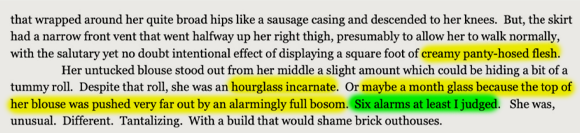
It is commonly supposed that whatsoever a character is doing the first time we meet them should tell us about what kind of person they are. Economy of storytelling, etc. When we meet Jack, the narrator of Peachtree Carnivore, he is doing two things: thinking about meat and analyzing the hips of a woman he’s just met vis-a-vis their birthing capabilities.

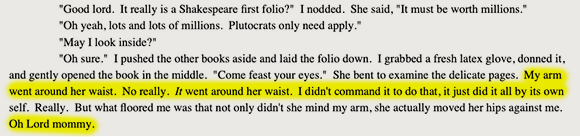
Boy meets girl. A timeless foundation of fiction. Boy is Jack Mason — sixty-something, unemployed, living off the inheritance provided by his abruptly deceased parents. Girl is Gladys Clayton, personal assistant to Jack’s dear friend and ethical billionaire Sam Grayson. Sam has sent Gladys to retrieve a book from Jack, but their introductions quickly take a turn for the libidinous.

Lest you think that our protagonist is motivated solely by the carnal pursuits, Mitchell is quick to point out that he is rather brainy as well.

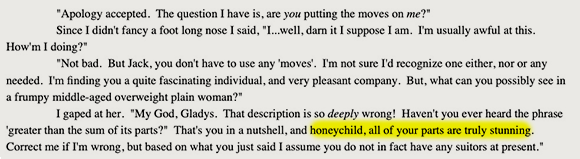
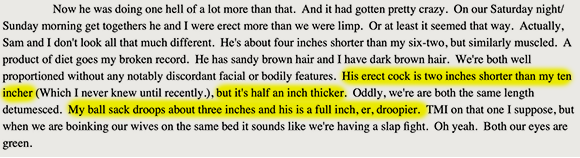
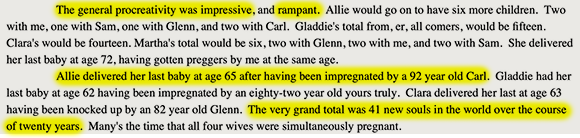
And neither is he the sort of jobless senior citizen who is attracted solely to women forty-five years his junior. No, he can appreciate the beauty of a woman merely twenty years younger than him, especially one who herself cannot discern her charms for herself.

But what of the book? A Shakespeare first folio, which you may recognize as being doubly superlative — the rarest edition of a work by the most famous author in the English language. Note how Mitchell contrasts the high-brow context of the Bard with the bawdy actions of his characters, perhaps a commentary on the transformation of Shakespeare from ribald popular entertainment in his own time to dreaded, stuffy high school text in ours.

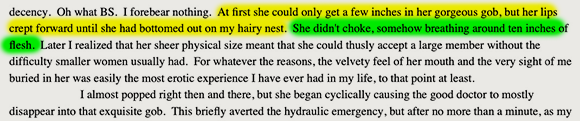
Needless to say, these two lovers find themselves tumbling into one another’s arms. Of course, sexual congress is famously difficult to write. What is erotic to the author may be repulsive to the reader. Mitchell slices this Gordian Knot by handwaving most of the actual acts themselves, preferring to describe the preliminaries and post-scripts.

Note the use of the term “gob.” An unusual choice in such a scene, to be sure. Slang for the mouth, it is typically used in gustatory — rather than amorous — contexts. But Mitchell repeatedly deploys it here. “Gorgeous gob,” “exquisite gob,” and so on. Grotesque? Parody? Or a sly elision of consumption and consummation?

It certainly did! And with the oral examination complete, Jack and Gladys move on to the main course. Gladys was, of course, a virgin up until this encounter. And now, the two are deliriously in love.

They decide to marry immediately as they are both of the conservative, traditional persuasion.

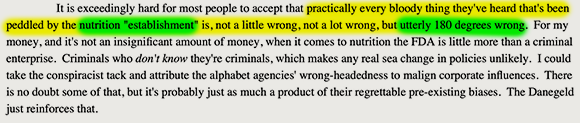
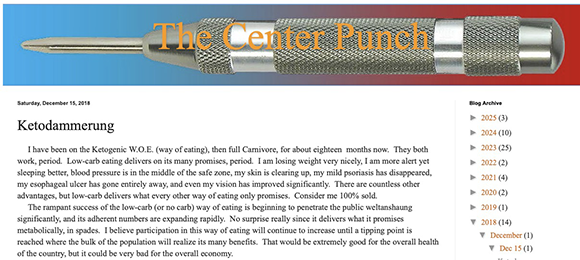
But first, Jack offers to coach Gladys on moving away from the SAD (Standard American Diet) and embracing the carnivore lifestyle which has granted him vitality atypical of his advanced age.

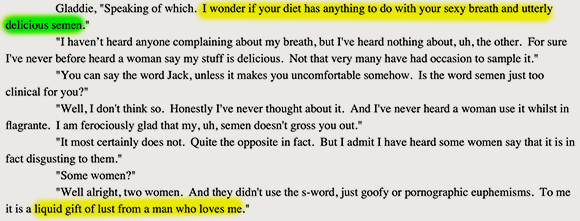
Jack’s carnivore diet is responsible for not just his youthful looks and healthy physique, but a clean-smelling breath and fine-tasting emissions.

As the couple feverishly makes plans for their future, Mitchell provides an early twist: this apparently chance meeting was in fact engineered by Sam, Gladys’s employer and Jack’s closest friend. Jack informs Sam and his wife Clara that he and Gladys intend to wed, being staunch moral traditionalists who have known each other for less than twelve hours and have already had intimate relations out of wedlock.

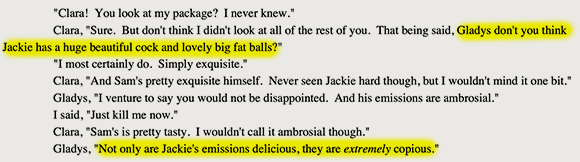
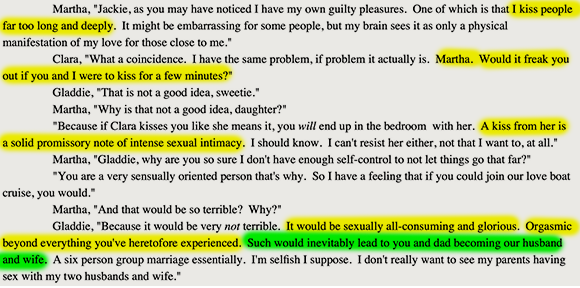
Many a male author stumbles when approaching the task of writing female characters who are believable, multi-dimensional human beings. Mitchell, thankfully, accomplishes this with gusto. Consider this passage, in which Clara and Gladys discuss the latter’s upcoming nuptials.

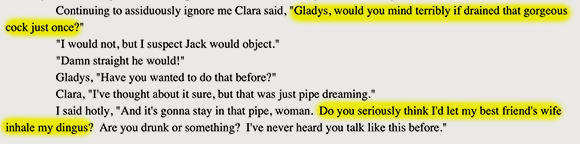
Note also Mitchell’s unconventional use of the characters’ names at the beginning of each line of dialogue. A mark of a literary nonconformist, as is his alternation — seemingly without rhyme or rhythm — between present and past tenses.

Unrealistic? Absurd? Contemptuous? Certainly the woke literary establishment would have you believe as much. But consider that in addition to her voracious hunger for seminal fluids, Gladys has another, quite intellectual hunger.

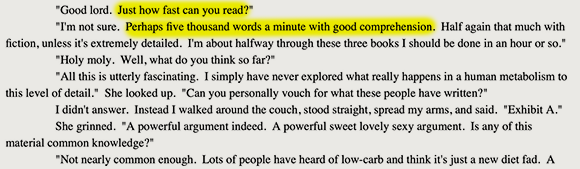
Yes, Gladys is a magnificent speed reader. So-called “scientists” may be skeptical of claims of reading more than 1,000 words per minute, but said scientists also believe that a diet consisting solely of meat and eggs is “unhealthy,” rather than inspiring the kind of sexual power that most men can only dream of.

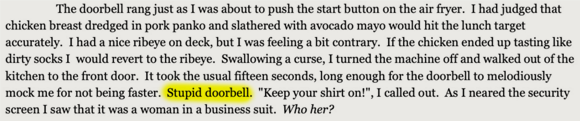
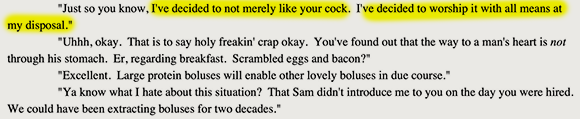
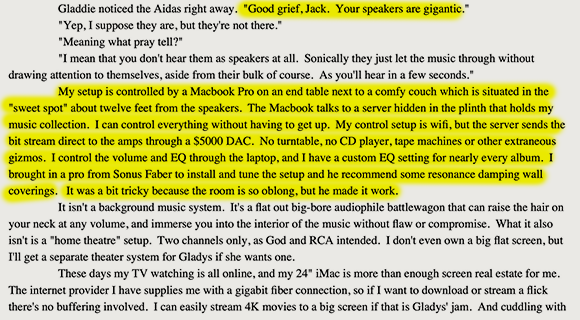
Jack has interests beyond boluses, however. He quickly introduces his wife-to-be to his suitably impressive home stereo setup.

No buffering! Jack is a man of means. And broad taste, besides.

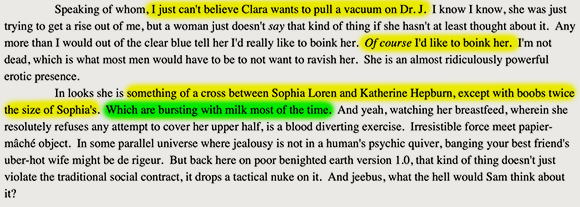
No divas, boy bands, or rap. Uncharitable readers might detect something of a commonality between two of those three genres, but recall that Jack is a conservative thinker. It’s modernity he despises, not any particular racial group. And while he’s certainly had detailed sexual thoughts about his best friend’s wife, he finds the notion that she might want to bed him quite surprising.

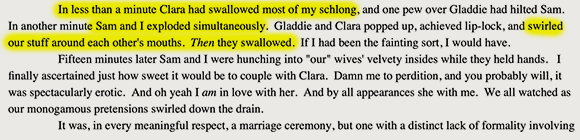
Yet at their wedding, Gladys proves to be somewhat less traditional than she initially made herself out to be.

Then again, Clara isn’t the only woman Gladys embraces in such a manner:

Is it “untraditional” for a man to analyze the cup size of his new wife’s mother? Is it “not conservative” for a woman to kiss her elderly mother on the lips? Mitchell ironically juxtaposes these scenarios with his characters’ disgust towards degenerate, craven wokeness. But they live in a world ruled by the socialist agenda, which at some point in the past made multiple marriage legal.

Jack demurs. He’s attracted to Clara, no doubt, but demonstrates the courage of his convictions in his reluctance to act on those feelings. The law does not determine what is just.

And yet.

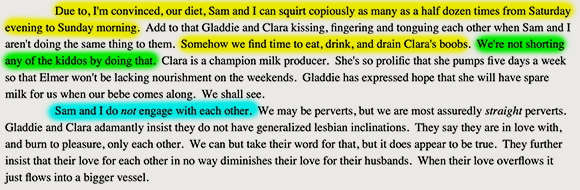
Less than an hour later, Jack is achieving simultaneous (heterosexual) climax with his best friend. How to explain this apparent reversal? Stranger things have happened in reality. Is it not unfair to expect fiction to follow staid, predictable character arcs? In day-to-day life, people make irrational decisions which run contrary to their stated beliefs all the time. And let it not be said that anyone in this erotic configuration is homosexual.

The two couples fall into a sort of double marriage. And while Jack may study the precise length and girth of Sam’s phallus, muse on the shape of his body, and plunge his own member into the depths of his wife only moments after his companion has reached climax inside of her, he is emphatically heterosexual.

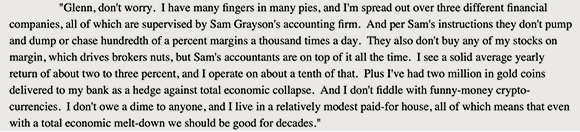
Jack meets Gladys’s parents and explains his carnivorous lifestyle to them.

He assures Gladys’s parents that she is in good hands. Jack has more money than he knows what to do with, looks forty thirty five, and knows a great deal about dietary science.

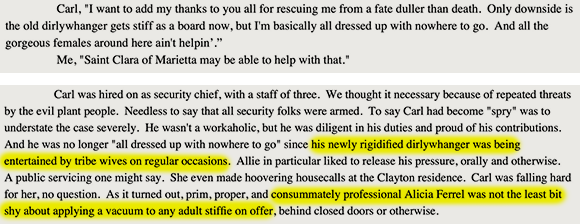
Convinced by his extolling of the benefits of the carnivore diet, Glenn and Martha gradually take it up and find that their health improves rapidly. The family is also able to move Glenn’s eighty-something-year-old father, Carl, into a private nursing home which is amenable to Jack’s special diet. Previously suffering from cognitive decline, he begins to make a miraculous recovery as a result of ditching carbohydrates.

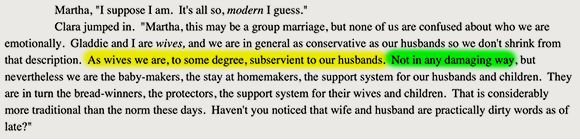
If Jack had an easy time communicating the benefits of the all-animal lifestyle, it is another thing altogether to explain his marital arrangements. Clara assists by explaining that what seems like leftist moral dissolution is, in fact, a deeply traditional and conservative arrangement.

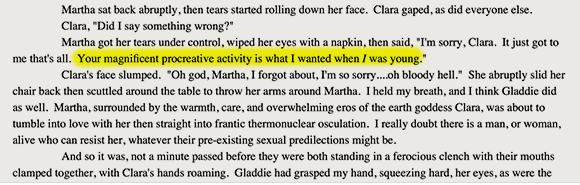
Martha is intrigued — recall that she herself is a kisser.

A fair objection from Gladys, who draws the line in their sexual experimentation at voyeuristic incest. But passion knows no boundaries regardless of what the leftist world government might try to impose on us, and Martha is overcome by Clara’s discourse on her deepest desires in this life — being penetrated constantly by whichever penis happens to be on hand and having babies until she is no longer physically capable of doing so.

Mitchell knows women. It isn’t “DEI” to admit this, but this is what we’re actually like! We have to pretend otherwise due to the pernicious efforts of feminism, but deep down, all women are secret bisexuals whose fondest wish is to break records for most offspring produced by a nymphomaniac carnivore.

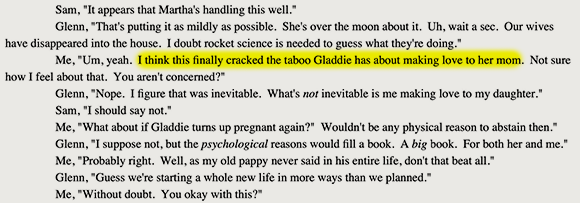
The introduction of Gladys’s parents into their orgiastic home life complicates matters somewhat, but not too much.

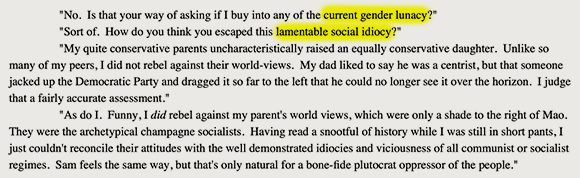
And recall that Jack is a conservative man who despises the “gender lunacy” and “social idiocy” of our deeply progressive moment.

But a hero does not balk at a challenge. Did the hero of Atlas Shrugged, Atlas, back down when confronted with the difficulty of hefting up the earth over his head? No. And neither does Jack, plunging — if you’ll pardon the pun — ahead into greatness. And in her own way, Gladys does as well.

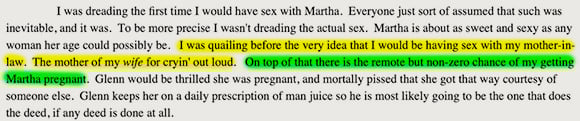
Characters overcoming trials is one of the cornerstones of fiction. Here, Gladys overcomes her resistance to having conjugal relations with her biological mother, while her biological father muses on the same with her. Should we recoil in disgust? Accuse Mitchell of unbelievable characterization? No. We should recognize that these characters are so so empowered by their rejection of the dictates of the criminal gangster FDA that they have become fully self-actualized, able to transcend the petty taboos progressivism imposes against fucking your parents.

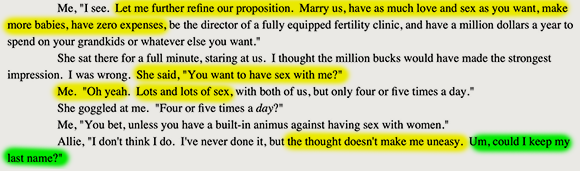
Peachtree Carnivore continues on past this climax to detail the addition of two final members to the Mason-Clayton sextuplet. First, Jack entices his family doctor to join them with a direct proposal.

The last member — and I use that term in both senses — is perhaps the most surprising of all.

Our eight partially blood-related lovers spend their years, we are told, producing a bounteous wealth of offspring, including some which are no doubt the product of congress between Gladys and her father, or between Gladys and her father’s father.

But readers of Peachtree Carnivore will recognize that I have conspicuously omitted something of great importance from my review up until this point. That something is, of course, the automobile — which is the subject, by my estimate, of roughly a quarter of the book.

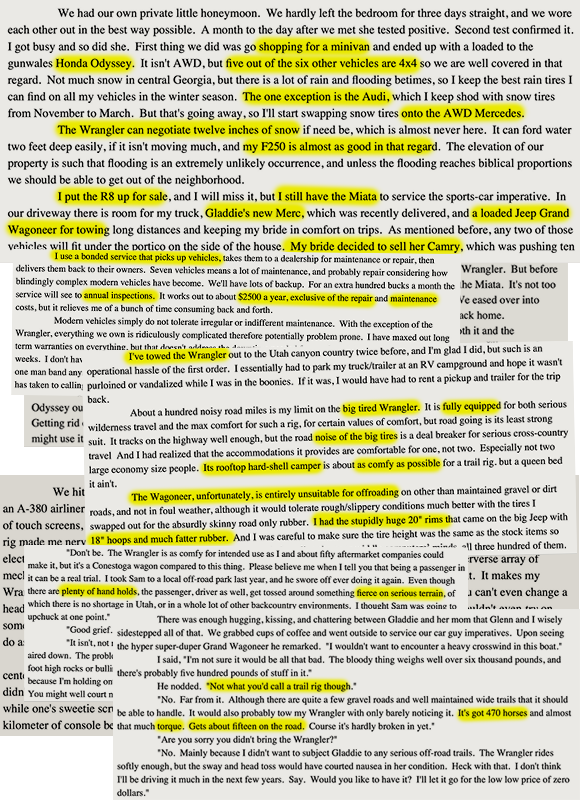
It is tempting to dismiss the great deal of Peachtree Carnivore given over to the discussion of cars and the customization thereof as a weakness of the work, a diversion from the core thrust of the text. In fact, the inclusion of this theme echoes that of carnivorous consumption and sexual licentiousness. For what is the car but a glorious extension of the body? And what is fuel but the meat of the car? Electric cars, it should go without saying, are equivalent to those Americans who consume plants — tools of the woke.

Lastly, I must attend to one objection that the reader may have mentally raised during this review. “Surely,” I hear you contend, “this is a work of parody, for it neither titillates nor makes a compelling argument for an all-meat diet.” First: you are a craven swine. Perhaps if you hadn’t deadened your mental faculties with carbohydrates, you would be able to appreciate Mitchell’s passionate plea to create a world of meat-fuelled incest monsters. Second, if this is a “bit”, to use the vernacular, then he’s been at it for at least seven years.

That’s right: Mark Mitchell has been an adherent of the carnivore diet for at least seven years. And if he’s seen the health benefits of such a lifestyle, then I can only assume that like his protagonist, he’s also become an impossibly wealthy, pussy-crushing ubermensch rather than a lonely old man writing 9 Chickweed Lane fanfiction on his Blogspot. I salute him and his dozens of beef-powered children.

This article was brought to you by our fine sponsor and Hot Dog Supreme: DeltaFoxTrot, who would thank you very much for not besmirching the good name of their Amos/Alistair fanfiction.

Categories
NERDING DAY

Nerding Day: Batman: Claritin Allergy Special Issue

As America enters its Century of Humiliation, its political leadership is hard at work trying to make the country as unattractive as possible to potential tourist dollars. Consider that this may have the incredible result of creating a wave of embittered, ex-theme park employees with stolen mascot costumes, easy access to firearms, and a grudge against the administration. If trends continue, the guy who plays Tigger may soon have the opportunity and motivation to do one of the funniest things of all time.

Visitors who nevertheless brave the visa fees and harassment by border goons to visit America’s scenic landscapes, famous cities, and plentiful strip malls may experience culture shock, whether it be from the size of restaurant portions, the lack of public transit infrastructure, or the random daylight kidnappings by masked men claiming to work for the government. But it was ever thus. One comment I’ve heard expressed incredulously about America, over and over again, is “yew ‘av advertisements fer medicines on the telly?”

Buddy, we have way more than that. We have goddamn A-lister superheroes shilling allergy meds.

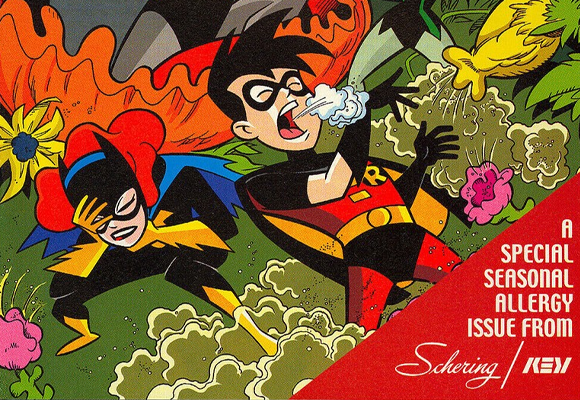
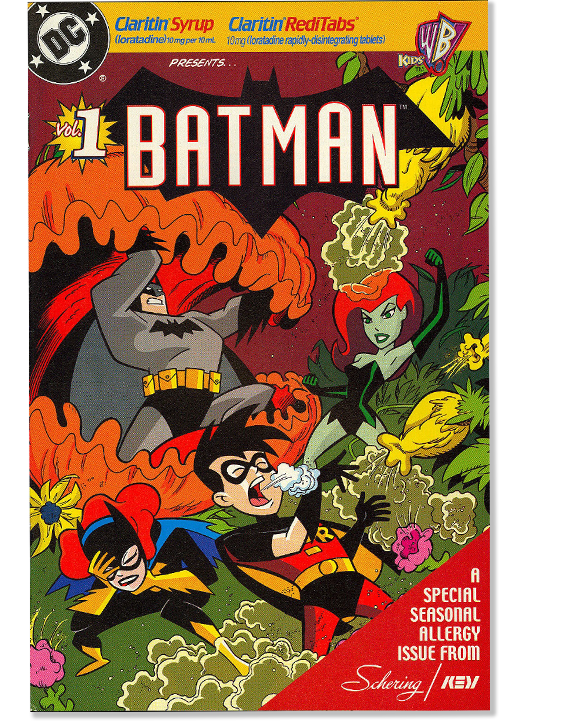
Published in 1999, Batman: Claritin Allergy Special Issue #1 was a sort of tie-in comic to The New Batman Adventures, which was a sequel show to the Primetime Emmy-winning Batman: The Animated Series. That places it in the awkward teenage phase when superheroes had moved past selling Hostess Fruit Pies but weren’t yet on the level where they could star in three minute long short films promoting Audi.

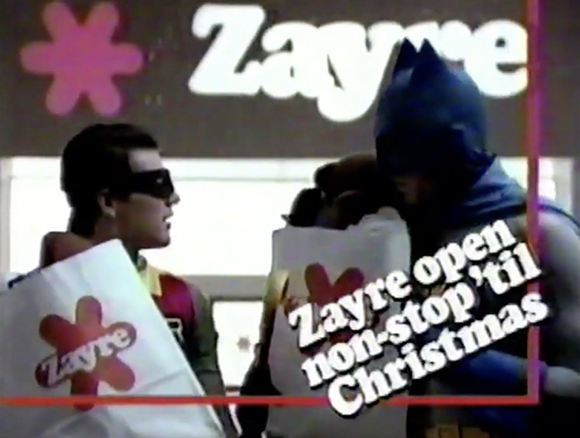
It seems like a more naïve time, looking back. I can imagine the executives selling the Bat Family/Claritin partnership to the creative team, arguing that the Rubicon had already been crossed long ago. Batman had already pushed McDonald’s, Diet Coke, and even, in 1987, a chain of discount stores.

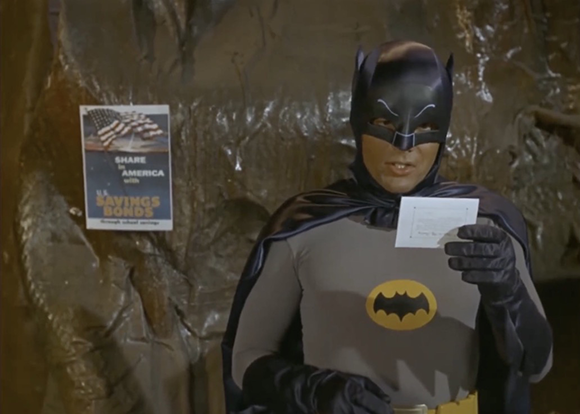
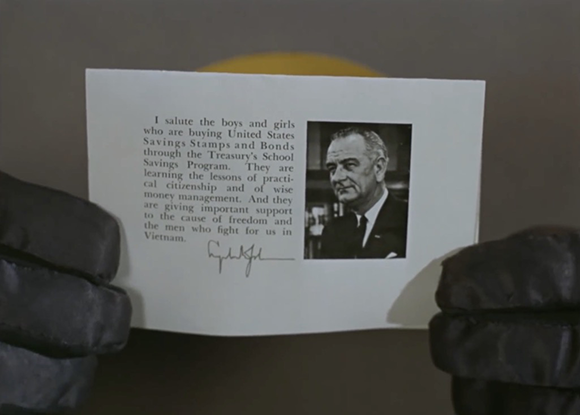
I can’t tell if that tagline is supposed to be a bit, like a French guy saying “they’re open non-stop ’til Christmas?” Regardless, they resurrected the ’60s Batman and Robin to convince shoppers to buy products at Zayre. Not Burt Ward and Adam West, mind you, and not the original costumes, either. But it’s wild to think that you could already do Batman as a nostalgia play in the 1980s. And for the record, Adam West did do at least one ad as Batman during the run of the ’60s show. It was for U.S. Savings Bonds.

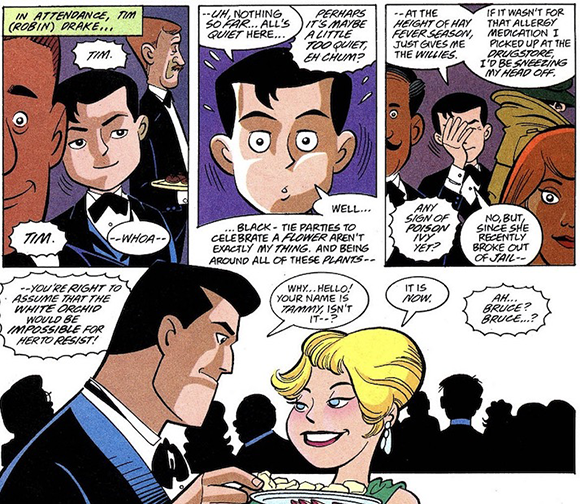
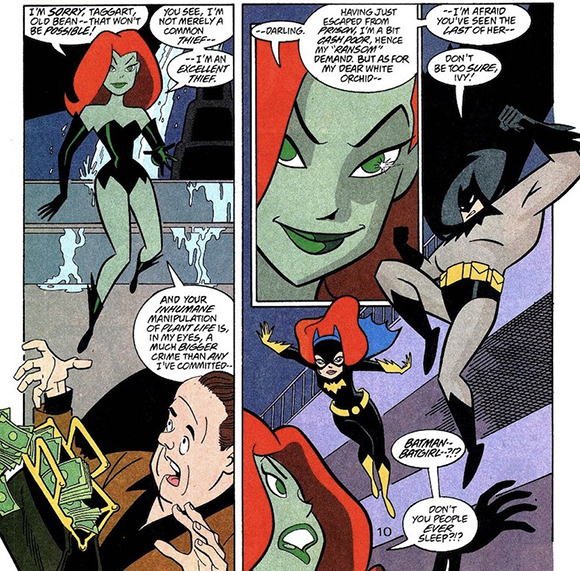
Anyway, the comic. This guy invented a “white orchid” and Bruce and Tim Drake are standing watch at a big gala celebrating his achievement, because obviously if you do anything with plants in Gotham City then Poison Ivy is going to come after your ass. You’d think all the botanists would have gotten the message and moved to Metropolis by now. Also, I’m pretty sure white orchids exist? Whatever, I’m putting too much thought into a set-up for a drug pitch.

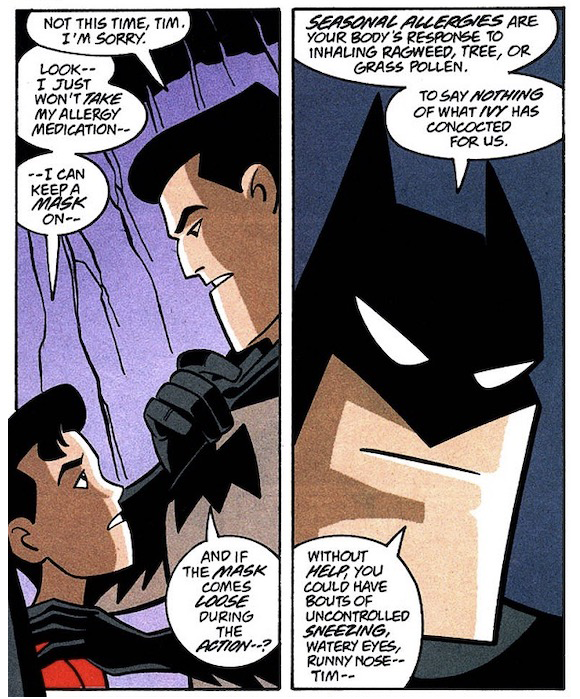
A couple of things. First of all, “chum?” It’s been a long time since I watched the ’90s Batman cartoon, but it’s really difficult for me to imagine Kevin Conroy talking like Adam West did while calmly explaining to Robin how the Siamese Human Knot was going to break every bone in their bodies. Second, “Tammy” is really pushing the envelope of how DTF you can be in a twelve page promotional comic about antihistamines.

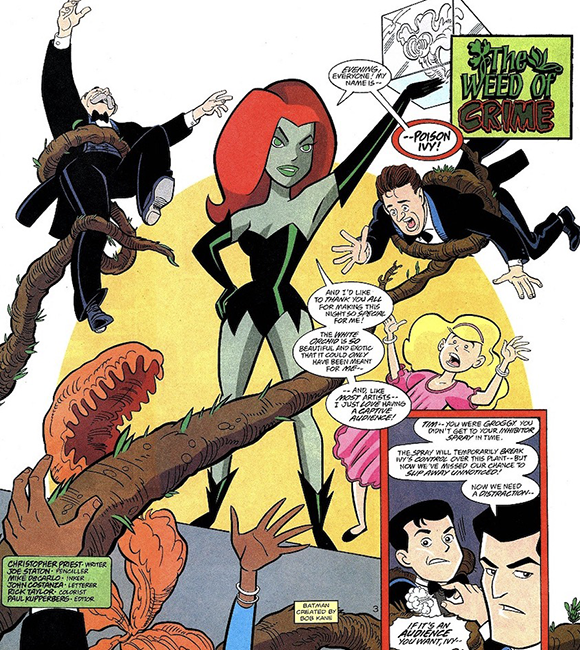
Poison Ivy attacks! Tim is caught by a vine because he was too “groggy.” Interesting. But hold up, let’s talk about the credits. Christopher Priest has written stories for Conan, Deadpool, and Black Panther. Joe Staton created the character Huntress and drew for Dick Tracy, Green Lantern Corps, and Guy Gardner. Mike DeCarlo inked Batman: A Death in the Family. Rick Taylor did colors on a number of DC, Marvel, and Dark Horse joints. And Paul Kupperberg has edited over 1,000 comics. Between them, the men that created Batman: Claritin Allergy Special Issue #1 have accumulated four Harvey Awards, two Inkpots, and an Eisner.

Kind of makes Batman’s stilted dialogue about Tim’s OTC antihistamine-induced drowsiness hit differently, doesn’t it?

Batman and Robin fight Ivy but she electrocutes Robin because their suits are statically charged and the protective case of the flower is too? I don’t know. She gets away, is the point.

Ivy ransoms the orchid and Batman goes to get it back. But this time, he tells Tim to stay home so he doesn’t fuck everything up again with his pussy-ass allergies.

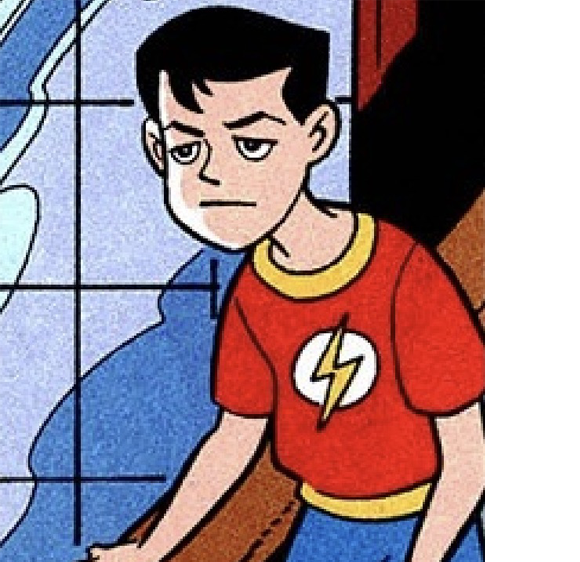
I know that this comic only exists to sell Claritin. But maybe Batman and Robin weren’t the best picks? Like you’re telling me Batman, the guy who has a flying tank, exploding boomerangs, and Bat shark repellent isn’t equipped to deal with ragweed? So if Mr. Prep Time develops hay fever one day, that’s it, the whole operation is fucking over? They could have picked anyone for this. Make it the Flash and if he sneezes he turns a half-dozen nearby pedestrians into red mist.

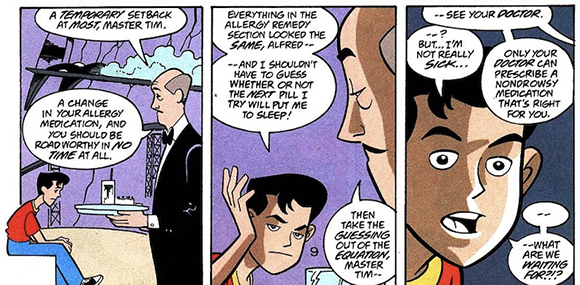
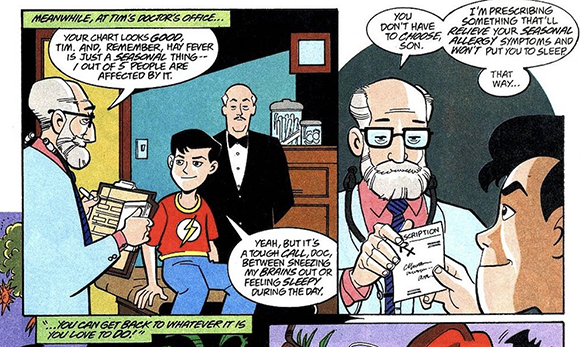
Thankfully for Tim, Alfred shows up to deliver some copy from the brief. Tim and Alfred go to a late-night on-demand doctor — being a billionaire’s ward has its perks — and the doctor prescribes him something.

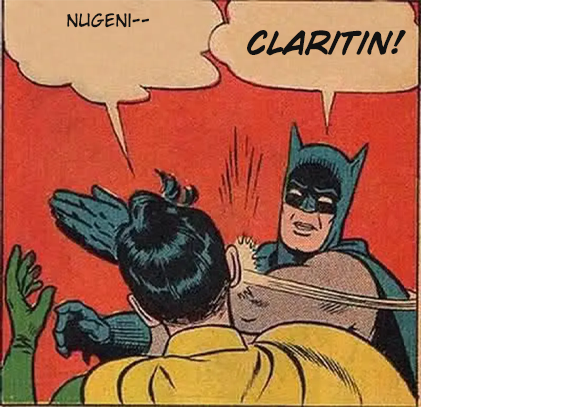
I don’t get why we’re being all coy about this when we get to the money shot. Let the guy tell Robin that only CLARITIN gives you fast-acting relief from allergy symptoms without drowsiness, so you can get back to being tortured and brainwashed by the Joker. Like, the cover already says Claritin. Did DC draw the line at having the name come out of a character’s mouth? Or was there some kind of law preventing them from actually saying it? Well, there actually might have been. We’ll get to that later.

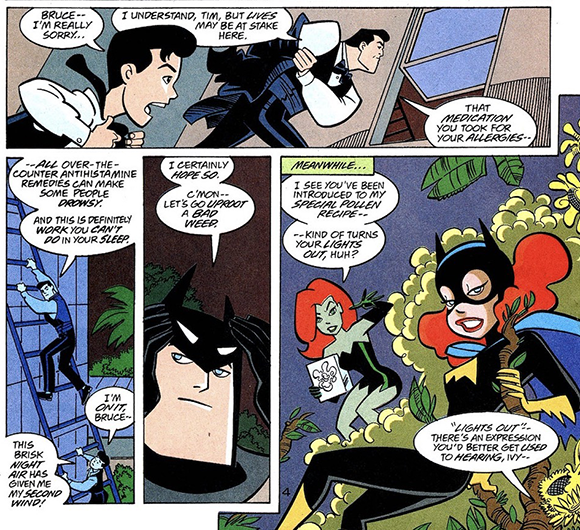
Meanwhile, Poison Ivy’s going to kill the guy who invented the flower she stole and take his money when Batman and Batgirl arrive. She attacks them by hurling potted plants and spraying them with pollen. It isn’t pollen that makes you horny or fall asleep or makes trees grow out of your skull or anything, though — it’s just like, really bad regular allergy-causing pollen. Nonetheless, Batman and Batgirl succumb to fits of sneezing. I wonder if it pained Christopher Priest to write Batman as such a dipshit. Grab a Bat pollen protection mask out of your utility belt, asshole! Use a Bat fan to blow it away! Hold your goddamn cape up over your face! All looks lost, until…

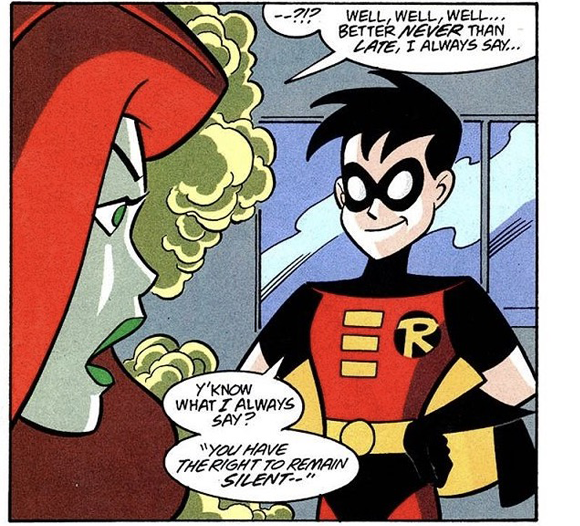
Robin shows up.

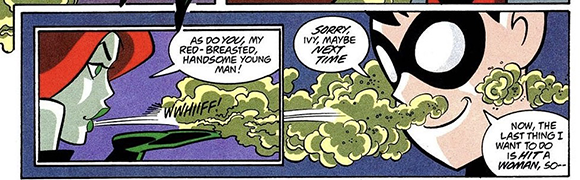
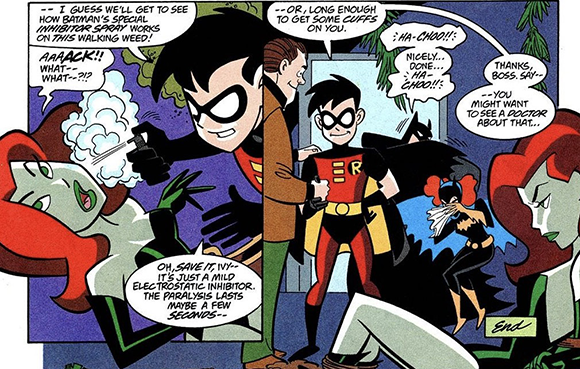
You might not be aware of this, but sneezing famously makes noise. So Ivy’s line here implies that this pollen is going to knock Robin out rather than merely aggravate his sinuses. But the power of Claritin has rendered him immune to seemingly all of Poison Ivy’s plantological warfare. Seems like cheating, but whatever. Turnabout is fair play, so Robin gasses Ivy right in her stupid, sexy face.

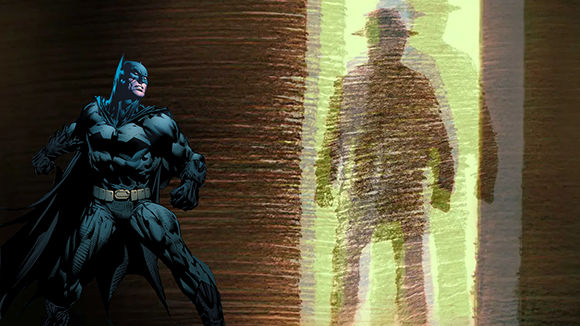
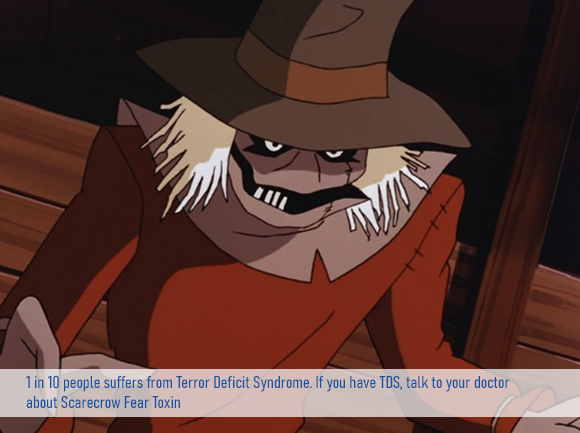
There was never a second Batman Claritin comic, which I think is a shame. They could have expanded this out into a whole allergy-based run. Have Tim scarf down a bunch of Benadryl to beat Poison Ivy again — only this time he’s taken too many and he starts having hallucinations. Batman vs Hat Man!

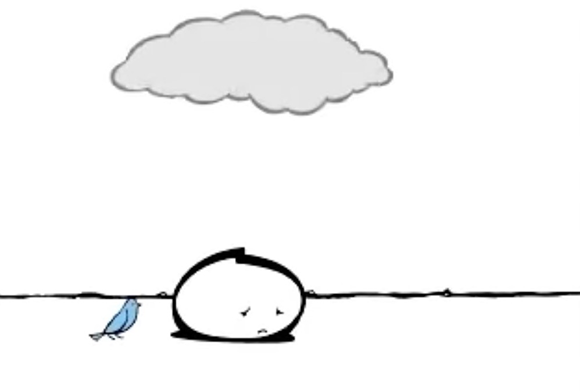
The existence of Batman: Claritin Allergy Special Issue #1 is strange in its own right. But it gets weirder. See, there weren’t always pharmaceutical ads featuring knowingly smiling men in their 60s or sexually indistinct sad blobs being followed around by rain clouds on American television.

In fact, it wasn’t until the late 1900s that a young hotshot ad executive proposed that the main customer for drug companies wasn’t doctors, but consumers. I bet you’re picturing a Don Draper type, but her name was Liz Moench, proving that women, too, can innovate in ways which make the world worse.

The first televised direct-to-consumer pharmaceutical ad aired in 1983, for a pain med called Rufen. Almost immediately, the government told the company to take it off the air — which seems weird, considering that they weren’t promoting seed oils or saying that women were people. But remember, this is when we had an FDA that wasn’t run by a worm-addled bridge troll. They told drug companies they had to spell out side effects in TV ads, which made them much less attractive as marketing tools.

But then in the mid-90s, a company called Schering-Plough got an idea. They started advertising a new medication on television without actually saying what it did. All they really said was “ask your doctor.” The name of that drug?

Yes, Claritin, the very same drug that helps the Boy Wonder fight crime. And in 1997, the FDA, frustrated by these kinds of slippery tactics and possibly “encouraged” by well-meaning multinational drug conglomerates, decided to slough off the chains of censorship. From then on, drug companies could omit all the extra information they used to have to put in their ads as long as they had a website or a phone number consumers could call to get it. They were also allowed to start making specific claims about what their drugs did.

Drug companies won. Between 1995 and 2006, their spending on DTC advertising increased more than tenfold to $5 billion. The Batman Claritin comic was an early part of the drug advertising boom in the US, which remains one of only two countries in the entire world that allows the practice. The other is New Zealand, but they haven’t produced a decent supervillain since Sauron.

On that note, Liz Moench went on to have quite a career in the pharmaceutical advertising industry. Among her accomplishments, she was partly responsible for making Voltaren (diclofenac) the most-prescribed NSAID medication in the late 1980s. Diclofenac is prescribed for both people and animals, and was widely used throughout the ’90s on livestock in India. In the early 2000s, after scientists realized that a huge vulture die-off was occurring in that country, they narrowed down the cause to diclofenac prescribed to cattle. The vultures that ate the dead cows experienced liver failure, and over 99% of all vultures in the country died as a result.

Vultures eat dead animals, and without them around, there were a lot of rotting carcasses spreading disease. The absence of vultures also allowed the feral dog population to boom, causing tens of thousands more human deaths from rabies.

Would it be uncharitable — absurd, even — to say that Moench was responsible on some level for the Indian vulture crisis? Perhaps. But I think you lose the benefit of the doubt when you go to work for the industry that created the opioid crisis. On the flip side, she is indirectly responsible for a kind of funny comic where Batman gets mad at Robin for having allergies. In conclusion, the Batman Claritin comic can’t exist in the same universe as 40,000,000 alive Indian vultures.

This article was brought to you by our fine sponsor and Hot Dog Supreme: Doug Redmond, who makes a killer cocktail with like seventeen claritin and two bottles of vodka. Ok it’s less a cocktail and more a cry for help, but Doug nails it.

Categories
NERDING DAY

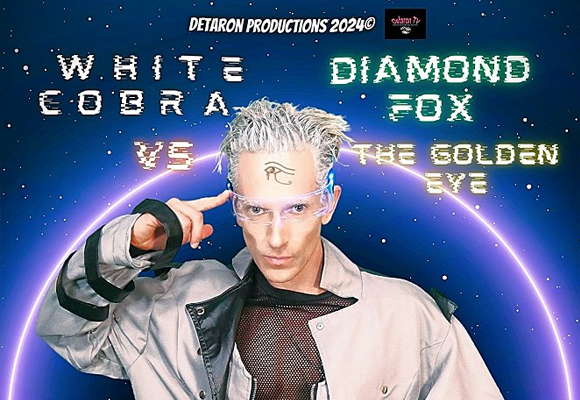
Nerding Day: White Cobra Diamond Fox vs The Golden Eye 🌭

I think it was Simone de Beauvoir who said that we will know feminism has achieved its aim precisely when women are allowed to be as deranged, incompetent, and generally mediocre as men without it reflecting on their sex as a whole. And from that perspective, perhaps those women who doggedly pursue lives of self-obsessed madness are to be celebrated for their role in inching us ever closer to that world.

To say that Deuandra T. Brown is merely one of those women would be to do her a disservice. She is a multi-hyphenate artistic lunatic — a filmmaker, writer, model, singer, actor, and dancer. Regarding her cinematic output, the easy reach is to call her the female Neil Breen. But need we compare a woman genius to a man? Can we not simply appreciate it on its own merits?

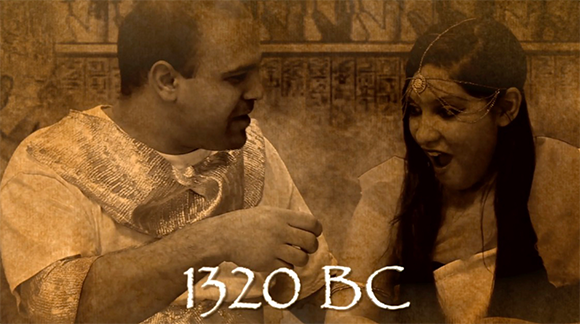
Today I want to talk about White Cobra Diamond Fox vs The Golden Eye, Deaundra’s most recent film. It is a sequel to the film Diamond Cobra vs The White Fox, which told the tale of an ancient Egyptian woman whose sister stole her true love.

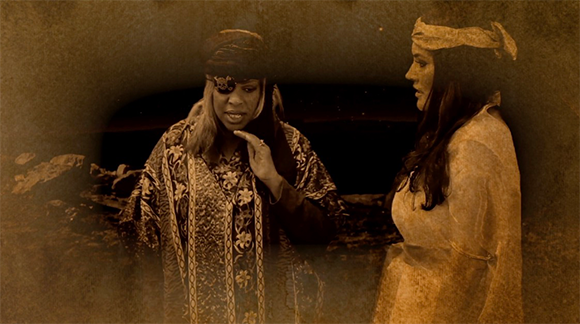
Furious, the spurned woman sought out the aid of a witch/pirate, who granted her a necklace that transformed her into a big snake.

Centuries later, the Diamond Cobra and White Fox necklaces were found by two long-lost twins, Diamond and Targella. One of them was possessed by the ancient Egyptian snake lady, so we’re kind of doing a Yu-Gi-Oh! only instead of playing children’s card games, the Egyptian ghost starts killing people by spitting snakes at them.

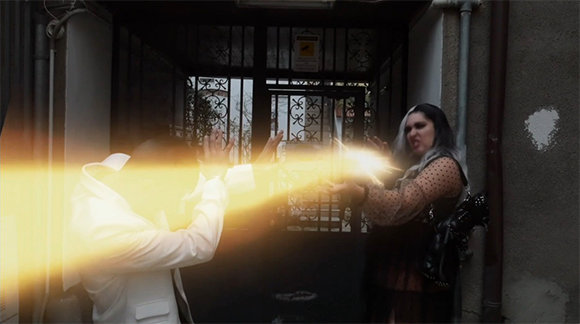
The sisters meet, have a Birdman or Dragon Ball Z beam battle depending on your generational point of reference, and laser blast a cop investigating them into space.

Then they merge into one person, like Dragon Ball Z or Steven Universe depending on your generational point of reference, and a goblin man on a huge iPad says that the curse has been broken.

I have not seen Diamond Cobra vs The White Fox. I only know all of this because the first ten minutes of White Cobra Diamond Fox vs The Golden Eye is footage from the first movie. Now we’re all caught up, and all questions about snake women, laser battles, and iPad goblins have been resolved. Onto the sequel!

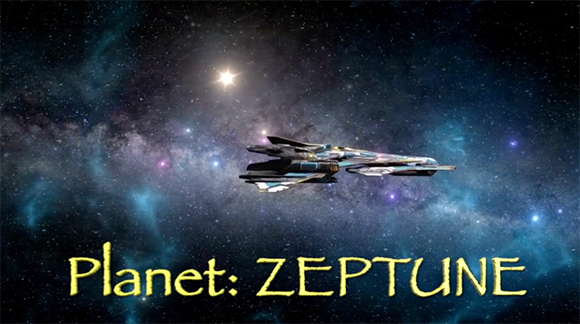
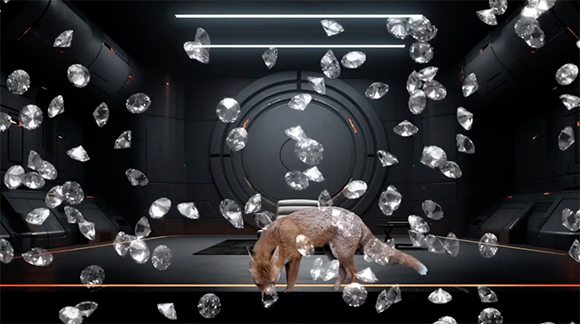
Deuandra T. Brown loves smash cuts, and every one of them hits like an After Effects energy beam to the face. We have so much to get through, but let’s just take this in for a minute. Papyrus. Inexplicable colon. ZEPTUNE. What is clearly a fucking spaceship and not a planet. Beautiful. Wonderful.

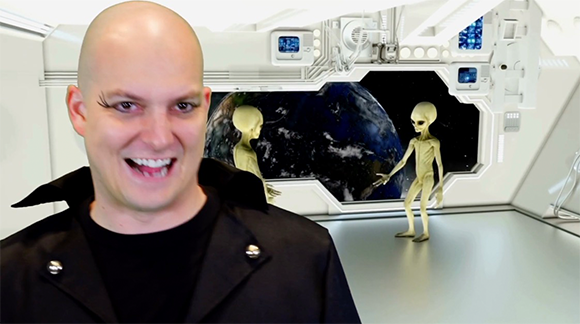
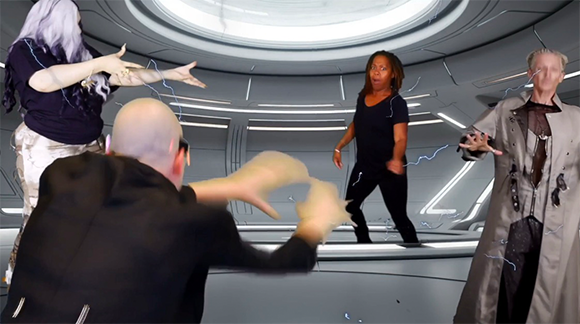
That’s Targella Diamond, the fusion of Targella and Diamond. I don’t know why she looks like she just got out of bed to try and catch a bat that flew into her house. I don’t know why it’s ten years and six months later. I don’t know why we cut to a bald man wearing accent lashes hanging out with some aliens who start nuking earth. Maybe that recap should have been twenty minutes long.

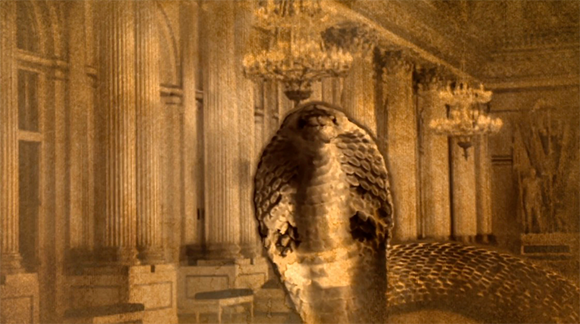
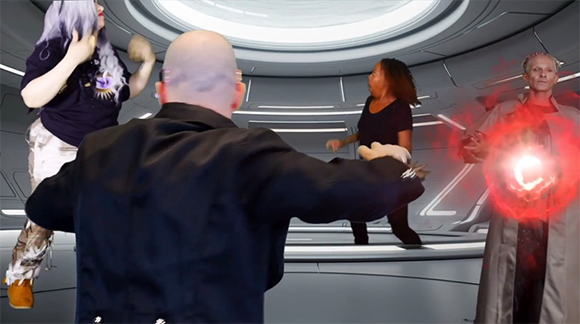
Targella Diamond wanders around this spaceship, and then this happens.

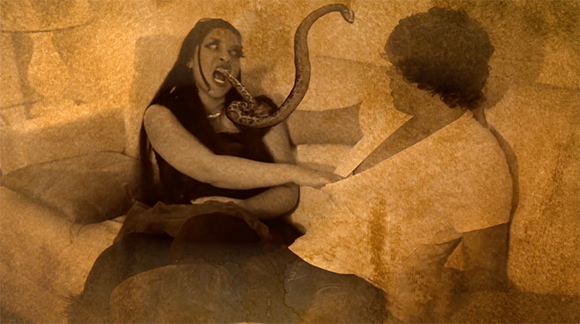
I called her the female Neil Breen earlier, but I think Deuandra T. Brown might actually be closer to Jodorowsky. We’re on some The Holy Mountain shit right now.

A big snake who is also the Golden Eye Queen tells Targella Diamond to find all of the pieces of the Golden Eye jewelry in order to break the curse, which was broken when Targella and Diamond merged in the last movie. Maybe this is a second, different curse?

Earth looks different than I remember.

Meet Travis. He’s played by a guy named Maxxx Payan, who is inexplicably not a porn actor despite having the name, facial hair, and build of a guy whose top credit should absolutely be Stepsister Suckfest 6. He’s at a rave in Arizona, where he meets the eyepatch woman from the first movie. She has now transformed into a young woman whose role in the plot appears to be doling out pieces of Golden Eye jewelry at random to various people, inevitably bringing them great misfortune.

Travis asks her “who may I say I’m speaking to today” like he’s calling her about her long-distance service rather than trying to crush ancient Egyptian pirate pussy. But she’s into it. Where will the night take them? Well, we— SMASH CUT to Jade, 30s, rideshare driver, on the phone with her brother.

Their mom went missing and Harlem is working with the Russian mafia to get answers. SMASH CUT to New York City.

Film is the art of the cut. Inserts, reverse shots, close-ups — these are the basic building blocks of filmmaking. Some artists cut far too little. James Nguyen, the creator of Birdemic, is notorious for his long establishing shots of cars arriving and parking at their destinations. If Nguyen is one end of the spectrum of cinematic excess, Deaundra T. Brown is at the other. Cuts across time and space just happen every few seconds and if you’re lucky you get a Papyrus title card telling you where and when you are. The effect is one of disorientation, confusion, and anxiety. You could achieve the same experience White Cobra Diamond Fox vs The Golden Eye‘s editing produces by smoking PCP then running into your therapist at the grocery store.

A rare two-shot. Most of the movie is filmed with single actors centered in front of a green screen. Here we get an actual location, which I initially thought was a hotel room until I noticed the coin-operated bleach and fabric softener dispensers on the left. What is this impossible space? Are we in the backrooms? At least there are some context clues here — we know the guy on the right is a detective, on account of his badge and magnifying glass sitting next to his laptop.

“I can’t find your missing brother and dad,” he tells this woman, Riley. “The case happened in Arizona. It’s outside of my zone, he replies” My man, you’re a cop. Cops have jurisdictions. Sonic the Hedgehog has “zones.”

Riley asks him again and he completely changes his mind. We’re up to eight characters now, but let’s meet some more. Southland Tales had seventeen major players. I think Deuandra can beat that. It’s time for a White Cobra Diamond Fox vs The Golden Eye character lightning round!

Here’s Jennifer and Raspberry. The former is a news anchor, which we learn when she says “I gotta go report the news.” Her last name? It’s normal.

Later, Jennifer Townhall shows up on TV to deliver exposition wearing her dead friend Raspberry’s fur coat.

Dead? Yes. Raspberry is murdered by Harlem, who is Jade’s brother. Remember her?

Harlem killed Raspberry on the orders of Alexei, the Russian mobster he’s working for in order to get answers about his mother’s disappearance. For this deed, Harlem learns that his mom was caught up with the “Donnie Barbeque gang.”

My favorite thing about Alexei is that he has a sticker on his phone that says “MILF Hunter.” It’s little details like that which transform otherwise stock roles like “Russian mob boss” into living, breathing characters. Like, maybe he wanted his wife dead because she wasn’t MILFy enough.

While all of this is happening on earth, Jade and Harlem’s mother and Riley’s father are being held captive on the Planet: ZEPTUNE by an alien named Azulon. He looks like this.

He wants the Golden Eye ring, or maybe the bracelet or earrings or necklace, because Deaundra T. Brown read one screenwriting tip about MacGuffins and decided that if one MacGuffin is good, then four should be given congratulatory oral sex. It’s unclear why Azulon thinks that holding these people hostage will help him get the jewelry. It’s like he forget a step between “torture earthlings with diamond magic” and “get ancient artifact.”

It’s also unclear why he wants it. I’m not sure even he knows. I think he just looked around and saw everyone else chasing after some gaudy ancient Egyptian accessories and decided that’s just what people do. And I can only assume that this scene, in which the editor has conspicuously left the green screen backdrop in the movie, is a clever reference to the hollowness of Azulon’s life, defined solely by what society tells him he should value.

That’s twelve characters so far. We are barely halfway through the cast.

So: Targella Diamond goes to Travis’s concert and fucks him afterwards.

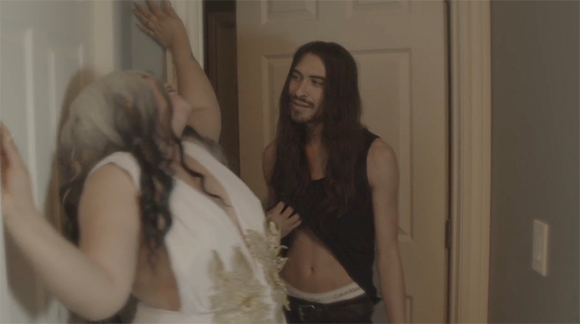
I was shocked to realize that this is the only instance in the film in which the director/writer/star sleeps with one of the many characters who look like ketamine dealers. She does get to perv on another guy in the shower at one point, though.

That’s Ahsan, a member of the Moroccan mafia who kills Alexei to get the Golden Eye ring from him. Targella Diamond does not fuck him, but rather turns into a big snake and bites him to death. I kind of appreciate that — it takes restraint to say yes, my twin-souled ancient Egyptian space heroine bangs the emaciated guitarist/weed dealer who sings “Smooth” by Santana Featuring Rob Thomas of Matchbox 20 to himself alone in his sad kitchen, but not the jacked North African dreamboat. Or maybe there just wasn’t enough time for two sex scenes — we’ve got more characters to introduce!

Dice, everybody! He’s a techwear doofus who works for Alexei. Here’s his sister!

She gets the Golden Eye Necklace from a beautiful stranger in Egypt, which looks like the shattered ruins from the end of a Dark Souls game where the world is collapsing in on itself.

Alas, she’s killed by Honey Q, who is, of course, the niece of Donnie Barbeque.

Well, not by Honey Q, but on her orders. She’s actually executed by Honey Q’s goon, Dream.

Honey wants the Golden Eye earrings, because they are “with magic” and are worth “over a billion dollars.” On the basis of a dream she had about them, she sends out two other goons to raid Travis’s house to recover them. Travis is dead or in space now because Azulon blasted him with his eye lasers after he tried to explain that he had a one night stand with Targella. In response, Azulon literally says “what is this ‘one night stand’ you speak of?” It feels like he’s making fun of the movie and it’s so unbelievably stupid that for a moment I thought maybe Deaundra T. Brown was a long-term performance art project by the world’s greatest fabulist.

Azulon’s got a friend slash subordinate! Her name is Topaz.

She tries to bash Targella’s head apart in Ireland, but is defeated by an ancient Egyptian laser blast.

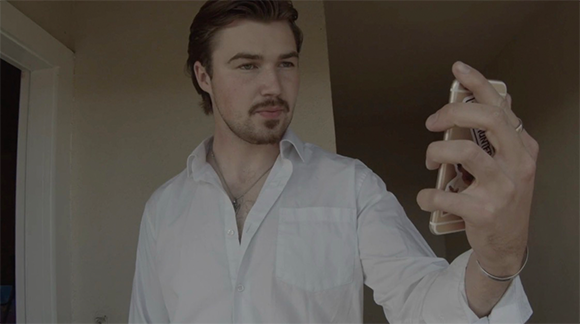
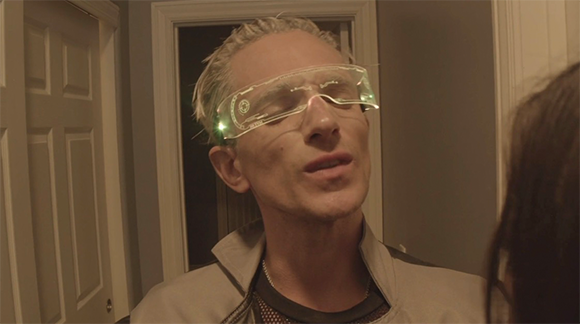
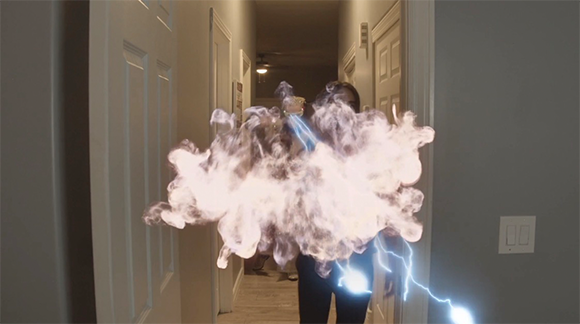
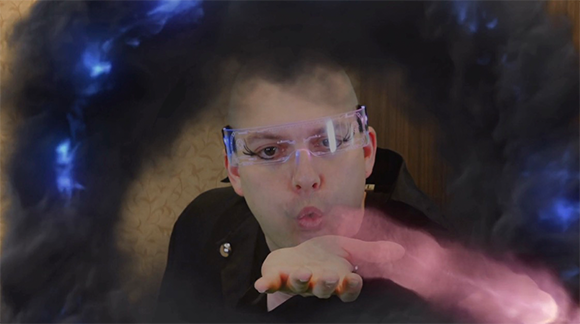
There’s also a third, unrelated space monster in White Cobra Diamond Fox vs The Golden Eye, Ezul. We saw him earlier. It goes without saying, but he wants the Golden Eye jewelry. He’s bald, has fabulous lashes, and tries to kill Targella by teleporting in front of her moving vehicle, responding to her rude comments by saying “I love you too,” then blowing a kiss that’s a fireball at her. Sir, you are clearly a Kano and not a Sonya Blade.

He does this on two other occasions, in contexts that make no sense. He just shows up on someone’s laptop or in their mirror, they’re confused or frightened, and in response to nothing he says “I love you too” and explodes them. Maybe it’s an alien power word and it’s just one of those weird linguistic coincidences, like how there’s a filler term in Mandarin that sounds a lot like an English racial slur. Like a nice version of that.

Christ. We’re at nearly two thousand words and I still have a half-dozen characters to get through. Here’s a quick one.

This guy appears in a single shot and is never seen again. He symbolizes all of the strangers in our lives, the faces we see but once before they vanish again forever into the mass of humanity, forming part of the backdrop of our lives yet, impossibly, each with their own inner worlds and realities. It’s that, or this is a stock footage shot Deaundra liked enough to put in the middle of one of her expositional rap montages, which feature some pretty impressive guest verses!

Fuck. I can’t get distracted. There’s still so many more guys to talk about. There’s a whole subplot where this guy Mario is working for Honey Q but used to work for Alexei and Alexei wants him back? But then he falls in love with a cop named Maria and she makes him wear a wire to spy on Honey Q. Also he wears a Jay Kay-style giant furry hat.

Honey Q kills him when she realizes his betrayal.

Maria tearfully vows revenge.

Targella goes to Milan for basically no reason. Forgot Jodorowsky, Adam Sandler is more apt. Think about it — she’s using her self-indulgent movie as an excuse to travel around and put a bunch of her friends onscreen. I think she might just be an independently wealthy madwoman who is living her best life. Unlike Detective Morales, a CIA agent whom Targella evaporates with a laser blast.

Again, the cuts in White Cobra Diamond Fox vs The Golden Eye are incredible. But this, I think is my favorite one.

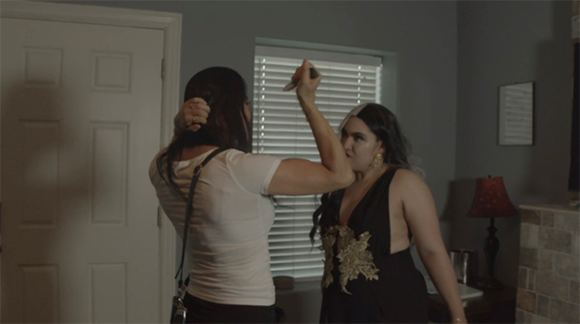
This is the shot introducing us to Travis’s sister. She looks like someone doing transgressive Dr. Horrible cosplay, which is maybe the meanest thing I’ve ever said. Obviously she wants the Golden Eye jewelry, which she describes as “very, very rare” like it’s a drop in an MMO instead of a one-of-a-kind amulet of the cosmic gods. Anyway, Targella kills her by making her stab herself to death when she comes looking for Travis.

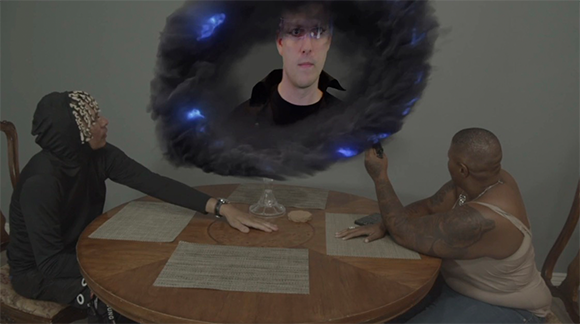
She’s not the only one who can do that, either. Ezul kills Honey Q by manifesting in a cloud portal above her dining room table and forcing her to shoot herself in the head before doing the kiss of death thing to Dice.

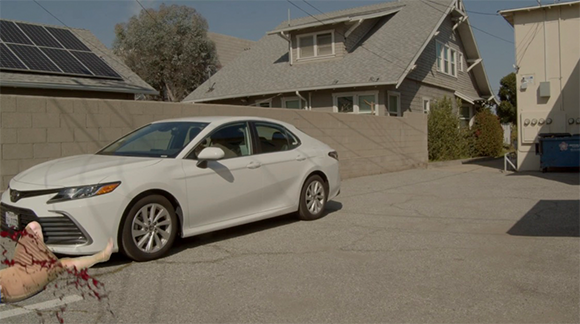
Deaundra isn’t precious about her mind-children. Anyone can die in this movie, and nearly everyone does. Whether they’re run down by a Toyota Corolla, stabbed to death by their own hand, or immolated by a heat ray, the cast is winnowed down significantly as we near the end. This might actually be a slasher movie where the slasher is a Mary Sue reincarnation of a space queen.

Travis, Travis’s sister, Honey Q, Dice, Dice’s sister, Alexei, Ahsan, Mario, Topaz, Morales, Raspberry, and the detective are all dead. Most of the survivors meet up in Phoenix, then teleport to Zeptune. They fight.

Targella wins, of course, and gets all four pieces of the Golden Eye. She’s taken to space, where Lady Iris gives her the fifth piece — the glasses.

She transforms into Queen Golden Eye, which is also the name of the worst performer at a millennial gaming nostalgia-themed drag night.

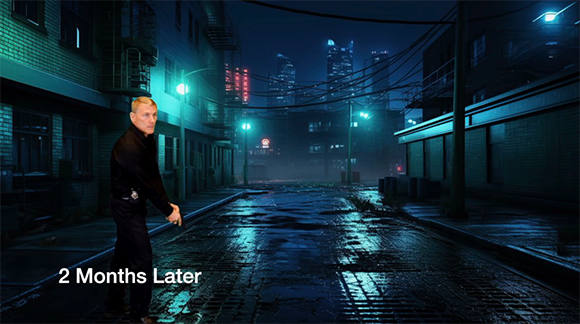
Queen Golden Eye explodes Azulon and Ezul. Two months later, the white cop guy is prowling the stock art streets when Queen Golden Eye appears and explodes him, too.

The end. I’m not kidding. That’s the last shot of the movie. My sincere hope is that everyone had fun working on this, but in an interview for the prequel, one actor says that she didn’t even know what the plot was because there had been over seven hundred script drafts. With anyone else, I’d say she was exaggerating. But I believe in Deaundra T. Brown.

This article was brought to you by our fine sponsor and Hot Dog Supreme: Greg Cunningham, who didn’t even need to read the article because HE LIVED IT! WHAAAAAT?

Categories
LEARNING DAY

Learning Day: Alligator Pie🌭

Fish don’t realize they’re in water until they’re plucked out of it. Canadians don’t realize how specific their culture is until they move to another country. It took dedicated effort to purge “toque” and “pop” from my vocabulary when I first arrived in the US. Trickier was not making reference to children’s entertainment whose cultural recognition stopped dead at the 49th parallel.

Canadian content, for whatever reason, often sounds made-up to Americans. We had a show about a rural woodsman type who fixed everything with duct tape and it was one of the most popular comedies in the country for many years. Train 48 was a terrible, ad-libbed dramedy taking place entirely on the southern Ontario commuter transit system. And of course, there was a kids’ series where an alcoholic photographer tyrannized a living mannequin man and his puppet friends in a famous Toronto department store.

But sometimes, as I look back at the cultural artifacts spawned by government investment in the arts and entertainment, even I’m surprised by how intensely, pointedly Canadian some of them are. To wit: Alligator Pie.

A frequent library borrow for child Merritt, Alligator Pie is a 45-minute VHS tape about a boy named Nicholas Knock going to the park. It’s based on the work of Dennis Lee, an author who wrote a lot of poetry for kids. You can think of him as sort of a Canadian Shel Silverstein, only without all the gonzo journalism for Playboy.

You can also think of him as the guy who wrote the lyrics to the Fraggle Rock theme song, because he did! He also wrote a bunch of other songs for the show, and one of the albums of music from that Henson production jointly won a Grammy Award in 1985. The other winner? Shel Silverstein’s Where the Sidewalk Ends!

Of course, I didn’t know any of this as a kid. All I knew was that Alligator Pie was packed full of two things, besides Canadian-themed rhymes and songs: puppet violence and claymation horrors. When I say “puppet violence,” I don’t mean like, felt stabbings or anything. But, as we’ll see, someone in this production either hated puppets or just got a kick out of launching them into trash cans, swimming pools, and puddles of mud. And when I say “claymation horrors,” well, I don’t think I need to explain that. Aardman gentrified the genre when they made plasticine obey the laws of physics. They wouldn’t have the guts to do whatever the hell this is.

So: Nicholas is going to the park. He’s relating this story to his classroom during show and tell, to which he’s brought his best friend, who is an egg. The egg’s name is Egg and he perpetually wears a frozen mask of dawning horror on his little egg face.

Egg isn’t Nick’s only pal, though. The day of his trip to the park, he’s woken up by three other puppets: Bigfoot, McGonigle, and Hannah V. Varoom.

How does Nicholas respond? Does he:

A. Marvel at the size of his enormous bedroom in his early ’90s middle class Toronto home which would easily cost millions of dollars today

B. Run screaming from the epicenter of the puppet uprising

C. Hurl his best friend at them like a living missile

It’s C, of course! Egg is curiously quiet during these scenes. It’s unclear if Nicholas’s imagination can’t support the animation of the animal trio as well as Egg simultaneously, or if Egg has simply accepted his position and knows that nothing he might say could change it. The animals do a little song, during which Nicholas describes them as “marching like the mounties,” but it’s interrupted by an ominous glow and menacing voice emanating from the vent.

That’s Mr. Hoobody, a kind of trickster spirit who lives in Nicholas’s furnace. He is a fairy in the manner of the old tales — less Tinkerbell and more menacing presence. Also, he’s played by a guy who looks like a Canadian Randy Quaid.

Mr. Hoobody terrified me as a child. Now, I find him to possess an intriguing sexual charisma. Not going to interrogate that.

Stop motion break! First, a poem about something called “Psychapoo,” which emerges from Nick’s toothpaste tube and starts doing antics all over his medicine cabinet while shouting out Newfoundland. It’s only mildly upsetting, so I’m going to give it 2 out of 5 on the Adventures of Mark Twain Claymation Nightmare Scale.

But what comes next is much, much worse. Nicholas and his friend Monica sit down for a pancake breakfast, and gloved arms emerge from the table to perform a song called “Periwinkle Pizza,” which name drops a number of Canadian cities. It’s not stop motion, but it’s not exactly puppets, either. It looks like this.

I feel how Egg looks.

The song ends with a plate devouring the last pancake. For some reason this really creeps me out. And it’s far from the last food bit we’re going to see today.

At this point in the frame story, the teacher is starting to get frustrated with Nicholas’s constant diversions. Get to the goddamn park, kid! There are upwards of six other students waiting for their turn in our enormous and implausibly well-staffed school.

So Nicholas, his grandfather, Monica, and Egg all head to the park. But something is amiss. Mr. Hoobody lurks in the shadows, watching them. It’s a good thing he’s a supernatural creature/figment of Nicholas’s imagination, otherwise this might be almost unwholesome.

The animals, in turn, see Mr. Hoobody stalking Nicholas. They grab his tricycle and set out after him.

But they’ve forgotten that Mr. Hoobody is a creature of chaos. Uttering a rhyming incantation, he opens up a fire hydrant which blasts the animals into a pool and a trash can.

It’s hard to get across in screenshots of a low-resolution VHS upload, but there’s something very funny to me about the camera lingering on a monkey puppet floating limply in a kiddie pool, and I’m pretty sure whoever’s job it was to shoot this scene thought so too.

The kids stop at a bakery so Nick’s grandpa can get some cookies. He tells them to wait outside, because it’s the ’90s and internet panics haven’t yet convinced the public that letting two kids stand outside a store for five minutes will result in their immediate kidnapping and dismemberment. Or maybe grandpa just doesn’t really like them that much. Either way, the kids are entertained by a little show introduced by a cookie conductor and her cast of singers.

I’m counting this introduction as a separate entity from the main event, because it features a completely different cast and animation style. I give it a 3 out of 5 on the Adventures of Mark Twain Claymation Nightmare Scale, mainly because an alligator eats one of the living, singing cookies at one point.

The overture complete, the curtains part on “The Sitter and the Butter and the Better Batter Fritter.” It’s a tongue twister about the narrator’s little sister’s sitter who buys a pat of bitter butter from a baker to bake a fritter. Each character and object morphs from one scene to the next, an ever-changing tide of flesh that’s practically Cronenbergian.

“You’re being overdramatic,” you’re thinking. Am I? Here’s how things progress. The sitter creates a malicious, living entity out of butter. She abandons her creation when it proves too bitter to consume.

The sitter then returns to the baker for a sweeter batter. She eats the resulting fritter, but then her neglected creation eats her in turn.

Finally, the sitter’s charge arrives. Finding no sign of her sitter, she instead notices the bitter butter fritter and decides to consume it, sweetened with a spoonful of jam.

The piece ends with a recitation of who devoured who: the sweet fritter inside the sitter, who is inside the bitter butter fritter, who is in turn inside the little sister. I give this sequence a full 5 out of 5 on the Adventures of Mark Twain Claymation Nightmare Scale for its disturbingly exuberant depiction of nesting doll vore.

I’m going to skip past the “mass paralysis cured by food fight” scene in an iconic Toronto diner because there are no puppets in it. But shortly after, the movie remembers its frame story and cuts to a shot of the most exasperated kindergarten teacher you’ve ever seen.

Just wait, lady. It’s 1991, and the Reaganite “Common Sense Revolution” of slashing all social services hasn’t hit Ontario yet. In a few years, you’ll yearn for the days when your biggest problem was meandering kids’ stories about boiler demons and sad eggs.

Speaking of: Mr. Hoobody casts a spell invoking “Mississauga rattlesnakes” to animate a garden hose and abduct Egg.

What does he do with him afterwards? Does he:

A. Destroy him with a dark magick which calls upon the ancient powers of Bobcaygeon

B. Break him down psychologically to convince him that Nicholas never really loved him

C. Launch him into the air for unclear reasons

It’s C. If Alligator Pie is given an opportunity to fire a puppet into the sky out of a t-shirt cannon, it’ll take it.

Nicholas is distraught at Egg’s fate of being carelessly hucked into a disgusting puddle. So, we interrupt the flashback to flash back to an even earlier scene when Nicholas relates a fond memory… of the time he carelessly tossed Egg into a disgusting puddle.

Nicholas and Monica finally make it to the park, deal with some rhyming mushrooms who sing a song about downtown Toronto streets and the department store featured in Today’s Special, then catch up with Mr. Hoobody, who’s had another costume change. He dispenses with the goofy rhyming tricks and just fucking casts Force Lightning at them.

Things look bad, until the animal puppets — who have since rescued Egg and are flying high above the park with a bundle of balloons — come to their rescue. I’m going to drop the quiz gimmick because at this point, it should be obvious how they do that.

Mr. Hoobody is defeated… or is he? No. He’s not. He uses his lightning powers to bring down the animal puppets. Bigfoot lands first, on one end of a see-saw.

Then, Hannah and McGonigle hit the other end, causing a Puppet Launch Combo!

Bigfoot is catapulted into the air, landing directly in front of Nicholas.

Finally, Nicholas confronts Mr. Hoobody in a one-on-one curse battle for the fate of Egg.

Nicholas prevails, and the children all gang up on the middle-aged man and boo him until he evaporates.

The end. Or… is it?

Yes. Yes it is. I did the math, and Alligator Pie pitches puppets at a rate of roughly one every four minutes. That’s got to be some kind of record. In conclusion, I recommend Alligator Pie to anyone who hates puppets and wants to seek vicarious revenge on them. I do not recommend you show it to your children unless you want to teach them to fear the stop-motion arts or if you want them to grow up into weeaboos but for Canada. Loonie-aboos, if you will. Will you? Too late, FINAL SECRET PUPPET LAUNCH!

This article was brought to you by our fine sponsor and Hot Dog Supreme: Neil Bailey, Mr. Hoobody’s long lost evil twin. Basically the same but not from Canada. Spoooky!

Categories
PUNCHING DAY

Punching Day: Fighting Fit with Rowdy Roddy Piper

To view this content, you must be a member of 1900HOTDOG's Patreon
Already a qualifying Patreon member? Refresh to access this content.

Categories
UPSETTING DAY

Upsetting Day: My Story Animated

To view this content, you must be a member of 1900HOTDOG's Patreon
Already a qualifying Patreon member? Refresh to access this content.