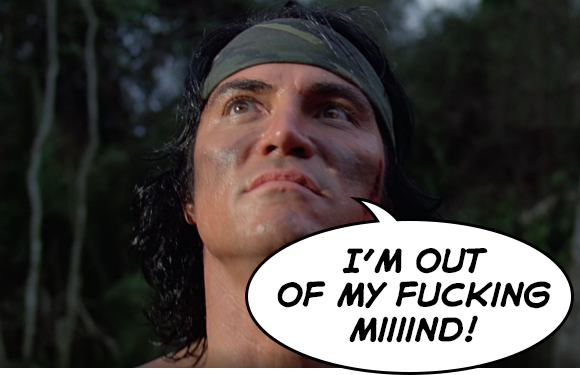
Predator is an important movie to me, and indeed to many children raised by muscles and aliens and explosions in the decade when VCRs first began stealing food from the mouths of hungry babysitters. A landmark of beefcake cinema, Predator is primarily a movie about being vascular and sweaty in the jungle. But in many ways, it is also a film about several future politicians who would all essentially roleplay their Predator characters during their respective gubernatorial bids.
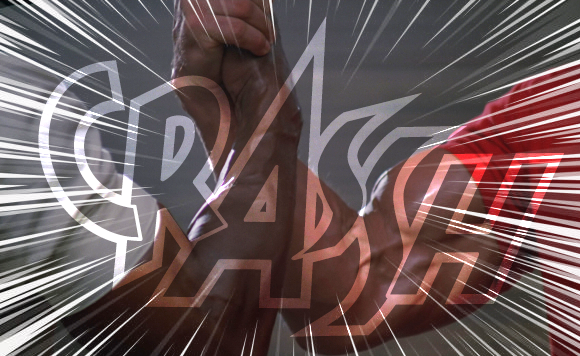
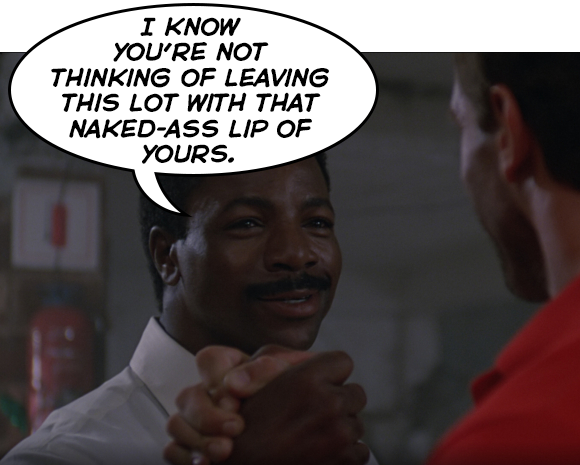
Without question, the most important element of Predator is hubristic action figure excess. It’s like watching a kid who just learned swear words after enduring his parents’ divorce play with G.I. Joes in the backseat of a Camaro with all the windows rolled up. One of the film’s most iconic images occurs within the first five minutes: Arnold Schwarzenegger and Carl Weathers violently locking hands in a glisteningly muscular greeting, the thunderclap of their palms meeting sending out a shockwave so powerful it knocks me further down the Kinsey scale like a rudderless ship in a hurricane every time I watch it.
Right up front, Predator wants you to know it is a movie about the burliest dudes in recorded history getting together to do some serious Man Shit in the jungle. Also, Shane Black is there; beefcakes must always keep at least one string bean nerd in their numbers to handle all the logistics, like making the necessary travel arrangements and ensuring everyone has made the proper deductions on their tax returns. Like a brave canary, he is the first to be killed.
Because Predator is an action film made in the 1980s, it begins with our team of heroic marble statues getting hired by the C.I.A. to invade a fictional Central American country to prevent the spread of Communism. The first half of the movie is so focused on these gigantic slabs annihilating scores of hapless insurgents that you could shut the movie off at the 40-minute mark and live the rest of your life having no idea that Predator is about an alien monster that kills earthlings for sport.
The biggest hint of science fiction contained within that blessed first third of movie is how an elite squad of comMANdoes with the combined weight of more than one elephant could ride in a helicopter without it plunging into the Earth’s core moments after takeoff. The movie ends with a montage of candid footage of each actor, alternately laughing and flexing in celebration of the joyous time they spent together as Jungle Dudez toppling regimes in the name of capitalism.
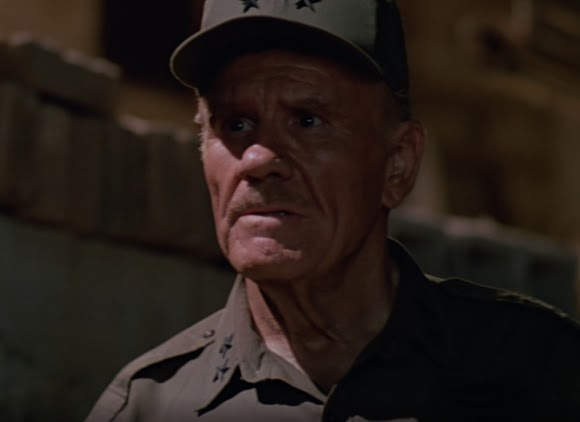
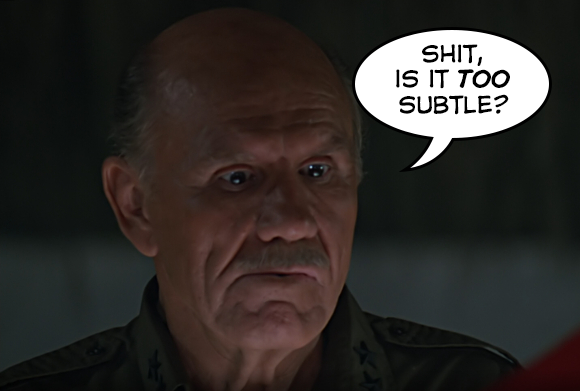
The point I’m making here is, Predator’s deafeningly violent war on subtlety is the most defining of its many characteristics, which is what makes this guy’s lip stand out like Robosaurus in the drive-thru line at In-N-Out Burger.
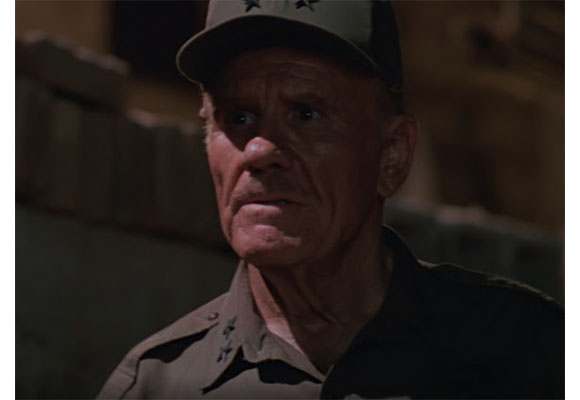
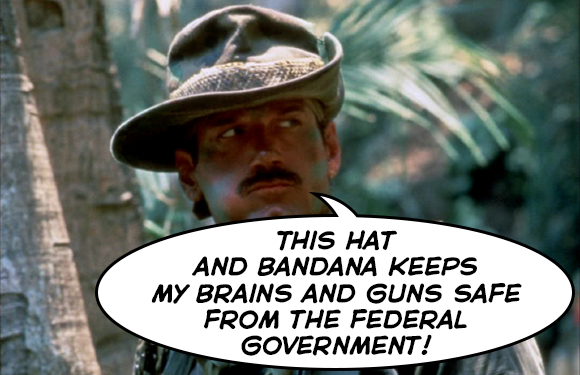
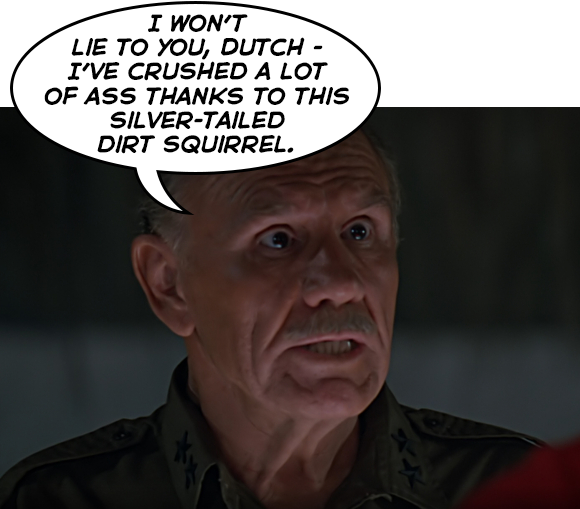
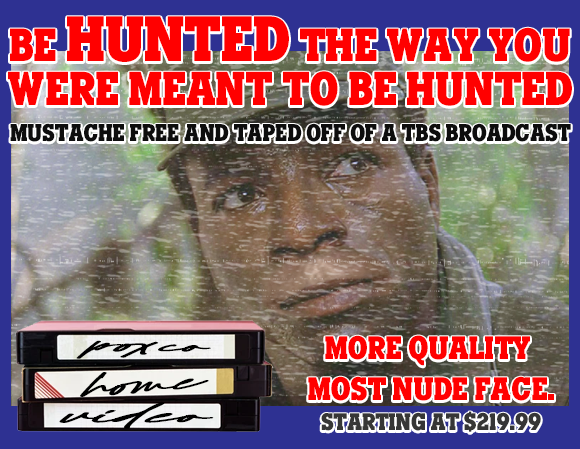
R.G. Armstrong, playing a character allegedly named General Phillips according to the aforementioned credits montage although I have seen this movie roughly eleven-hundred times and you cannot convince me his name isn’t simply “War Grandpa,” is sporting a mustache so thin I legitimately did not notice it until Predator came out on DVD and I saw it for the first time without the characteristic grain of tobacco stains and hundreds of rewinds unique to rental videocassettes of the era. The ghostly whisp of facial hair haunting this man’s face was so slight that I never saw it over a decade of regular viewings. Predator, a film so averse to half-measures that it ends with Arnold Schwarzenegger diving out of the way of a nuclear explosion, somehow features an actor who felt his character of Grizzled Old Soldier would be better realized by the hypnotic suggestion of a mustache. It’s like Don Ameche suddenly appearing to seduce elderly widows in the middle of Michael Bay’s Transformers.
There’s a clear hierarchy of facial hair in Predator. Sitting comfortably at the top are Carl Weathers and Jesse Ventura, sporting the kinds of bushy ticklers required to wear khaki pants in the 1980s. There was a two-week waiting period if you bought a convertible during the Reagan administration, during which you were handed a photo of Carl Weathers’ mustache and sent home to cultivate the proper lip ornament before the dealership would hand over the keys.
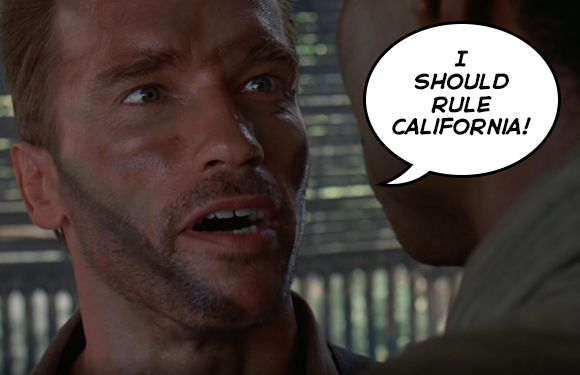
Below them on the mustache totem pole sits Arnold Schwarzenegger’s rugged five o’clock shadow, a compromise I believe was reached after all parties agreed that the sight of Arnold sporting a full Selleck would’ve knocked the planet off its axis. Meanwhile, Mac is so clean-shaven that he literally carves the flesh off his face with a safety razor.
But then, in slides R.G. Armstrong with his cat burglar sandpaper strip, representing the only understated choice in the entire production. Not only is his mustache understated, but it is so understated that I literally could not see it until dawn broke on the year 2000 and we embraced digital video like the apes circling the monolith at the beginning of 2001. Similarly, I have beaten several people to death with bone clubs since discovering Armstrong’s mustache, so frenzied is my obsession.
As you can see, it’s not totally invisible – there is a telltale shimmer.
What does the faded memory of lip hair on General Phillips’ face mean? Is it a cowardly display of fealty to the moist beefcakes thundering past him towards their jungle destiny like a wildebeest stampede, leaving him behind, discarded and forgotten, like Mufasa’s corpse? Does his gossamer-thin face warmer belie a sad truth about his character: a proud warrior, past his prime, too old to join in the fight against Communism and aliens but pitiably clinging to his last remaining participation badge by desperately shouting, “Hey guys, I have a mustache too”? Is this the decaying shadow of former glory? Did Sting’s “Fields of Gold” play in his mind when he trimmed it?
Or is it a bold power move? According to modern philosopher and 9-11/moon landing truther Marion Cotillard in The Dark Knight Rises, it is the slow knife which cuts the deepest. It took me nearly half my life to spot the shimmering, nigh-invisible wraith on R.G. Armstrong’s face. I cannot conceive of a slower knife than that. Somewhere, deep in his old, useless bones, General Phillips knew that his weird combover-adjacent mustache would have the last laugh. “I may be lost in a sea of beefcakes now, in the year 1987,” he arguably said to himself. “But years from now, in the year 2022 to be exact, people on something called ‘the internet’ will revisit this day and finally notice me. They’ll see me for the grand peacock that I am and raise their voices in unison to ask the universe a single unanswerable question: ‘What the fuck is on that guy’s face?’”
Flinging the Predator DVD into my compatible playback device like a Busey-sectioning smart disc and discovering that ethereal nose cape for the first time was like stumbling into an unexpected summer romance on a riverboat gambling cruise with your legal guardians. Never in my wildest dreams could I have predicted it. It’s like doing a word search on the back of a cereal box and accidentally decoding a message from the Zodiac killer. In a movie about an invisible demon on safari, the real apparition was the powdered sugar landing strip painted on this wizened old soldier’s leathery face. I award War Grandpa’s insidious mustache with 17 salutes from Carl Weathers’ severed arm, on a scale of zero to whatever number I just wrote.
Tom Reimann is the co-founder of the podcast and streaming network Gamefully Unemployed, where he has been sporting an undetectable mustache for well over a decade.
… This article was brought to you by our fine sponsor and Hot Dog Supreme, John Dean: Who also has a secret mustache and you will never guess where.
There was a string of films in the ’90s that painted a very specific picture of the near future – 90s Futurism, we’ll call it. Or, in layman’s terms, The Promise of Timecop. The Timecop Promise swore we’d gallop into the next decade on the backs of Prodigy vocalists cloned by The Sixth Day technology, wearing clothes Marilyn Manson lost in a move. We’d all have haircuts the 1980s were simply too cowardly to embrace. Every gun would look like it was stolen from a Virtua Cop machine, and every bladed weapon would be electrified. Physical media would not only continue to exist but would mutate into some indecipherable geometric riddle designed to flunk mentally unstable applicants from a bus driver’s exam. Or everything would just be Sony MiniDiscs. And virtual reality would be so lifelike you’d TimeCream your jeans.
The 1995 cultural flashpoint Virtuosity possesses all these elements: techno music and chunky handguns complimenting optimistic predictions of the evolution of physical media and an obsession with virtual reality. Virtuosity was by no means the first ‘90s Futurism film, nor the most commercially successful, nor the most significant. But it is my favorite ‘90s Futurism film, and therefore the best, because it features Russell Crowe wearing a series of fanciful suits in the colors of his favorite Ninja Turtles.
If you’ve never seen Virtuosity, please check the URL in your browser, because you have mistakenly arrived at the wrong website. But in case you need a refresher, here’s the basic story: It is the year 1999, and also the future. Because we cannot stop giving the LAPD a multi-billion-dollar budget, the police are at the forefront of technological innovation. They’re like Elon Musk if he sucked even harder but the stuff he made actually worked. The cops have designed state-of-the-art virtual reality systems and an entire subdivision dedicated to perfecting Artificial Intelligence, which they created at some point but don’t like to make a big deal out of it. They also have a lab where synthetic human clones can be hatched from eggs.
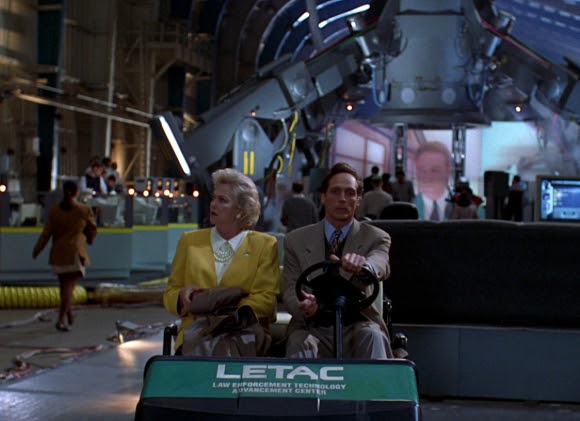
The LAPD has conquered death, is what I’m getting at, and the Queen of the Police, Louise Fletcher, drives around on an electric cart with her business slave, William Fichtner, to supervise all the exciting new CopTek.
For some reason, the cops are using their powerful VR system to run “training simulators” for new recruits, because their real-life training of six months of community college and an obstacle course was deemed too dangerous. Presumably too many cadets were rolling their ankles during the tire hop or accidently stabbing their pencils into their eyes during particularly challenging written exams. To protect future officers from this embarrassment, recruits are strapped into Lawnmower Man chairs and immersed in photorealistic virtual worlds designed to teach them how to be more effective threats to public safety.
Because this is the futuristic world of 1999 as envisioned by screenwriters in 1995 whose understanding of VR was limited to whatever they could glean by spying on children at Software Etc., the training simulators are exactly as sophisticated as a Mega Man II stage – trainees must chase down a Robot Lord and fire as many virtual bullets into his virtual body as they can squeeze out of their virtual guns. The Robot Lord in question is one of the police department’s hyper-advanced A.I.s — an entity called SID 6.7.
SID is a composite of the personalities of 200 serial killers and also Hitler, a cocktail diluted by so much slobbering crazy that it loses all nuance. The simulator might as well be tasking recruits to protect citizens from a runaway boulder. SID is the training partner equivalent of letting a 6-year-old make you dinner – it sounds like a fun idea, but all you’re left with is colorful diarrhea and a solemn vow to never trust again. Matching wits with SID will provide trainees with the experience they need to hunt down a rampaging baboon, but little else in terms of functional detective skills. Maybe baboons are a big problem in the futuristic world of 1999, but the movie is unclear on this point.
SID 6.7 is played by Russell Crowe with the reckless abandon of a child who has just murdered his babysitter and can eat as much ice cream and thumb tacks as he pleases. Crowe approaches the role like he is trying to see how much he can get away with on a scene-by-scene basis until a crewmember wrestles him to the ground so the building can be evacuated. His performance is that of a man trying to conjure a felony drug conviction. If Joaquin Phoenix had won his Joker Oscar in 1995, Russell Crowe as SID 6.7 would’ve run onstage and swallowed him whole. SID is the answer to the age-old question, “What if I hired Max Headroom to murder my parents and paid him in truck stop cocaine?” He is so dangerous that the cops are using convicts to test out the training simulator until they can figure out how to keep SID in line.
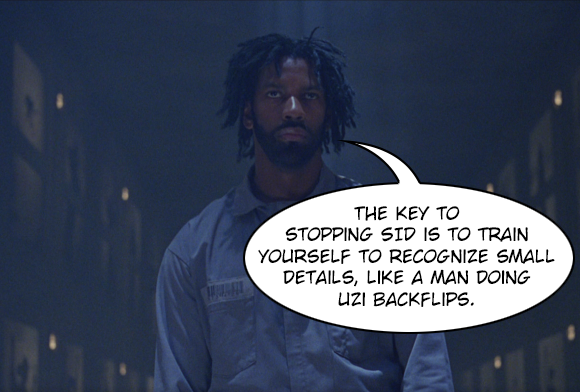
Disgraced former detective, Parker Barnes, in prison for shooting a camera crew who jumped in front of him like scare actors at a haunted house during an intense gunfight in a hive of terrorists, is the only convict to have ever outsmarted SID. At least, that’s what we are told. The extent to which he “outsmarts” SID appears to be “he correctly identifies SID as the only white person in a room full of Japanese businessmen.”
Parker is played by Denzel Washington, and that will never stop fascinating me. Denzel is one of the finest actors of any generation, and you would simply never know it by glancing at his filmography. He loves schlock. Schlock like Virtuosity, and the world is a better place for it. Parker also has a fully functional cyborg arm, as befitting the futuristic world of 1999.
SID figures out how to murder a guy in virtual reality, so the Queen of Police orders that he be shut down. But SID’s sociopathic creator, Darryl, decides to set SID free instead. Darryl is a man with a frighteningly angular skull who has unquestionably written several Gab posts about involuntary celibacy. Darryl has lost more than one friendship over Magic: The Gathering. He rants about “historical inaccuracy” from behind an anime avatar whenever black people or women show up in video games.
Darryl births SID from one of the synthetic clone eggs we discussed earlier, and SID begins murdering his way through the futuristic world of 1999 Los Angeles like the Hamburglar after shooting Officer Big Mac during a cheeseburger heist and deciding he has nothing left to lose. The police have no choice but to spring Parker from jail to hunt SID down, because none of their training has prepared them to handle SID (see “runaway boulder,” above).
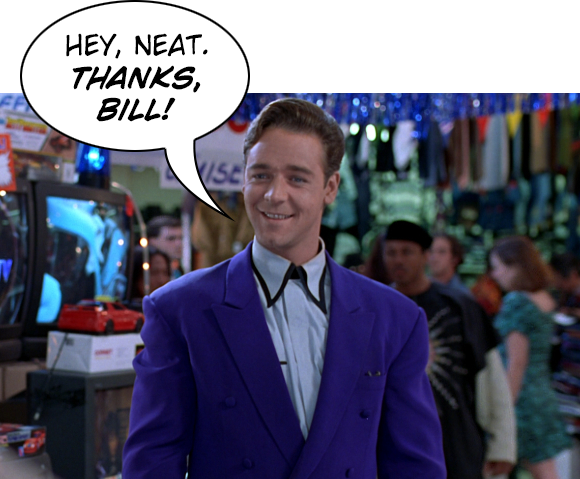
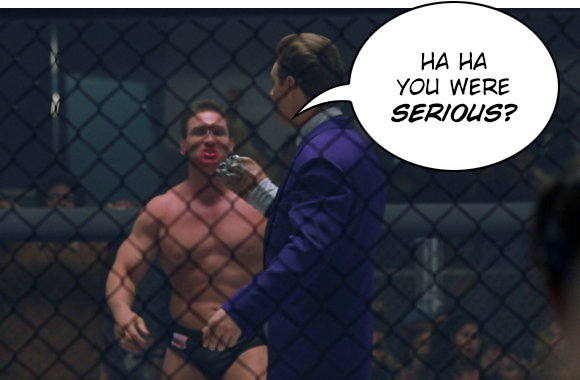
Parker and SID have a series of action-packed future adventures, including a futuristic car chase, a futuristic UFC fight, and a futuristic child abduction. SID collects a number of outfits, most notably a purple suit presumably donated to the production by Bill Bellamy.
Their game of future cat and timemouse culminates in a skyscraper fist fight and a battle of wits to defuse a bomb before it detonates Kaley Cuoco. Parker rips SID’s twinkly electronic brain cube out of his meaty android skull and smashes it beneath a moving vehicle as Lords of Acid launch us into the end credits on a stereophonic bullet train of techno.
Virtuosity is a movie that takes place in a version of 1999 that I cannot stop thinking about. Not merely because it didn’t come true, but because it never could have come true. The movie was released in 1995, which means the ‘90s Future it was predicting was only four years away. That’s a single presidential administration. That’s the length of time between two Batman sequels. We can’t even reliably predict if a highway offramp will finish construction in that amount of time. Virtuosity makes the unfulfillable promises of an alcoholic who slept through Christmas. Virtuosity is a more embarrassing called shot than the time Babe Ruth pointed his bat to the heavens and confidently declared, “I’m going to take an uncomfortable shit on every star in this galaxy,” only to tragically die before space travel was invented. There was simply no way we could have ever reached the heights Virtuosity dared us to achieve in the amount of time it demanded we reach them.
In the interest of the public good, and because the only other way I can organize my thoughts about the film is in a stack of feverishly handwritten notebooks like Kevin Spacey in Se7en (and presumably like Kevin Spacey in real life), I will now chronicle my favorite ‘90s Futurism moments in Virtuosity.
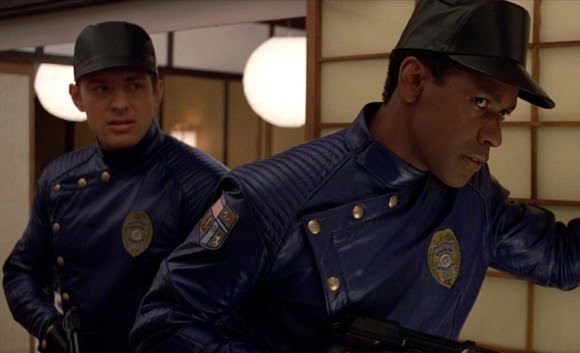
The cops all dress in skin tight vinyl uniforms, like Goth Nazis. They look like inappropriately sexual furniture at a daycare center. They’re dressed like they exclusively police the splash zone at a Golden Corral. They’re dressed like personal trainers at Meatloaf’s sexnasium. Also, Parker’s partner Donovan is the evil cop from the SAW movies. I’m not sure what that means, but I am certain it means something.
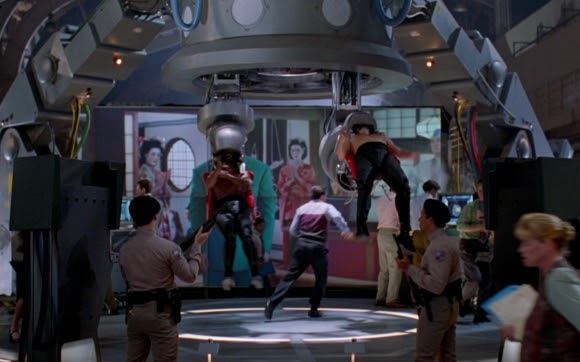
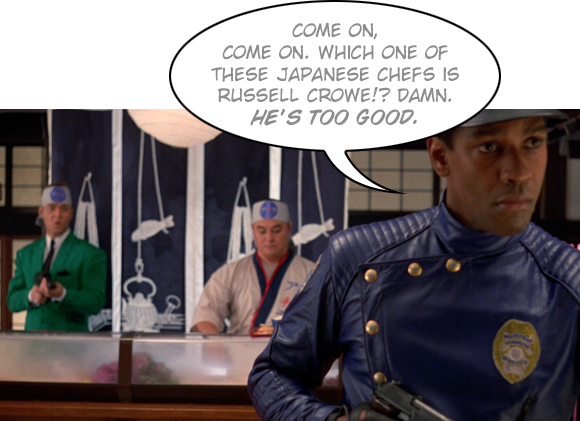
When they’re inside the simulation, Parker tracks down SID by noticing a smiley face emoticon above a sushi restaurant. This is meant to be a training simulator for police officers, but the clue to discovering SID’s whereabouts is completely unrelated to police work. It’s a trivia question about ‘90s Internet culture, and it’s a trivia question for children. I can only assume this means that detective work in the future is indistinguishable from Celebrity Jeopardy.
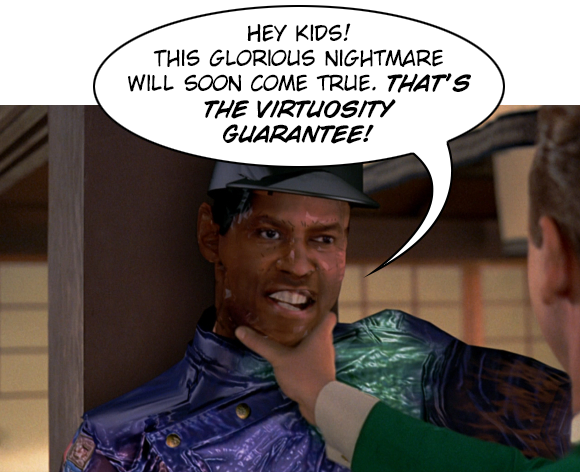
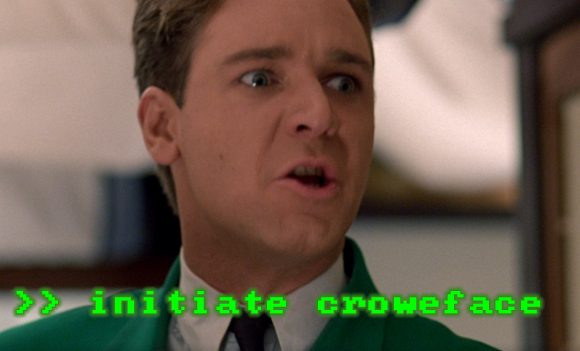
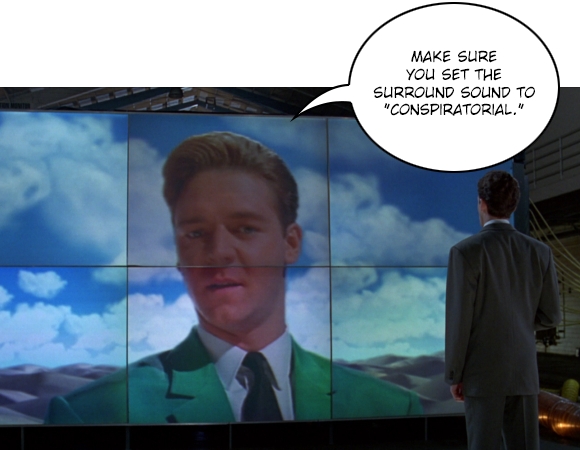
Related to that point, Parker says something to Donovan about being on the lookout for SID’s distinct eyes as they enter the sushi bar. But SID is “hiding out” in the restaurant by being the only Russell Crowe wearing a Kelly green suit in a sea of Japanese people.
Both of those characteristics are going to leap out at me like an escaped jungle cat before I even get around to noticing his eyes. Again, it cannot be overstated how little anyone could learn about police work from this simulation. I suspect Police Queen Louise Fletcher had been looking for an excuse to pull the plug on the VR simulation program long before SID figured out how to kill people in it. It’s comforting to know that the 1999 of the Future still has all the same problems with incredibly shitty software nobody wants to admit is bad.
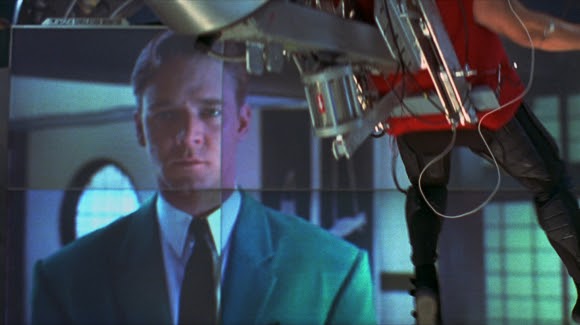
There’s a big ol’ TitanTron viewscreen in the police station broadcasting the simulation so the whole department can watch along. When Parker and Donovan get pulled out of the simulation, the view on the screen dramatically zooms out of SID’s world like a Brian De Palma shot.
This means that the police took the time to program artistic camera angles to make the simulation more interesting for everyone to watch. Also, after SID electrocutes him to death in the simulation, Donovan stays strapped in his future chair convulsing like a werewolf transformation for at least two minutes before anyone thought to unplug him. We know they could’ve pulled Donovan out at any time, because they pull Parker out right before SID smirk-chokes him to death like a haunted puppet. So that room full of stuffed-shirt bureaucrats was just staring at Donovan as the man loudly expired. Just the noisiest, most distracting death imaginable outside of an elevator collapse. The Future Police are either far too professional to interrupt their notetaking to get Donovan out of the simulation, or the simulation is powered by human souls.
Okay, one last thing about the simulation – the Queen of Police notes with some dismay that “virtual reality was supposed to be a safe place to train my law enforcement people” after Donovan strokes out on a gurney. Once again, I must question what scenario this training sim was meant to prepare anyone for. A shootout with an indestructible night club manager? Is that a common beat for cops of the future? Given the evidence Virtuosity provides us, I can arrive at no other conclusion.
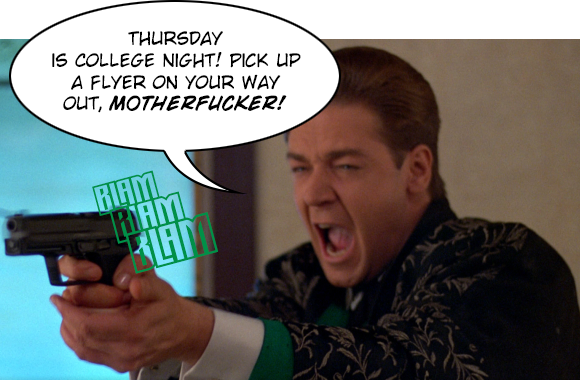
Also, SID possesses the combined instincts of 200 serial killers and mass murderers, and he uses this knowledge to shoot up a restaurant during lunch. Just like Hitler would’ve done.
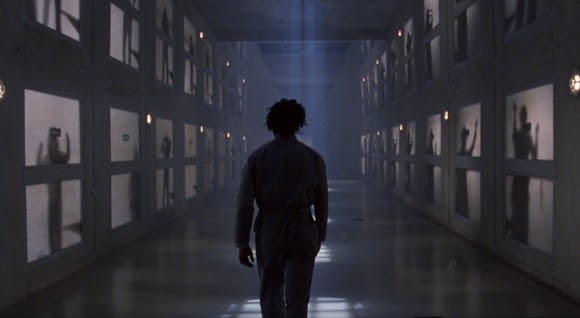
Prisons in the distant farscape of 1999 are almost entirely automated. Also, each cell is a backlit white cube, like the prisoners are a bunch of background dancers at the VMAs.
Parker is attacked on his way back to his cell, but he deftly uses his cyborg arm to defend himself. We have solved the problem of lost limbs in this future, but we’re still pursuing VR technology like it is the crudely polygonal road to Valhalla. ‘90s Futurism was inexplicably enamored of VR, which if you recall was a technology that fully existed in 1995, only with disturbingly shitty graphics. I want to see a ’90s future movie where VR is no less a fundamental part of everyday life, but the technology stopped at the Virtual Boy.
Darryl speaks openly to SID on the sim-room TitanTron about his secret plan to break SID out of the simulation and set him loose in the real world.
There are people working behind him in the background. Everyone can hear their conversation. SID is a program; surely this conversation could’ve been conducted via text. But we didn’t have text messages back in the ‘90s Future, because there is nothing bodaciously futuristic about text.
Darryl has also built a sex chess A.I. named Sheila on the same official police training system as SID, and nobody has alerted the media about this.
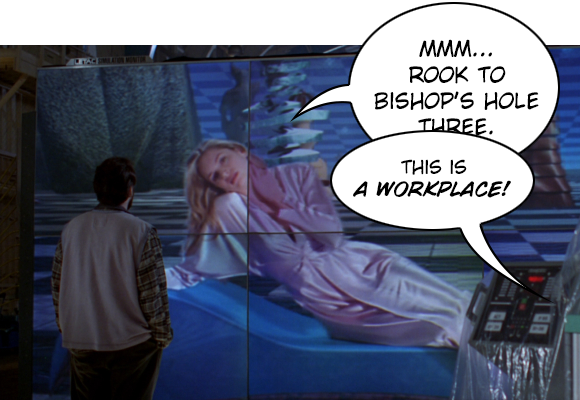
As was similarly foretold in Timecop, futuristic sex pests just fuck their computers whenever and wherever the mood strikes them. Throwing on a visor and shooting ropes to techno music is a totally acceptable way to spend your lunch break in the office of the future. But perhaps Sheila is also being developed for training purposes. If that’s the case, is she supposed to teach cops how to play chess or how to satisfy their partners? Because they don’t seem to have much use for either lesson.
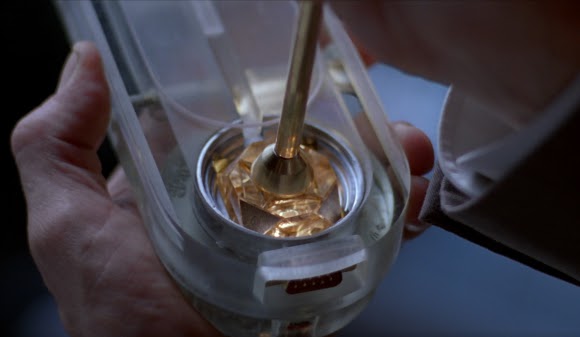
Weird cubes are the preferred media format in the Bradburyian futuretopia of 1999. They look like LED yo-yos at the Air and Space Museum gift shop.
Hands down my favorite aspect of ‘90s Futurism is the unhinged versions of physical media they invent. For some reason, nobody realized there simply wouldn’t be much physical media in the future. This is especially poignant in Virtuosity, a film about a CD-ROM universe ruled by a digital Russell Crowe.
Also, murderous runaway androids appear to be somewhat old hat in this universe. Nobody bats an eye when SID escapes the computer system. They take it totally in stride. It’s like if the cops found out the Christian devil was real and just sighed “here we go again” and put out an APB.
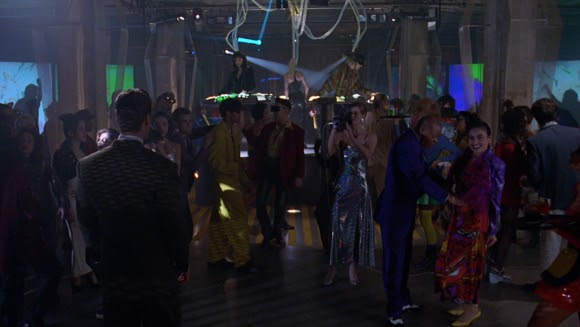
The first stop on SID’s rampage is a loft techno club, which were big in the ’90s future, and constitute my second favorite aspect of ‘90s Futurism.
Everyone listens to techno in the future ‘90s. Not only does everyone listen to techno, but all music is techno. It’s like La Bouche won the Franchise Wars from Demolition Man. Also, everyone in this 1999 Los Angeles of the future dresses like an off-duty American Gladiator.
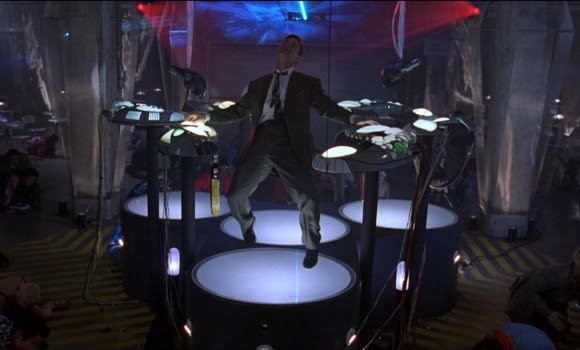
Like every celebrity DJ before him, SID’s first act of public violence is to hijack a programmable turntable and use it to hold a room full of people hostage.
He steals this turntable from Traci Lords. As with the Donovan/SAW connection, I am powerless to decode this information.
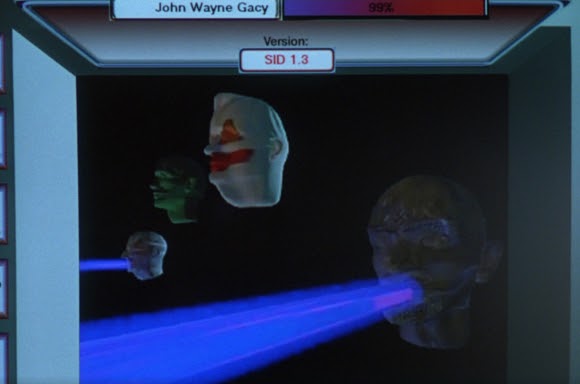
When Parker and his BFF psychotherapist Madison access Darryl’s home computer, we see that it is exclusively voice activated. There’s no keyboard – Parker specifically makes a note of this. I appreciate the accessibility option, and sometimes I want to be able to juggle while I’m doing my work, but this must have made it extremely difficult for Darryl to hatch his nefarious plans if he had to speak every stage of them aloud to his desktop PC. Also, Darryl’s computer took the time to make 3D models of all the murderers in SID’s personality and animate them shooting beams of light out of their mouths to a tiny infant version of SID.
The only reason to do this is because it is objectively hilarious, making Darryl’s home computer my favorite character in the film.
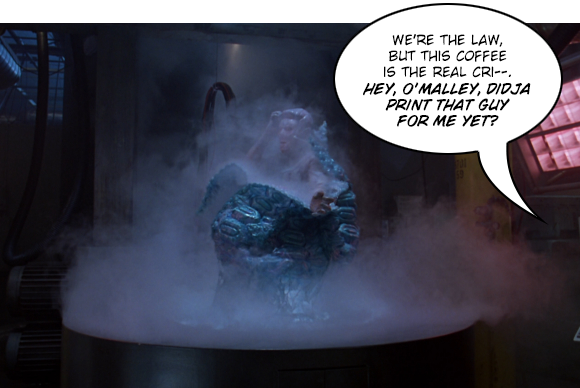
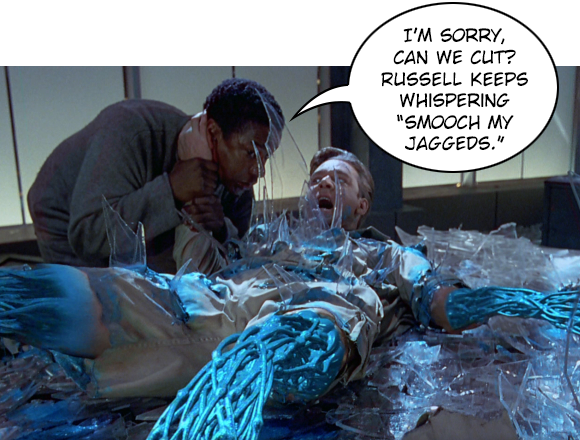
Virtuosity’s version of 1999 is far enough in the future for androids, glass-eating clone bodies hatched from glistening sweaty eggs, and Johnny Cab robot bartenders, but near enough for Ken Shamrock to still be fighting in the UFC at the Olympic Auditorium.
We have no choice but to believe that Ken Shamrock is an android. To be honest, everything about Ken Shamrock makes much more sense when you consider the possibility that he emerged from a giant egg as a fully formed adult.
SID is listening to a song by Russell Crowe’s band as he drives up to kidnap Kaley Cuoco. So, Russell Crowe exists somewhere separately in this elseworld, and SID is his biggest fan.
The other possibility is that whomever SID stole the truck from was listening to Russell Crowe, but I reject that explanation. Not in my Virtuosity.
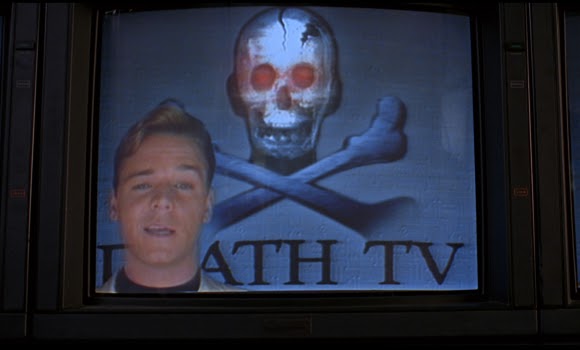
SID brings his own Death TV graphics package with him to the television studio in the film’s finale. He took the time to put that together, as it was an integral part of his plan to capture the imagination of TV viewers everywhere. I assume he made them on Darryl’s home computer using only voice commands.
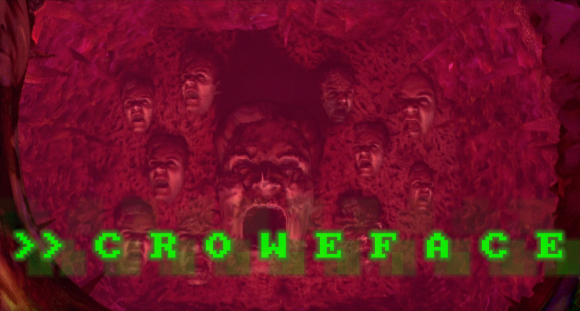
When he realizes the heroes have trapped him back in VR at the end of the movie, SID sends Parker to digital Hell, which is a blood red landscape populated by Russell Crowe’s face.
SID is an A.I. that can be removed from the simulation at will, which means it’s unlikely he would be able to alter the world around him to such a dramatic extent unless Darryl gave him admin privileges, which Darryl would never do, because Darryl has the nefarious gait of a man who despises sharing. His need to be in control is so complete that he prefers to play Dungeons & Dragons alone. His apartment has a single chair in it, because he is allergic to friendship. So, this can only mean the Russell Crowe Hellscape – the Pit of Crowekoon if you will – already existed in the simulation.
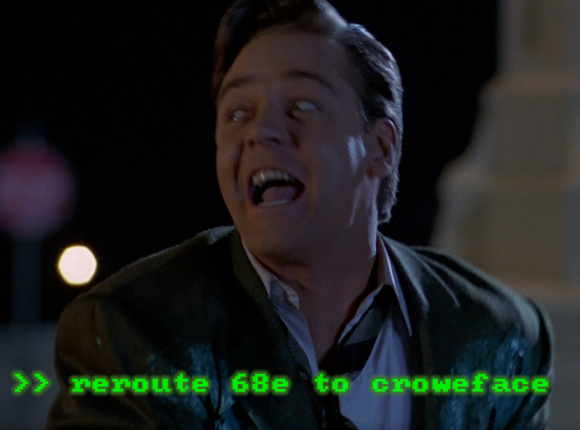
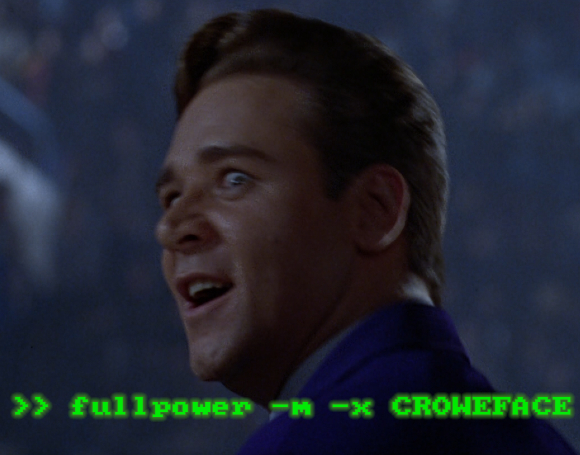
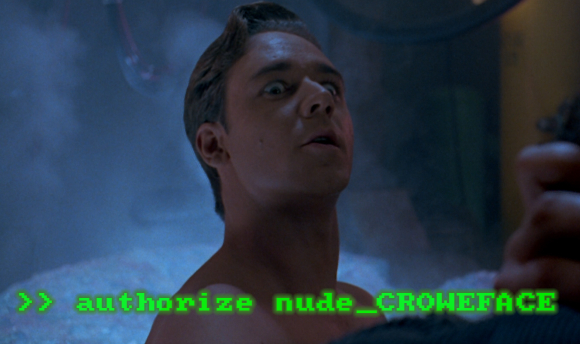
All roads – virtual or otherwise – lead to Croweface.
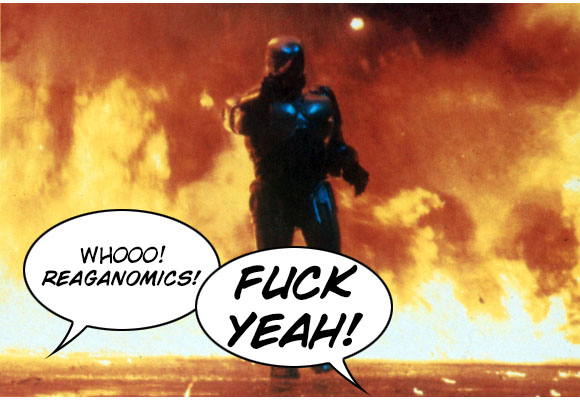
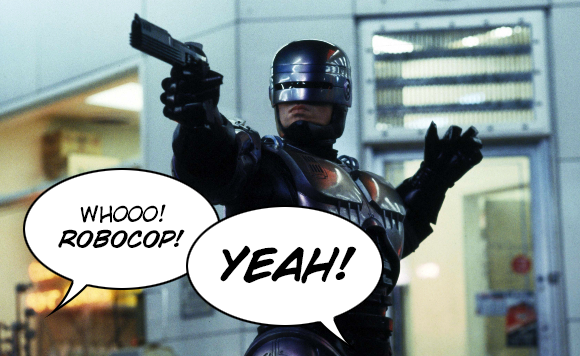
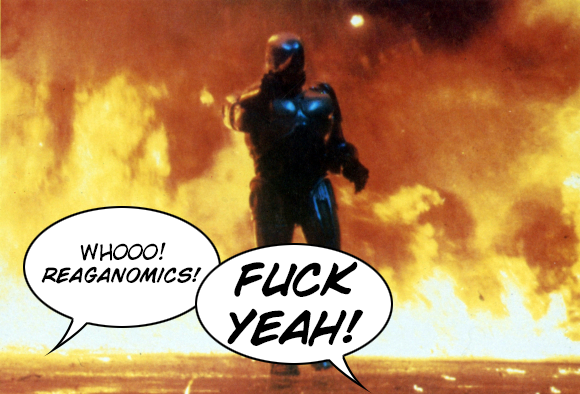
If you took a sentient bag of mescaline to Cirque Du Soleil, its Yelp review would be the Robocop screenplay. A film willed into existence by Paul Verhoeven, a gasoline-blooded sex wizard masquerading as a movie director, Robocop grabbed Reagan-era policies by the throat and chokeslammed it into nitrous dust. It then spat that dust into our eyes like Rick Flair with a handful of cheat powder, and the result blinded us with such radical bodacity that 30 years later an alarming number of people still take the movie at face value.
Don’t get me wrong – Robocop is objectively awesome. I endorse all movies that combine disparate nouns with the word “cop,” be it your Kindergarten Cops or your Wolfcops or your Beverly Hills Cops, or even your One Good Cops. And of all those films, Robocop is the Robocop-est. But Robocop is, very pointedly, a dystopian nightmare satirizing the privatization of social services, taking the recklessly excessive policies of Reagan’s 80s to their most extreme conclusions. Remember when they remade Robocop in the early 2010s as a glossily chaste action figure commercial with some light commentary about the pitfalls of drone warfare? If they’d just waited a few more years until 2021, when America has reached the point where the media is unironically suggesting thatAmazon and Facebook should be allowed to join the United Nations, a reboot would’ve practically written itself. That sentence I just typed is indistinguishable from any of Robocop’s goofily dystopic in-universe commercials trying to sell us performance health care on a pre-approved line of credit. The fact that it was dressed up as a story about a metal man dispensing “justice” the only way he knows how – with psychotic violence – was the spoonful of sugar to help us choke that medicine down.
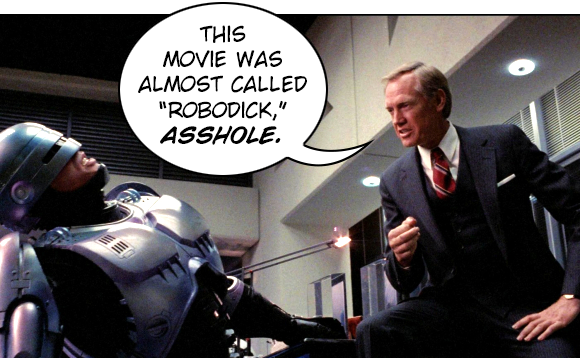
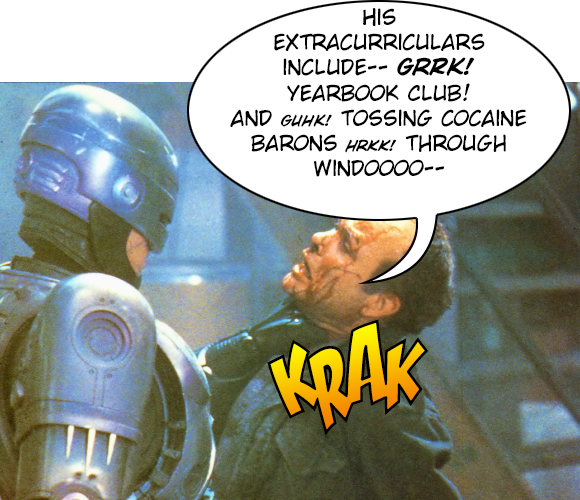
Anyway, I bring all of that up because today I want to talk about Robocop. I always want to talk about Robocop. I cry out his name in my sleep, so insatiable is my need to keep his mechanical spirit alive in the hearts and minds of all Robogod’s children. But today, on this blessed Punching Day, I specifically want to talk about Dick Jones, the testicle-crushing president of Omni Consumer Products.
That’s not even a completely accurate description of Dick Jones. Dick Jones doesn’t crush his rivals’ testicles so much as flatten their testicles like a prom corsage in a textbook about the advantages of beating children that he stole from a prison library and display the book in a glass casket as a warning to future disrespectful scrotums.
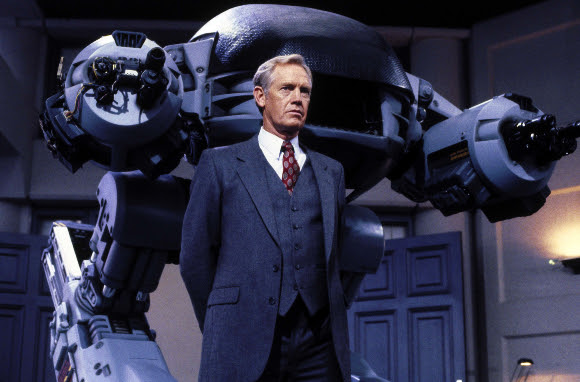
Dick Jones is the villain of Robocop, a perfect distillation of 1980s corporate culture right down to his smart wingtips. He’s Marvel Comics’ the Kingpin on a juice diet. He’s the last boss of Final Fight sprung to glorious life. Dick Jones would drown Gordon Gekko in a bathtub. He would feed Patrick Bateman’s thumbs to an ATM machine. Dick Jones would show up three hours late to a dinner with Tony Montana and then order off-menu for the whole table, and Tony wouldn’t say shit.
Perpetually sporting tailored suits and a veneered sneer, Dick Jones doesn’t give one piston-legged fuck about anything but collecting all of the money in the universe. He spearheaded OCP’s acquisition of Detroit’s police force, primarily to use as a staging ground for his Tyrannosaurus mandroid ED-209. ED-209 is a tank with feet, the kind of thing a kid doodles in the back of a police car. It’s an avatar of violent whimsy. It has the vibes of a murderer working on his standup routine. It’s like a Teddy Ruxpin with bloodshot eyes. If Hasbro built a razor-beaked Furby that only spoke German, Dick Jones would’ve deputized it as a school resource officer, and it would be ED-209’s partner. What I’m getting at is that ED-209 is the absolute last thing you’d ever want to put into contact with the general public, and Dick Jones wants it to be a policeman. It’s the public safety equivalent of giving every elementary school student a flesh-bound book and a ceremonial dagger. The population of the city is about to be dramatically reduced, and in an historic fashion.
We’re introduced to Dick Jones when he brings ED-209 to work like a therapy dog and it kills someone in front of his boss. Just absolutely obliterates a junior executive in the middle of a quarterly strategy meeting. Slams that fucker into meat confetti with bullets the size of Pringles cans. And this is the robot Dick Jones built to ticket unruly motorists and guide children through crosswalks. Everyone in the meeting reacts as if the robot malfunctioned, but if you ask me, nothing could be further from the truth. Based on everything we come to learn about Dick Jones, that robot was functioning as designed. Dick Jones didn’t accidentally build ED-209 to massacre people for littering or breaking curfew; he built that shit on purpose because that’s what he thinks about everyone who isn’t Dick Jones. He’s every auto executive who griped about having to do a product recall simply because a few lousy jagoffs got decapitated by the automatic seatbelts.
Dick Jones is such a nail-shitting bastard that balding reptilian crime boss Clarence Boddicker screams his name into Robocop’s face to avoid getting policed to death. Clarence Boddicker, a man who graphically executes his fellow human beings like a Ghostbuster but for people, invokes the name of Dick Jones in his moment of greatest terror. That’s the kind of letter of recommendation I wish my guidance counselor had written for me.
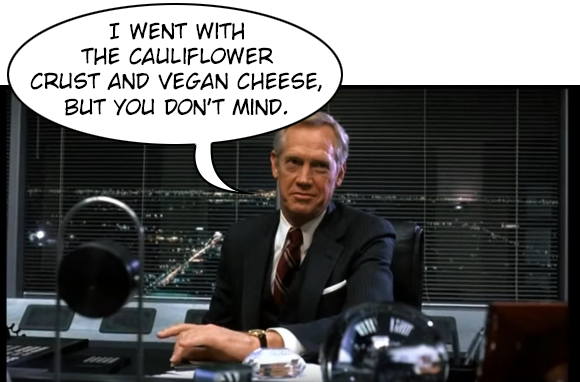
But what really seals the deal for me is the scene in which Dick Jones plans a man’s murder while finishing a shit. Just muscling out the tail of a monster dooker while paging Clarence Boddicker a coworker’s home address.
You see, after ED-209 turned an employee into bone paste during a budget meeting, OCP defunded Dick Jones’ murder bot project and turned to Bob Morton, an up-and-coming executive with a dream of fusing mangled dead flesh with remorseless metal and circuitry to create The Future of Law Enforcement™. Morton swoops in to pitch his Robocop program and becomes the new star of OCP, stealing Dick Jones’ thunder. If anything I’ve written up to this point has been coherent, I apologize, but what should’ve been clear is the fact that stealing Dick Jones’ thunder is the last thing you should ever do. That’s like calling an Uber Pool to take you to Hell. Both the journey and the destination are an eternity of suffering.
The Robocop program is a big success, and Bob Morton becomes the talk of the town. OCP promotes him to executive vice president, which puts him in prime position to come gunning for Dick Jones’ job, and if you aren’t screaming “Bob Morton, no!” at your screen by this point then I have failed at my duty of spreading the gospel of Dick Jones.
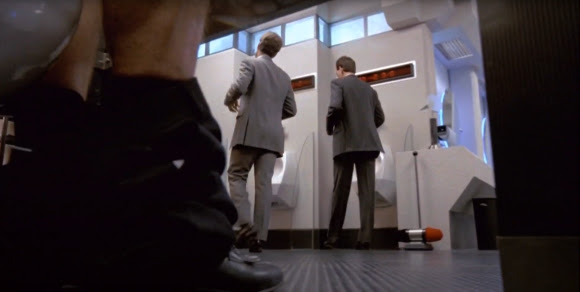
Like Icarus before him, Bob Morton flies too close to the sun, and the sun in this case is the OCP executive lounge. Dick Jones is busily baking a considerable tube loaf loaded with the bones of previous Bob Mortons when Bob Morton comes whirling through the door in a cloud of hubris.
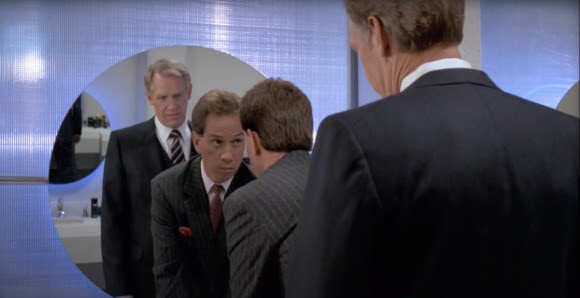
Chatting with a fellow executive, tragically unaware of the extremely occupied stall behind them, Bob Morton brushes off his friend’s advice to watch his ass for Dick Jones and breezily calls Dick Jones a pussy. I’ve sat through approximately 127 viewings of Robocop, and I gasp every single time.
Does Dick Jones come harrumphing out of the bathroom stall, crabbily tugging up his trousers with a face full of bluster to confront Bob Morton? Absolutely not. Come on. This is Dick Jones we’re talking about. Dick Jones patiently lets Bob Morton continue to hang himself while quietly finishing his shit.
The rest of the executives in the lounge correctly panic and flee as soon as the disparaging wind of Bob Morton’s words pass through his lips, so extreme is their fear. It’s unclear whether they saw Dick Jones enter the stall or if they simply recognized the scent of his turds, which we can only assume must be rhinocerotic in both size and odor. He’s painted the room with the scent of his butt-shouts, is what I’m getting at, so Bob Morton is making his casual declaration of war against Dick Jones while breathing the warm air from Dick Jones’ asshole. He’s unwittingly signing his own warrant while smelling the farts of his destructor.
When Dick Jones finally emerges from the stall, revealing himself to Bob Morton and his friend, the friend pisses all over the front of his pants and rushes out of the executive lounge. This is both a result of his frantic hurry to escape, and a cunning display of fealty. Indeed, had Bob Morton also peed on himself, he might have avoided Dick Jones’ wrath. With the patience of geologic time, Dick Jones corners Bob Morton in his executive fart chamber and informs him that he has just fucked up big time. I don’t want to belabor the robopoint, but it truly cannot be overstated that Dick Jones delivers the prophecy of Bob Morton’s doom five feet away from a magnificent pile of his own shit. That’s like serving your partner divorce papers at Disney World. It’s a flex of pure cruelty, like the Ultimate Warrior in inquisitor’s robes.
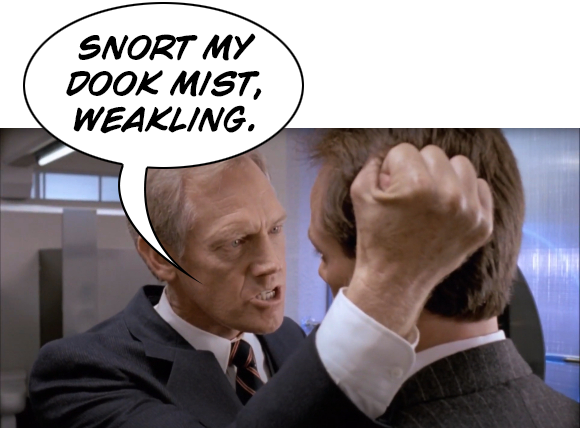
Bob Morton struggles to recover and stand his ground, but it’s far too late. Dick Jones holds grudges like a mummy curse. In a final display of ultimate power, Dick Jones grabs Bob Morton by the skull and yanks his head back, to maximize his intake of the shitty breeze wafting through the executive lounge. “Suck my farts,” Dick Jones all but hisses. “Breathe in the rich scent of stained oak and dead horses that is your demise. My ass belches beckon you to the abyss.”
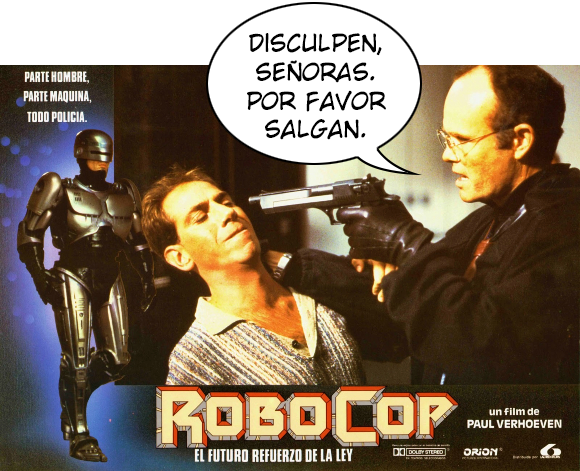
The very next day, Bob Morton is trying to forget the terror of that assy encounter by throwing himself a cocaine party with some attractive young models in his den, which has five (5) TVs. But Dick Jones is not a man who rests on his laurels. He sends Clarence Boddicker to murder Bob Morton with a lethal combination of gunfire, hand grenades, and a sassy DVD message. Clarence Boddicker chases the models out by uttering, “Bitches leave,” but with the subtle understanding that he is also speaking to Bob Morton’s immortal soul; a moment immortalized in the official Spanish lobby cards:
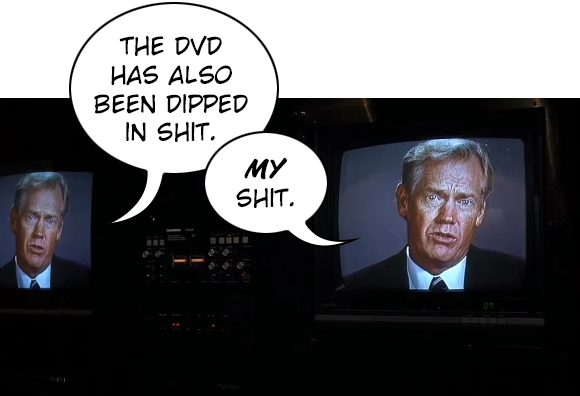
He then blasts Bob Morton’s legs into a divergent timeline wherein Biff Tannen becomes president and pops the DVD into Bob Morton’s admittedly impressive entertainment center. Dick Jones appears on all five televisions to erase what little remains of Bob Morton’s dignity with one savage final windmill dunk, the gist of which is, “Yesterday, you smelled my shit. Today, you’re gonna eat it.”
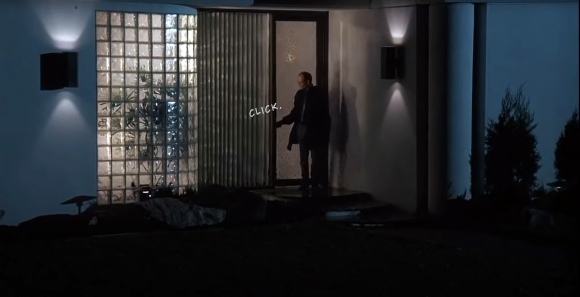
Clarence Boddicker then leaves a grenade on Bob Morton’s coffee table next to the cocaine and walks out, gently closing the front door behind him, which is possibly my favorite detail in the entire film.
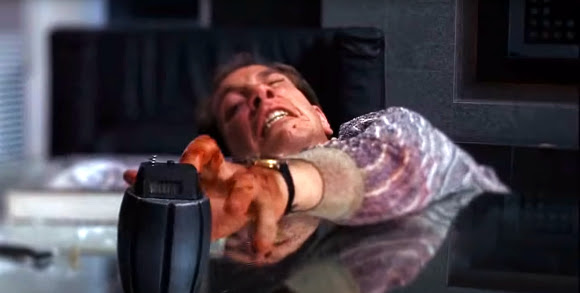
Bob Morton claws feebly at the grenade as Dick Jones’ prerecorded roast continues to play, but only succeeds in knocking the bomb out of reach before it finally explodes. Bob Morton’s final thought before being catapulted out of this world is, “I’m about to be murdered by a guy who forced me to smell the colossal dump he took at work yesterday.”
That’s what happens when you call Dick Jones a pussy, Bob.
Tom Reimann runs the Gamefully Unemployed podcast and streaming network with David Bell. He also writes for Some More News, and is allegedly a Senior Editor at Collider.
… This article was brought to you by our fine sponsor and Hot Dog Supreme: Josh S, who teaches a killer business seminar on how to take a Dick Jones Power Crap.
Collectible Card Games™ were like bitcoin in the ‘90s. Some freewheeling hero of licensed commerce figured out that you could create a backdoor gambling trap house for dweebs by making up rules for trading cards, and that became the speculative currency of the year 1995 alongside Pogs and Hootie and the Blowfish.
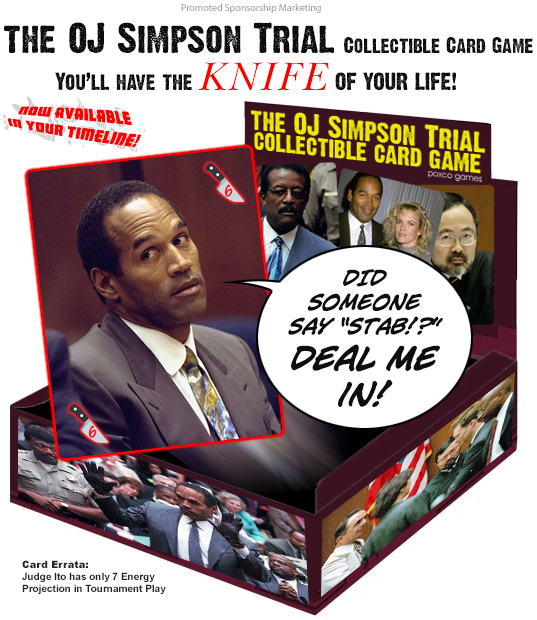
During that brief, glorious window of time, nearly every property you could think of was spun off into a Collectible Card Game™. Monty Python and the Holy Grail, at the time a 30-year-old film with no sequels, was made into its own Collectible Card Game™. There was never an official Collectible Card Game™ adaptation of the O.J. Simpson trial, but I’m certain those discussions took place. Boxes of The Island of Dr. Moreau game and the Clinton Impeachment game were presumably shipped to third-world children alongside cases of Buffalo Bills Super Bowl champion t-shirts. If the CCG boom had lasted longer than 12 months, we would’ve seen a 9/11 Collectible Card Game™ with a robust Iraq War expansion, complete with a chase Rudy Giuliani on lenticular printing depicting America’s Mayor melting into a puddle of raven-dyed gin sweat in real time.
There were even official Collectible Card Games™ sponsored by Major League Baseball and the NFL, in what may have been the most blindly ambitious assessment of crossover appeal since Deion Sanders’ 1994 album Prime Time, an entire collection of songs performed by an undeniably skilled athlete who has clearly never listened to music. I’m not saying that none of the kids who bought Collectible Card Games™ in the ‘90s played sports, but I’m willing to bet most of them won the “Most Spirited” award.
Collectible Card Games™ represent the perfect storm of monetizing nerdery, combining strategy/RPG tabletop gaming with the collectibles industry, which thrives on selling functionless cardboard and plastic to people who have strong opinions about the Spawn movie. Consequently, it wasn’t long before the Marvel Super Heroes waded their costumed boots into the fray, and anyone who grew up in the ‘90s reading comic books off of the rack at Food Lion can probably tell you why. The ‘90s were a dark time for Marvel – remember, this is 20 years before Disney and the Marvel Cinematic Universe – and the company was notorious for selling the merchandising rights to their characters for the cash equivalent of a BOGO coupon to a kissing booth run by the lead singer of an Incubus tribute band. Spider-Man made a lot of personal appearances at car dealerships in the ‘90s, and stacks of koozies bearing the official visage of the mighty Thor languished unredeemed in prize baskets at miniature golf franchises across America. Marvel was desperate for exciting new ways to pimp Earth’s Mightiest Heroes to dorks with disposable income, and Collectible Card Games™ were just such an opportunity.
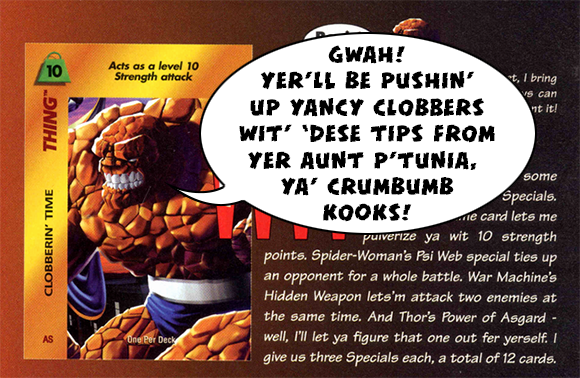
In the summer of 1995, Marvel OverPower exploded into comic book stores, hobby shops, and weird kiosks at the mall run by men on a first-name basis with their tobacconists. The basic mechanics of the game were introduced via a series of instructive comic books, each written in-character by members of the Marvel Universe. I had the one written by Benjamin J. Grimm, and let me tell you, the ever-loving blue-eyed Thing was never meant to train anyone to do anything, let alone a complicated strategy card game with its own speculative economy. My copy of that issue has long since been lost to the sands of time, but I recently paid 400% of the original cover price for a new one so that we might go through it together in a future article. In the event that the article ends up not happening, at least I will have a copy to pass on to my children. In the event that I never have any children, at least I will have a copy to mail to a random child. I only believe in no-win situations wherein there truly is no winner. It’s the Kobayashi Maru of paying $10 for a 25-year-old instruction booklet dictated by a fictional character whose superpower is being a rampaging dumbass with no patience or impulse control.
Now, to be clear, nothing about Marvel OverPower is a bad idea. Collectible Card Games™ were exploding at the time, and Marvel already produced annual gameless trading card sets featuring their characters. It would’ve been strange if they hadn’t tried to cash in on this lucrative new trend. And OverPower is a pretty good game! It has an interesting design that eschews the resource management aspect of Magic the Gathering that has since become the template for most customizable card games. Rather than fiddling with mana or casting costs, you just kind of play whatever the hell you want over a series of hands that essentially boil down to a gussied-up version of poker. And Marvel has a deep bench of rad heroes and villains, brought to life by decades of talented artists, who would lend themselves perfectly to a Collectible Card Game™. The trouble is, Marvel has an equally deep bench of the most unappealing characters in the history of visual storytelling, and in the ’90s they were trying like hell to figure out which one of those ridiculous shitheads was going to be the next Spider-Man. When coupled with their other notable 1990s habit of devaluing their own brand to make a quick buck off of shoddy merchandise, and their forever habit of not giving one solitary shit about artists, OverPower became a charming oddity of high-quality trading cards featuring the worst art I have ever seen depicting characters who lived shorter lives than the NASA Teacher in Space Project.
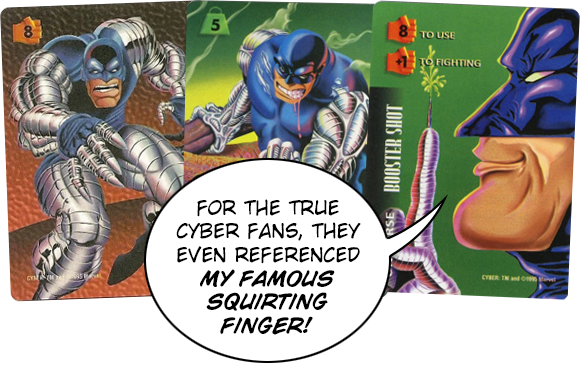
When I cracked open my first starter deck of OverPower, I was rewarded with a deck of cards bearing the hideously misshapen faces of the most indecipherable trivia questions 1995 Marvel Comics had to offer, such as Cyber and Century. Instantly forgettable characters with names that sound like words Kid Rock hurriedly selected from a rhyming dictionary made up roughly 20% of OverPower’s inaugural set. Even characters who are well-known now, like Nebula and Deadpool, weren’t exactly decorating any lunchboxes in 1995, and yet they were heavily featured in this exciting new gaming endeavor. And unlike Nebula or Deadpool, Cyber is no one’s favorite character. Nobody is buying Cyber posters. Cyber gets picked dead last in the fantasy supervillain draft every year by the guy who showed up late because he mistyped the bank’s Wi-Fi password. The only way Cyber will ever appear in the MCU is on a Disney+ series playing on a cracked vidscreen in the background of the wasteland while WALL-E busily crushes piles of dusty bones into stackable cubes. And yet Cyber is on no less than three different cards in the very first box of OverPower cards you were likely to open, looking like a mechanical aerobics instructor:
He looks like the X-Men’s pool guy. His mutant power appears to be Sleeveless Colossus, and as keen-eyed Marvel fans have probably noticed, Colossus is already sleeveless. The noble Russian superhero had been doggedly fighting his personal war against sleeves for two decades by the time OverPower rolled around, so it’s unclear what Cyber hoped to bring to the table. The only thing that is clear is what he doesn’t bring to the table, which is more sleeves.
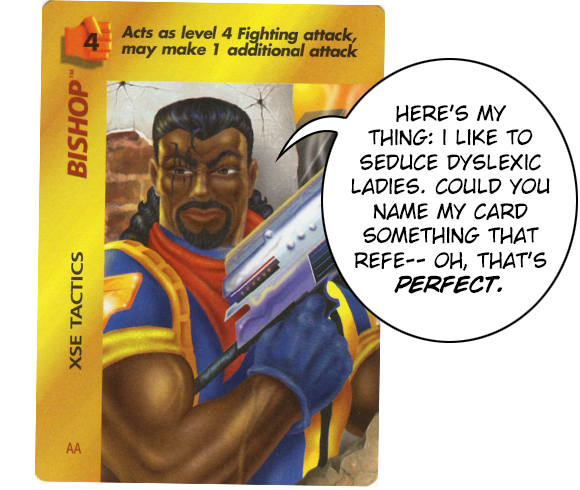
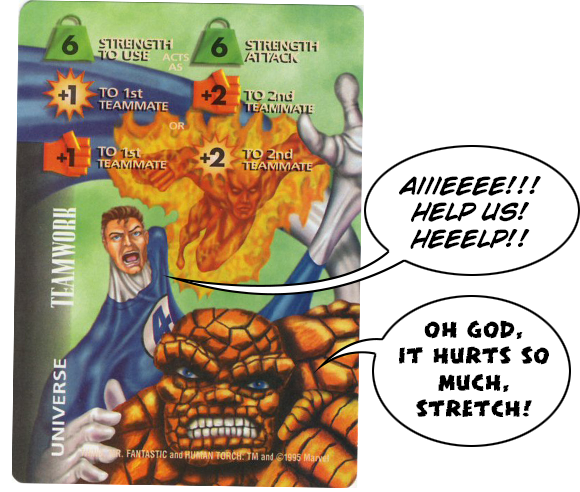
Cyber is but one example of the truly atrocious art you were treated to upon tearing open any given pack of OverPower cards. Much of the artwork was badly repurposed from existing comics, and all of it was given a bizarre graphical sheen that effectively made each card look as if it were created in Microsoft Paint by an insane computer moments before it self-destructed. Things like perspective and human anatomy – already on thin fucking ice in the comic books of the ‘90s – were cast straight out of the goddamn window:
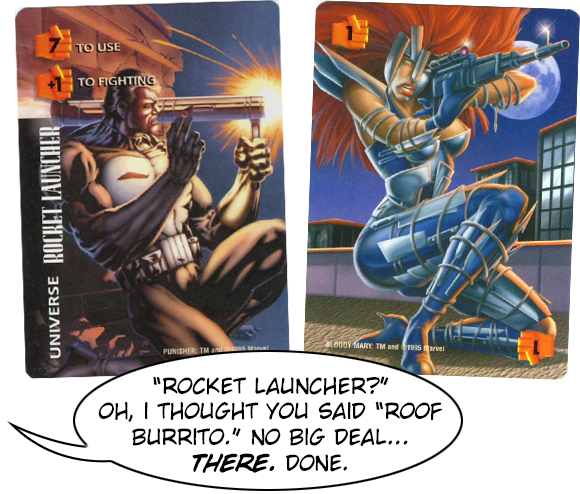
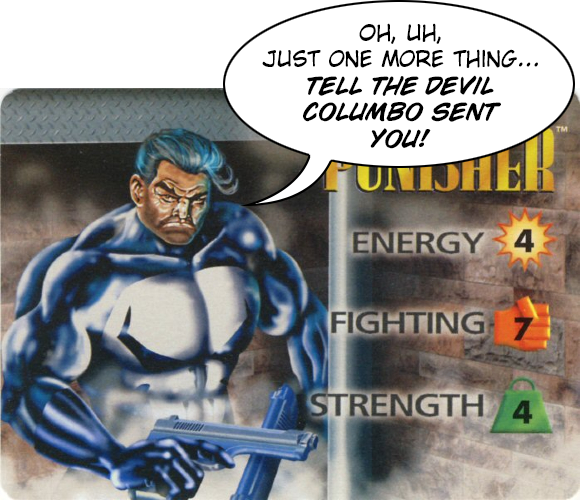
Even when the art wasn’t necessarily bad, it was always 100% out of its fucking mind, such as the Punisher’s hero card in which he looks like Peter Falk dual-wielding handguns the size of his torso:
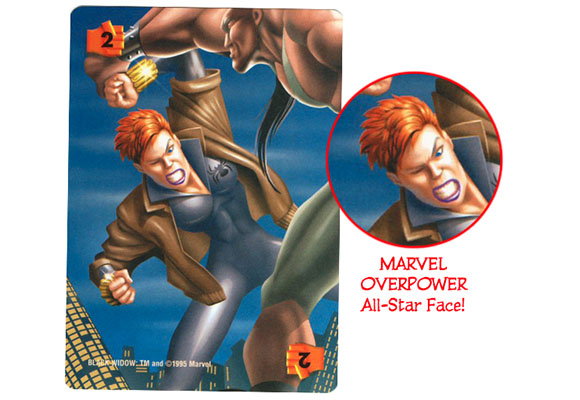
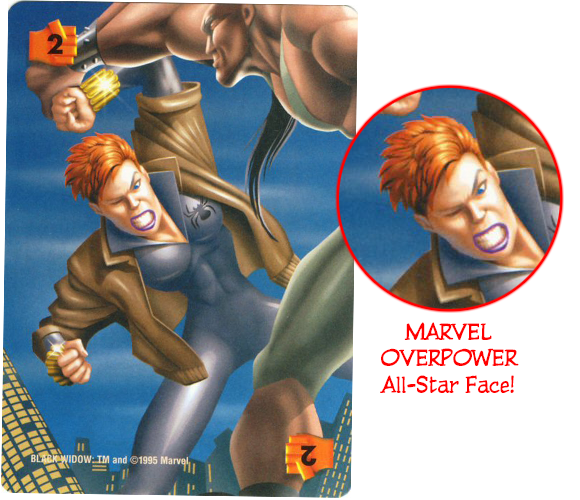
The cockeyed Black Widow uppercut was an abiding favorite. Notice how one eye is tightly shut while the other is looking off in a random direction, as if she’s receiving instructions from Dean Stockwell’s hologram:
“Ziggy says you have to dislocate this palooka’s jaw or else Dina and her kids are gonna die on that roller coaster tonight!”
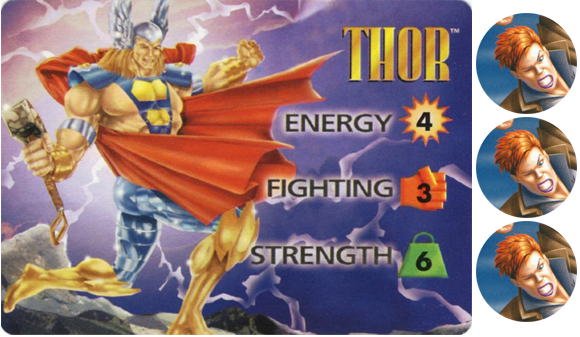
Thor’s hero card depicted the formidable god of thunder doing what can best be described as a Christian endzone dance:
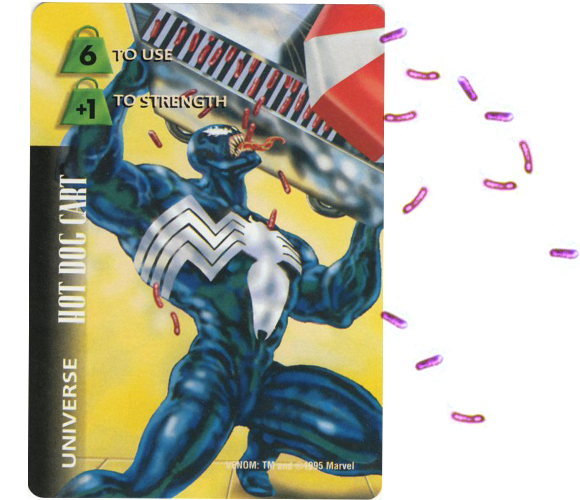
And here’s Venom, then and now one of Marvel’s most popular characters, dumping a cart of hot dogs into his mouth like he just lost an extremely specific bet:
I have no choice but to believe that Tom Hardy based his entire performance on this single image.
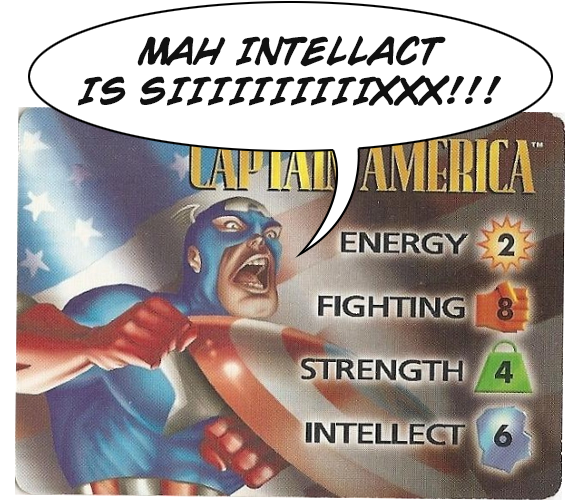
And even though it came in an expansion several years later, I would be criminally remiss if I did not highlight Captain America’s IQ OverPower hero card:
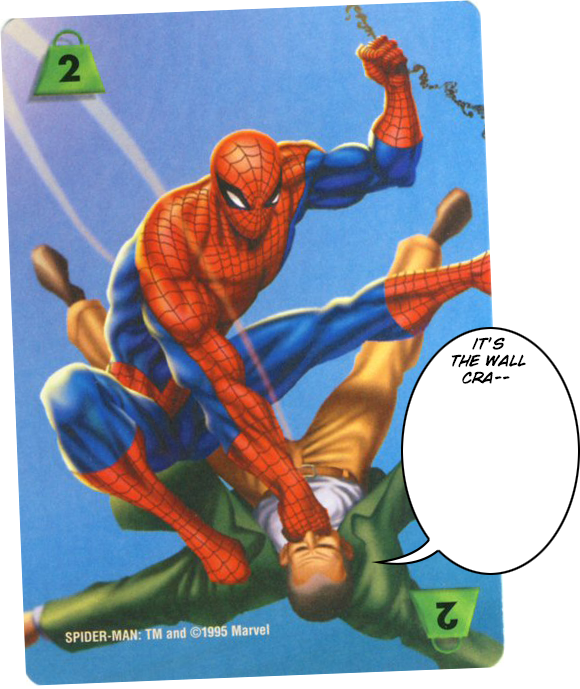
Finally, here’s my favorite card in the entire inaugural set: Spider-Man calmly caving a man’s face in mid web-swing:
Does this man have the power of flight? If not, why did Spider-Man carry him all the way up into the sky to detonate his face? The man’s hair is gray – how old is he? The movement flourish suggests that Spidey wound that punch up from the small of his own back, and calculating for the proportional strength of a spider, such a blow should rocket this man’s teeth, tongue, and uvula through the back of his skull like a shotgun blast. What did this man do? What crime could he have committed to deserve such treatment? Truly, he has been OverPowered™. Please know I recorded all these thoughts in a spiral-bound notebook while staring at this card and listening to the Mortal Kombat soundtrack in my parents’ dining room the year Toy Story was released in theaters.
Sadly, Marvel OverPower did not last beyond the ’90s. But nor was it truly meant to. As these tarot cards of strange fortune indicate, OverPower was a towering monument to the decade of impossible musculature and shiny sleeveless beefcakes, forever preserving the worst period of modern comic books in poorly drawn amber. It’s like a bronze statue of Alanis Morrisette, meant to fade with the receding sunset on December 31, 1995. To say that Marvel OverPower represented a significant period of my life is an understatement. For a period of about 10 months in the ‘90s, I lived for this game. If I could be buried in a casket made of OverPower cards, with a Captain America hero card expression painstakingly painted onto my face, my wife would be the most bitter widow in history. In the spirit of making wildly irresponsible purchases, I have waded back into collecting this undeniably perfect game, and if time and the whims of the universe allow it, I will break open more moldy packs of terribly illustrated playing cards for an autopsy report here on the Hotdog. Or I’ll never mention OverPower again. One of those two things will definitely happen.
…
This article was brought to you by our fine sponsor and Hot Dog Supreme, Donald Finney: who has a Fighting of 9! A Jetski of 3, Guitar of 1, and Fiscal Responsibility 2 — but Fighting 9 is good!


 Unlock with Patreon