Categories
NERDING DAY

Nerding Day: Superhuman Samurai Syber-Squad 🌭

Everyone wanted in on that sweet Power Rangers heat in the ’90s. And while Saban Entertainment cranked out their share of shows based on Japanese tokusatsu to capitalize on the craze for spandex-clad warriors battling bug-eyed monsters like VR Troopers, Masked Rider, and the horrifying Big Bad Beetleborgs, they weren’t the only ones with their eyes on the prize.
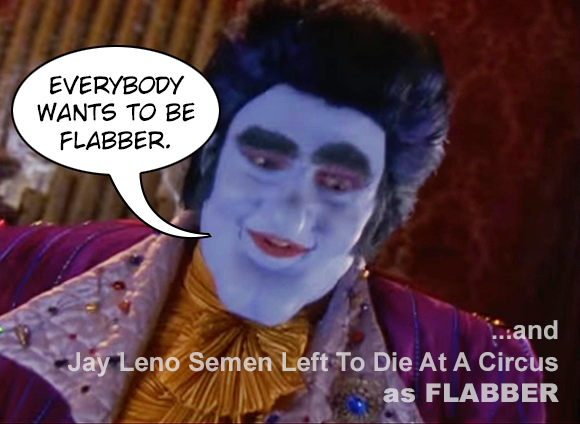
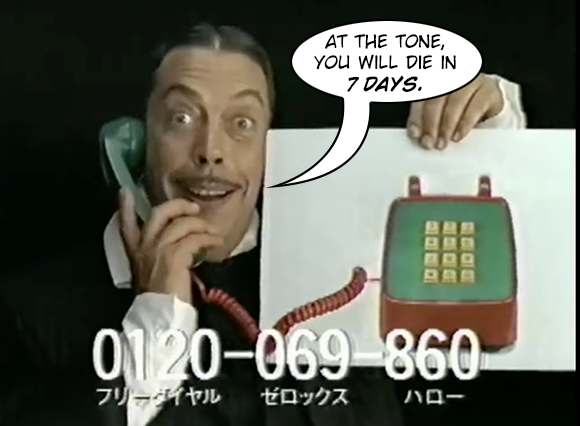
In 1994, DIC Productions, who put out at least half of the American cartoons produced in the ’80s and ’90s, partnered with Tsuburaya Productions to create Superhuman Samurai Syber-Squad. If you’re unfamiliar, I bet you’re picturing a Power Rangers-like team of samurai-themed guys. If so, you are wrong. This is a show about four kids in a band called Team Samurai who occasionally go inside their Compaq brand computers to kill monsters devised by a socially awkward outcast classmate and brought to life by Tim Curry.
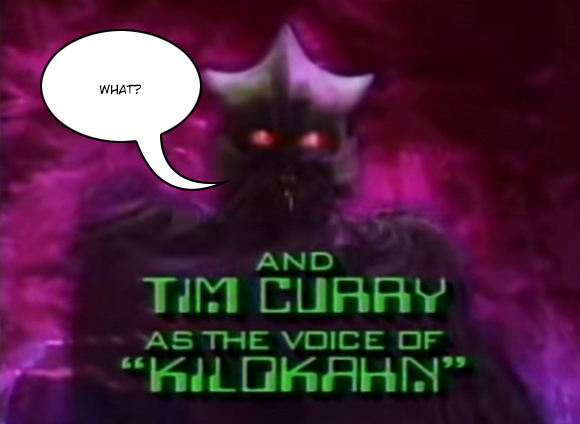
Sam(urai) Collins and his bandmates Tanker, Syd, and Amp are drawn into battle against the evil Kilokahn, a military AI gone rogue, when a power surge turns Sam into a video game character of his own creation. Sam is played by Matthew Lawrence, who was also Shawn’s brother on Boy Meets World and one of the kids in Mrs. Doubtfire (the one who sees his dad pissing in drag).
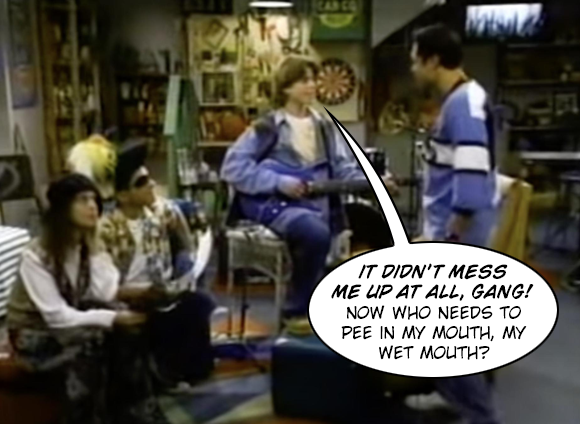
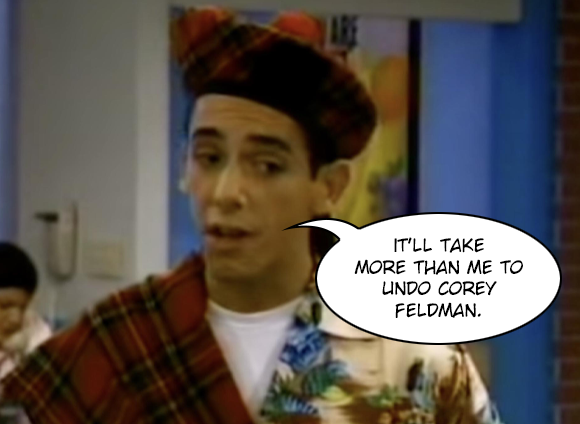
Sam’s friends Tanker and Syd were portrayed by Kevin Castro and Robin Mary Florence, respectively, who are best known for… Superhuman Samurai Syber-Squad. Amp was played by Troy Slaten, who was in Parker Lewis Can’t Lose and is now a lawyer interested in “ending the scourge of mass incarceration, ending the jail turnstile and ending the school-to-prison pipeline.” Hey, that’s actually pretty cool! Chalk one up for child actors.
But, of course, the real draw of the cast is Tim “Hexxus in FernGully” Curry as Kilokahn. He looks like a cyber-Shredder, he calls human beings “meat-things,” and he craaaaaves power. (Hi daddy.)
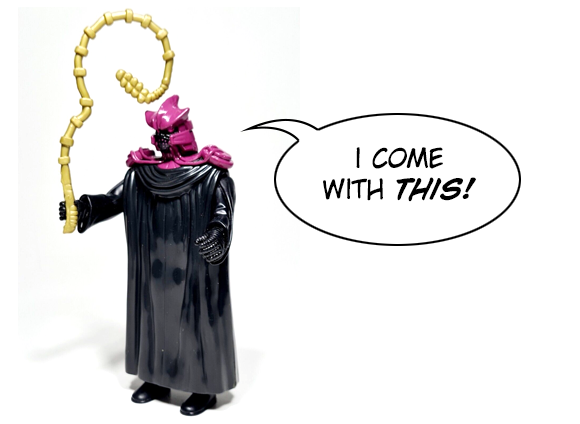
Kilokahn makes a deal with Malcolm Frink: Malcolm designs “mega-viruses,” and Kilokahn brings them to life to mess up Sam’s chances with their shared love interest, Jennifer. Of course, Kilokahn also wants to subjugate all of humanity, so Malcolm maybe isn’t thinking this all through, but who can judge what the young do for love? I once allowed a girl I had a crush on to pierce my ears with a sewing needle, and at least Malcolm isn’t getting staph from teaming up with a genocidal computer program.
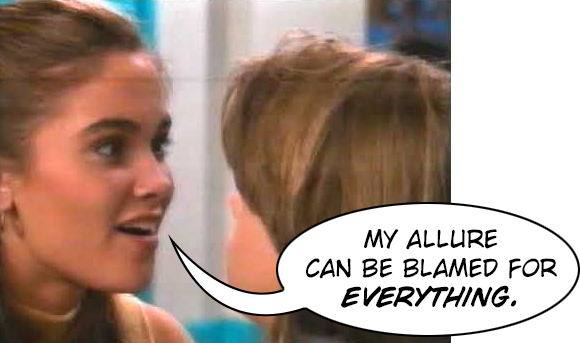
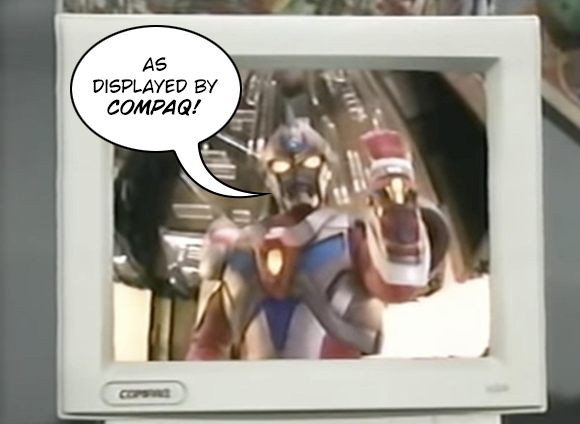
How does Malcolm fuck with Sam? In the first episode, he creates a virus to stop Sam from calling Jennifer and asking her out. But uh oh! Kilokhan shuts down the entire world’s telephone lines. Sam is sucked into his computer after a power surge and becomes Servo, an Ultraman-looking hero who kicks the virus’s ass, and telephonic communication is saved.
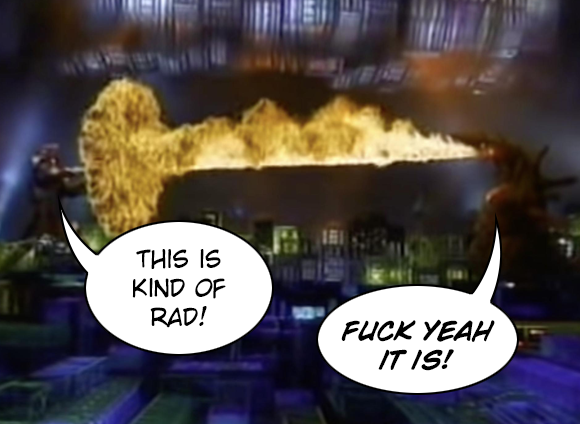
Sam decides to keep all this a secret from everyone except his bandmates — not because he’s worried about the potential dangers or the government tracking him down to weaponize his ability to physically enter computers and do karate stunts, but because he’s embarrassed about it and doesn’t want people to think he’s a computer geek.

Sam sucks. He is, by his own admission, only interested in playing rock music to attract women. He tricks Jennifer into giving him her phone number. And he’s completely uninteresting, a vacant-eyed indictment of the emptiness of American youth culture in the ’90s.
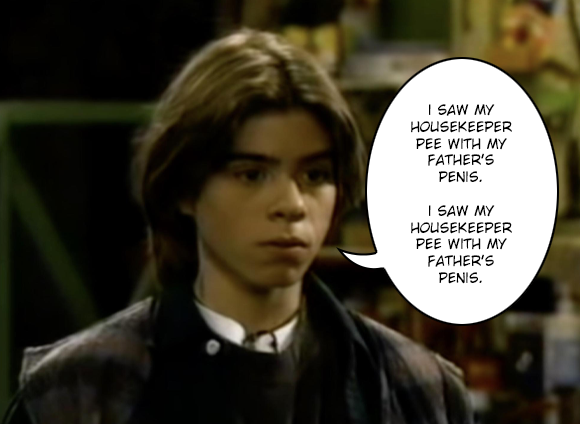
Contrast him with Malcolm — a creative, driven young man who is computer-savvy, a talented artist, and has a cool put-on British accent. Malcolm is the kind of kid who probably got the shit kicked out of him throughout high school for being overly theatrical and wearing black all the time, then landed a great job working for a game developer and realized that he was never all that into Jennifer anyway.
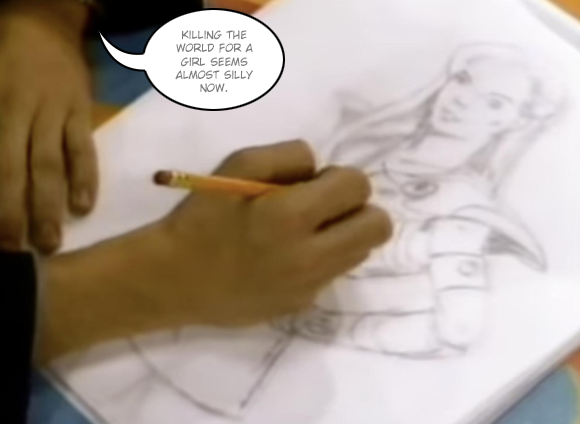
Maybe his rivalry with Sam and his willingness to partner with the computer devil stemmed from his sublimated desires for his all-American classmate whose easy charm and circle of friends represented everything that Malcolm wanted but felt was denied to him because of how different he felt from his peers.
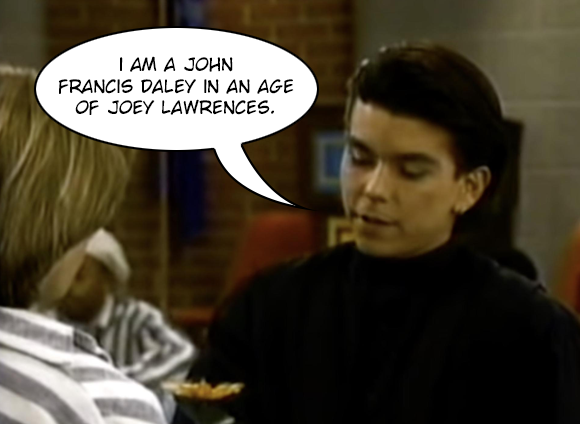
And maybe one day he’d meet someone, a programmer with a shy smile named Jake who could give him what neither Jennifer, nor Sam, nor even Kilokahn could — love and understanding. They would be happy, Malcolm and his husband. There would always be nights when he would wake up in a sweat, feeling sick to his stomach at the horrors he had wrought in his youth: the time he set up an impenetrable wall around half the world to stop Sam from getting to a gig; the time he forced Syd to go on a crime spree by putting a virus in her wristwatch; the time he tried to roast everyone in the school alive by raising the thermostat and locking the doors; the time he nearly made Sam go insane from isolation by trapping him in his video camera; the time he turned the city’s entire water supply into hydrochloric acid. That’s not who you are anymore, Jake would remind him. You’re the man I fell in love with.

And on occasion he might think of Sam, wonder where he was since they’d last seen each other at graduation, made eye contact across the stage and silently nodded, the last gesture of recognition on the part of two worthy rivals parting ways.
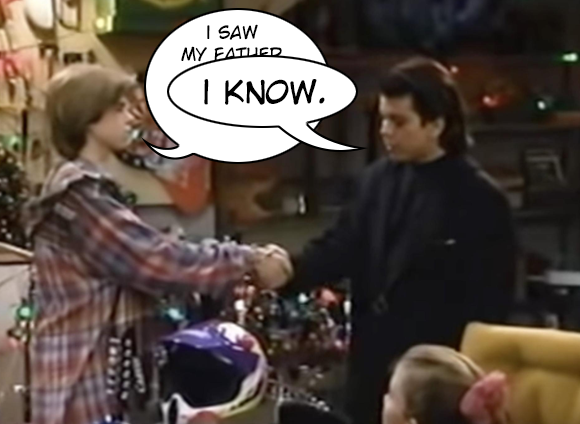
Meanwhile, Sam is still living in his mother’s basement and swearing that he’s going to “make it” any day now. Jennifer is a dream from long ago, and when Tanker and Syd come back to town to see their families, they smile weakly when he talks about the open mics he’s playing and how close he thinks he is to getting a record deal. Nobody has the heart to tell him to give up, that it’s not going to happen.
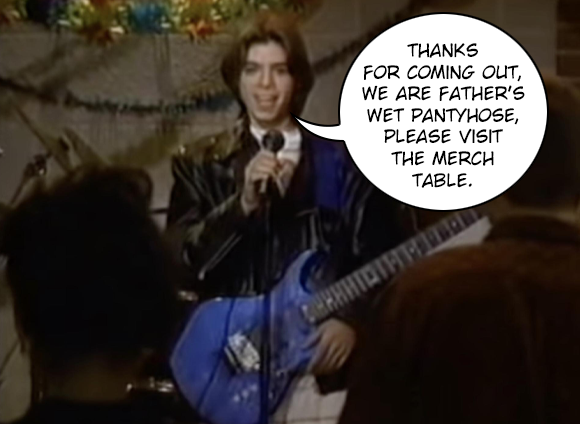
Sorry, I think I just started writing the world’s only Superhuman Samurai Syber-Squad fanfiction. But I digress. Aside from the humans, the monsters, and Kilokahn, there’s another character in SSSS: Compaq Computers.
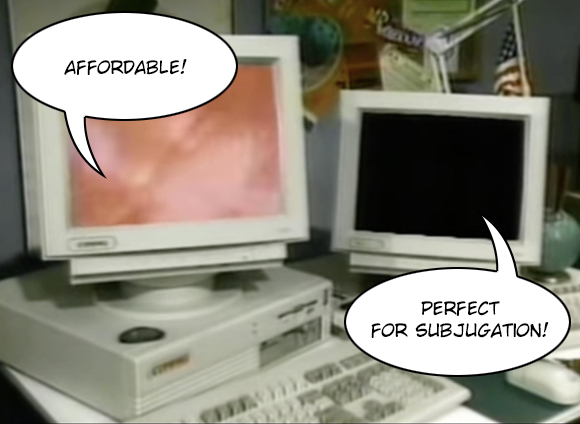
Whenever a character is shown looking at something on a computer screen — which happens a lot — the Compaq logo is prominently visible on the monitor. This seems like a really odd choice for product placement in a show aimed at kids. Was the idea that children would think that Compaq computers had the capabilities to transform them into digital superheroes so they’d beg their parents to buy one rather than a Dell or Gateway?
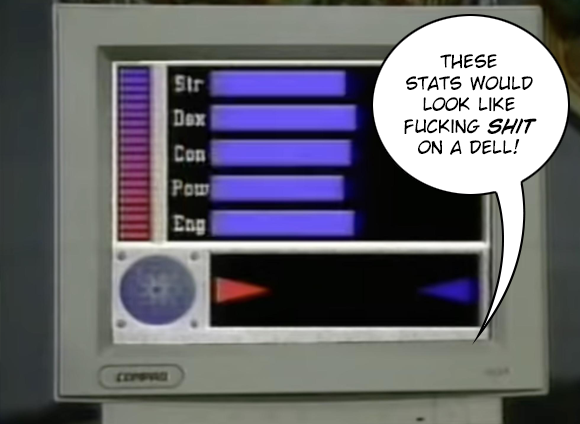
Or was the idea just to establish brand recognition so that when the target audience was grown up and shopping for a home computer, they’d have some flash of recognition, some positive association with Compaq machines they couldn’t explain? Am I overthinking this and the Compaq executives just went to the same strip clubs as the DIC guys and they made a seemingly senseless, coke-addled deal one night? Yes.
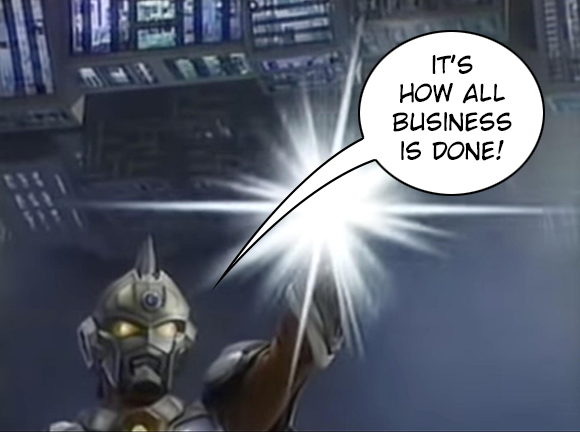
Unlike a lot of similar shows, SSSS is actually pretty close to the Japanese series it draws its action footage from. Gridman the Hyper Agent is also about a bunch of teens who fight virtual monsters with the help of a cyber superhero. In that show, the viruses are also created by a misfit fellow student and brought to life by evil program Khan Digifer. Of course, in the original version Khan Digifer wasn’t played by Tim Curry. Can you imagine? What do the Japanese think of Tim Curry, anyway? Do they think of him as the Copy Machine Wizard because of that time he was in a Xerox commercial?
Unfortunately, Gridman ended with the protagonist dying in its 39th and final episode. That meant that SSSS had to get creative with their material around the same episode mark. After a dramatic finale in which Malcolm turns face and helps save Christmas from Kilokahn (real, that really happened), we got a number of episodes featuring all of the hits of the desperate screenwriter trying to make things work. There’s a mirror universe episode where Malcolm is nice and Jennifer is a nerd! There’s an amnesia episode where everyone forgets who they are! There’s a clip show where it’s revealed that one of the core cast members is an alien who has returned to his home planet!

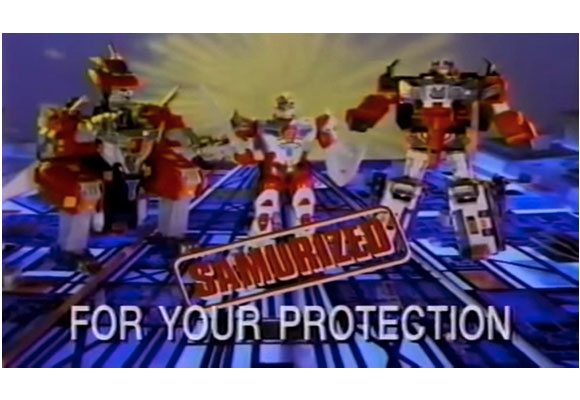
And of course, there were toys. I only ever remember seeing them at the hardware store and they were marketed with the phrase “SAMURIZED FOR YOUR PROTECTION.”
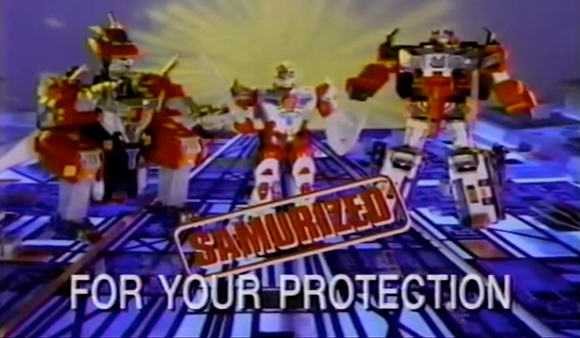
What the fuck does that mean? I would have asked my dad when he was done shopping for screws or whatever, but one time my family went to stay in this cabin out in Atlantic Canada and my sister and I found a wrapper over the toilet that said “sanitized for your protection” and we thought it was the funniest thing in the world, like the toilet had been sealed off to protect us from the horrors within. Anyway he got pretty annoyed at how hyper we got about it and snapped at us, so I wasn’t going to risk bringing up that memory again.
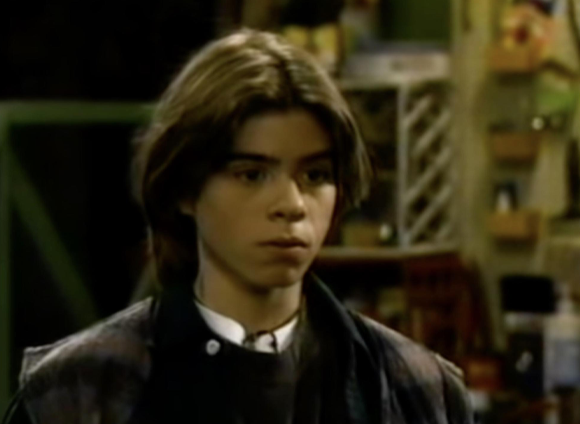
What was I talking about? Oh, right. A show where the kid from Mrs. Doubtfire (not Mara Wilson or the other girl) fights the digital mind creations of a friendless and possibly closeted goth brought to life by Dr. Frank-N-Furter.
I watched a number of episodes of the show to jog my memory for this piece, but I also referred to the Wikipedia article, which is… extensive. Once again, I’ve stumbled onto a subject obsessively remembered by like six people and forgotten entirely by the rest of the planet. To put things in perspective, the Wikipedia article for beloved and accomplished actor and musician Tim Curry is about 4,600 words. The article on legendary German character Faust, which is linked in the plot section of the SSSS article to describe Malcolm Frink’s deal with Kilokahn, is 5,200 words. The article on SSSS is larger than both of those put together, clocking in at over 12,000 words long.
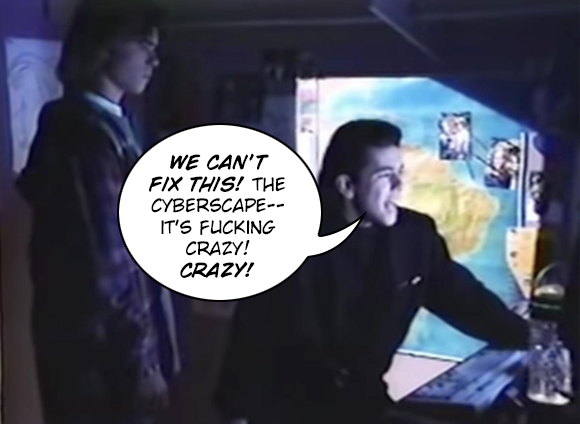
It’s a trite observation at this point that Wikipedia articles on subjects of relative inconsequence — such as ’90s television shows about teenage cyberwarriors fighting mutant diamond dinosaurs inside Compaq computers for the fate of the earth — receive far more attention than those which most people would agree are more critical to the collective store of human knowledge. I don’t care, I’m going to say it anyway. Hideo Kojima was right in Metal Gear Solid 2. The internet was a mistake.

Ironically, that seems to also be the prophetic message of Superhuman Samurai Syber-Squad, a message we failed to heed. And that might be the most interesting thing about Superhuman Samurai Syber-Squad — it accurately predicted how fucking terrible the internet and a world of connected technology would be. Now, if you’ll excuse me, I have some fanfiction to post to Archive of Our Own.


This article was brought to you by our fine sponsor and Hot Dog Supreme: Joshua Graves, lead singer of Daddy’s Damp Stockings, Cleveland’s second best Father’s Wet Pantyhose cover band.
Categories
NERDING DAY

Nerding Day: Rifts 🌭

Back in the early 2000s we didn’t have “actual play podcasts” or Matt Mercer’s soothing voice or a vibrant indie publishing landscape for tabletop games innovating on ways to add knives to fish. If you wanted to play a pen and paper roleplaying game you were basically stuck with whatever you could pilfer from your friend’s nerdy older brother’s pile of Battletech manuals, copies of Wizard, and softcore porno mags. In my case, that game wasn’t Dungeons & Dragons, but a bizarre mash-up of every conceivable genre called Rifts, put out by Palladium Books in the early ’90s.

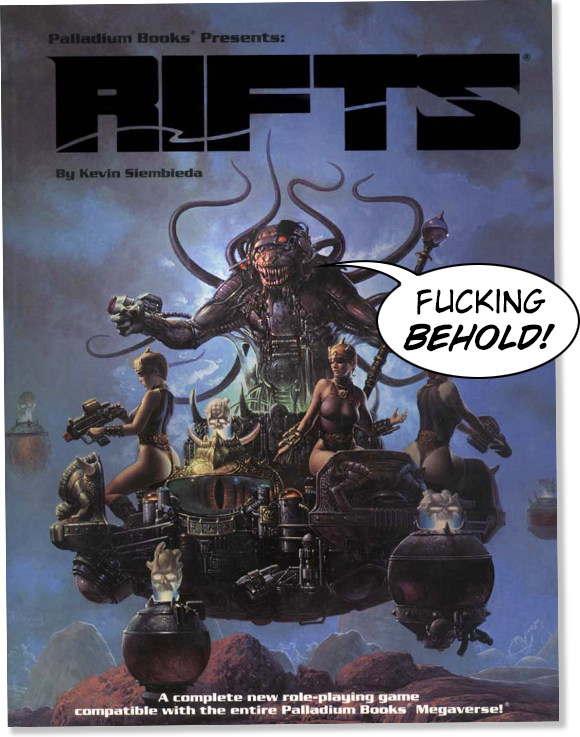
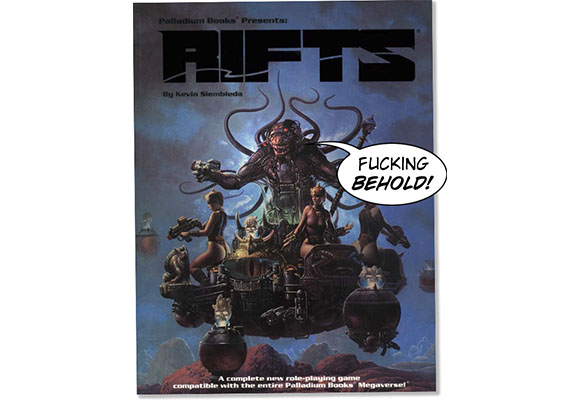
Rifts is set in a post-apocalyptic world where humanity nuked itself to hell and then things got really bad. The simultaneous deaths of billions of people re-energized the magical ley lines crisscrossing the planet, which then started opening the titular rifts to other dimensions, turning earth into an interdimensional crossroads where magic and technology collide. It was kind of similar to cyberpunk games like Shadowrun but had its own unique vibe and immediately became successful despite the comical ineptitude of its creator, Kevin Siembieda. Rifts went on to spawn dozens and dozens of sourcebooks and a few different editions of the core rules, but the first version of the main book is the one that’s the nearest and dearest to my heart. And before we get into what’s inside the book, we have to talk about the cover. The fucking cover! Look at this shit:

Kevin Siembieda, in his infinite wisdom, decided that the single best image to represent his new RPG wasn’t one of the titular rifts (though he did that in a later version), nor any of the iconic player characters from it, but a giant, slobbering tentacle monster whose upper body is totally jacked and whose lower body is a giant party boat upon which several semi-nude women with rockin’ tits brandish sci-fi weaponry. This plainly rules. For the record, neither the Splugorth Slaver nor the Blind Warrior Women, as they were later named, are featured in the core rulebook. This is unrelated art from an unknown van.

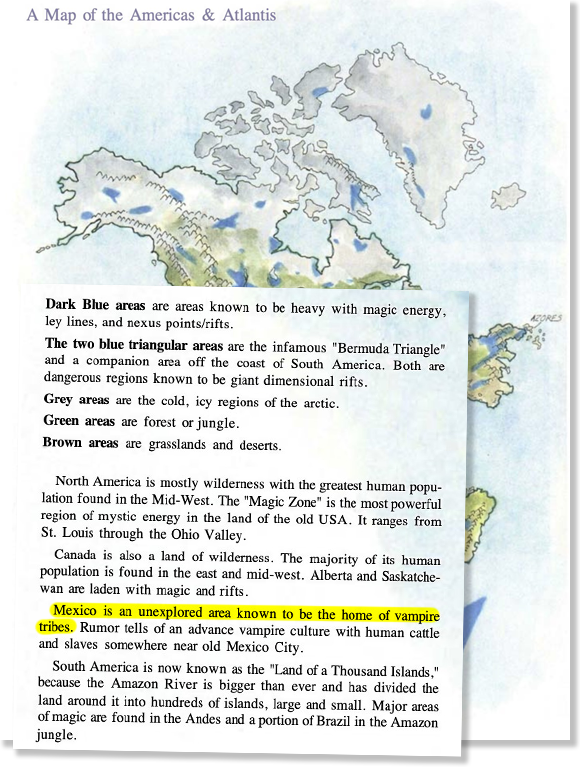
But that’s part of the magic of Rifts! Yes, as we’ll soon see, the game sucked, but it had mystique. Kevin Siembieda would just allude to shit without really explaining it, which is one of the best things a science fiction writer can do. Mexico is full of vampires! Dinosaurs roam the swamps of Florida! In Europe, giant robots are fighting an empire of gargoyles! Atlantis is back and it’s been taken over by interdimensional monsters from its original inhabitants, tattooed wizard people! Every adventure you have in Rifts starts by “yes, and”ing a third grader’s least refined idea.

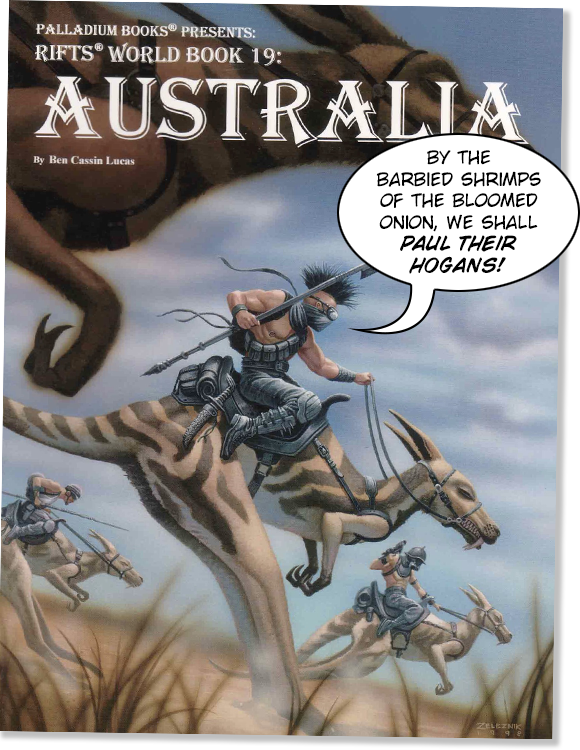
The problem is that keeping any kind of mystery in your fictional world takes restraint, a quality Siembieda is not known for. He would later start filling out every inch of the globe with World Books covering Canada and Germany and Atlantis and Japan and — I’m not kidding here — Quebec specifically, and that’s when the magic started to fade. It didn’t help that he took the laziest and most stereotypical approach possible to every locale Palladium covered. Rifts Canada has demon beavers. Rifts Japan has karate dragon cyborgs. Rifts Australia has Mad Max guys who ride giant mutant kangaroos.

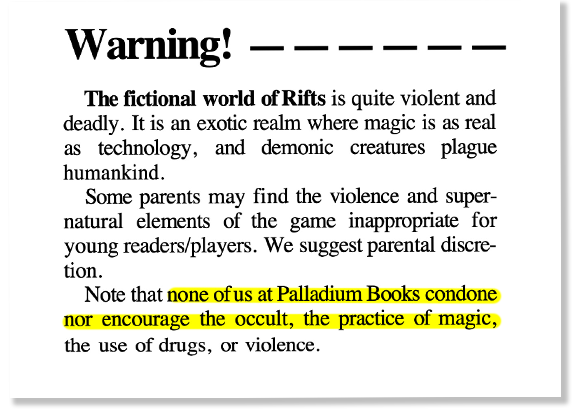
But back to the main Rifts book itself. The first thing you get when you open it is a message found in all of Palladium’s games that was presumably a response to the Satanic Panic associated with Dungeons and Dragons. My favorite thing about it is that it says Palladium doesn’t encourage the practice of magic, implying that magic is real. Their defense is not “Magic isn’t real, Silly.” It’s “All of this works, but we need you to be fucking cool about it.” For God’s sake, readers, do not attempt to cast Summon and Control Rodents, Create Mummy, or Magic Pigeon!

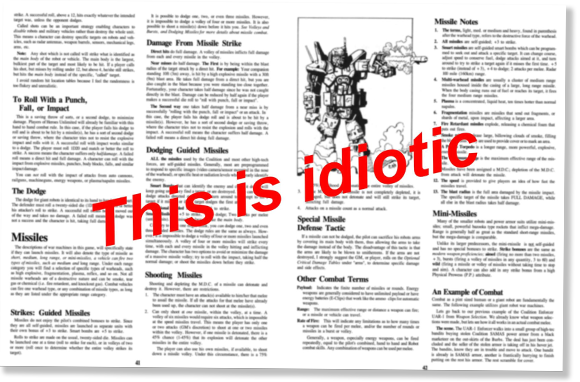
Mechanically, Rifts followed in the footsteps of Palladium’s other games. It’s crunchy, math-heavy, and uses every kind of die that exists. You have piles of stats, skills, gear, and other bullshit and combat regularly takes hours to resolve because of how clunky the system is. It’s truly awful, requiring that you mark down dozens of different penalties and bonuses on your character sheet. There are several pages devoted to the rules for missiles alone.

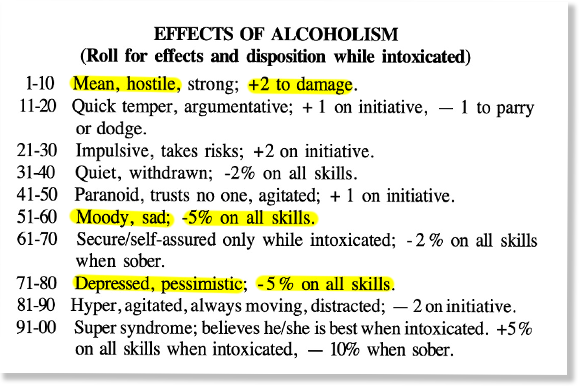
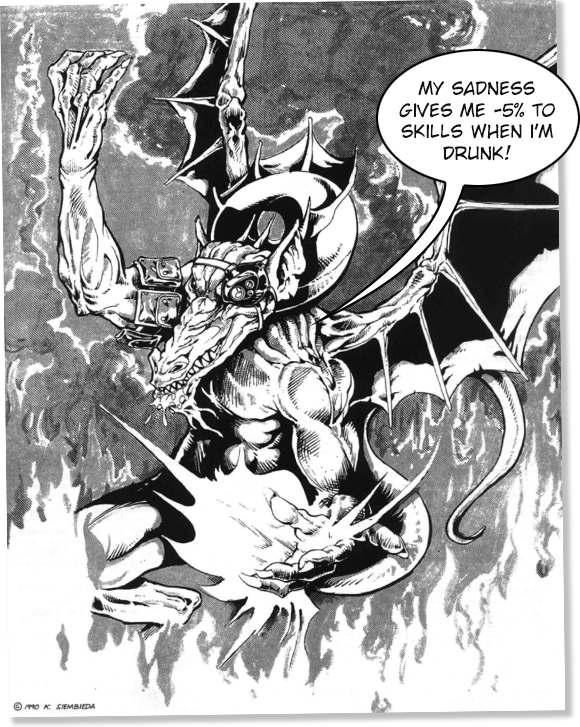
A lot of the material is lifted straight out of their past books, like the insanity system, which is from their Call of Cthulhu-inspired title Beyond the Supernatural. There are also in-depth rules for alcoholism and drug addiction, which are treated with all of the solemnity you would expect from a role-playing game with borderline tentacle porn on the cover.

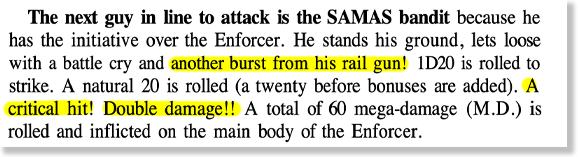
Rifts’s main “innovation” versus Palladium’s other titles was the infamous “Mega Damage.” See, regular damage is cool, right? Like when you shoot a gun or punch someone and they take 1D6 damage? Wrong. You know what’s cool? When you shoot a laser gun and it does 1D6 MEGA DAMAGE! Hell yeah, brother!

Mega Damage was supposed to represent the high technology and strength of magical energy of the Rifts setting. Basically, one point of Mega Damage equals 100 points of regular damage. So if you’re an average human and get hit by even the weakest Mega Damage weapons, you’re toast. This means that every self-respecting Rifts character either walks around in full environmental body armor at all times or else is a dragon, cyborg, or other kind of being who can naturally withstand Mega Damage. It was trying to fix a problem nerds already knew to ignore since Superman first met Green Arrow.

But instead of fixing anything, it immediately raised a lot of extremely stupid questions. What happens if you shoot a Mega Damage laser at the ground? Could you take a Mega Damage weapon to a parallel dimension that doesn’t have advanced technology and rule the world with it? Can a Mega Damage dragon that has shapeshifted into a human being have sex with another human without a fatal accident? Also, is that morally ok to do if they don’t know you’re secretly a fire-breathing tactical commando wizard?

Why did Kevin Siembieda think this was a good idea in the first place? Possibly because Kevin Siembieda had a powerful psychic connection to Rifts’ target audience of 13 year old boys, all of whom thought that anything MEGA was fucking awesome. Naturally, all of this was explained in the most breathless way possible, which brings me to another issue.

There is no elegant way to put this, so here goes: Kevin Siembieda is an absolute fucking slut for exclamation points. If this guy could Scrooge McDuck into a giant vault of exclamation marks that would be his greatest fantasy come true. He sucks and fucks for exclamation marks. Remember that Seinfeld episode where Elaine is dating that guy who doesn’t use exclamation marks? He’s the opposite of that guy. He uses them constantly and to the point that your eyes just start to gloss over them. There are 183 exclamation marks in Rifts. I counted.

What kind of characters can you play in Rifts? Basically fucking anything. You want to be a cyborg? Sure. You want to be a psychic who starts Mega-Damage Capacity fires with their mind? You got it. You want to be a drug-fuelled Batman wearing football pads? Be our guest.

They’re called Juicers, by the way, and they fucking rule. The only problem is that the GM can kill you off with a timeskip whenever he wants because your heart explodes after a few years on da juice.

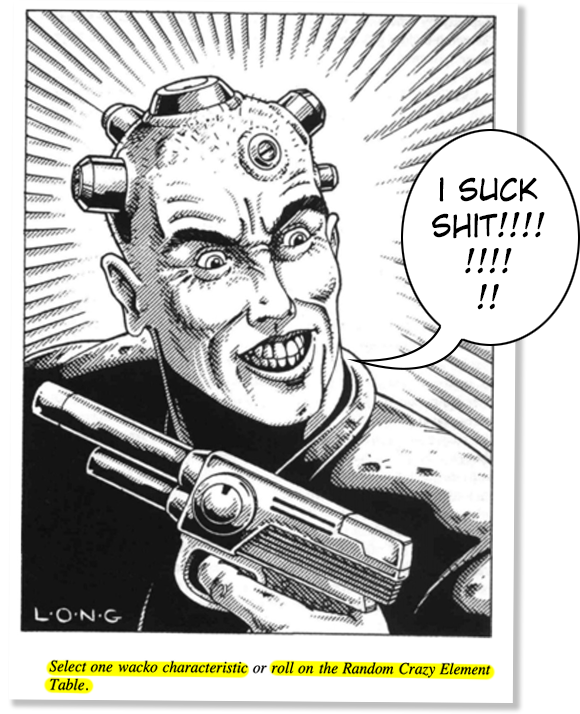
There were a few characters that almost nobody seemed to play in Rifts. For some of them, it was because of the way they were depicted. Like, there’s a class called the Crazy that’s basically a psychic Joker who gets their powers from implants that also gradually melt their brain. It sounds cool, but this is the only piece of art the book gives us.

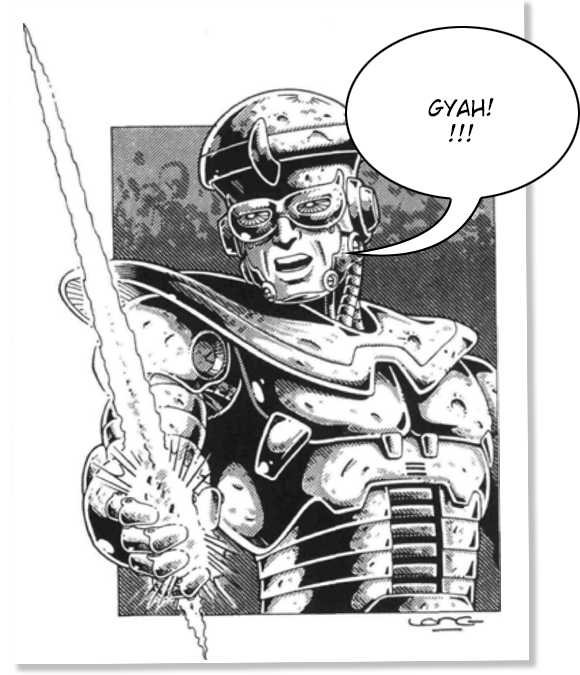
Actually this guy rules. But what if I told you that there was a class called a Cyber-Knight that has cybernetic armor and can summon a psychic energy sword at any time? That’s gotta be great, right? Well, no. It’s fucking stupid.

There are also characters nobody wanted to play because Rifts is a game about kicking as much ass as possible and who the hell wants to be a “Rogue Scholar” or “Wilderness Scout” when you can be a Techno-Wizard or a Mind Melter? There’s also a class called “Vagabond” that’s just a normal guy, and their claim to fame is that they start with a toothbrush and “several pieces of candy,” which nobody else in the game gets.

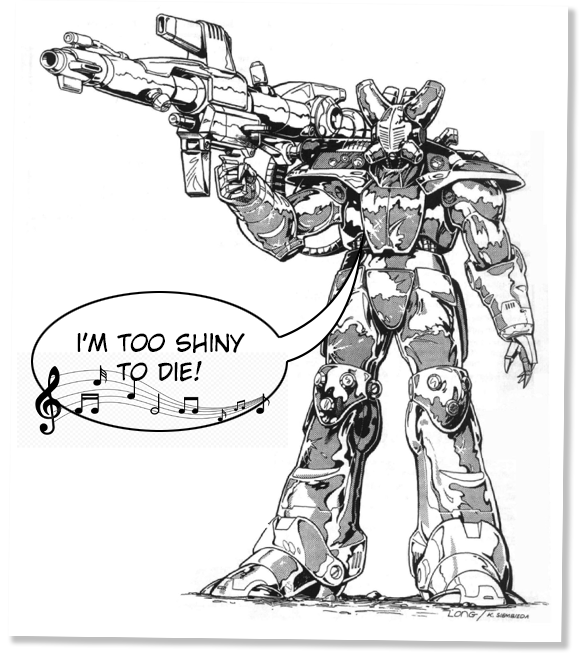
On the flip side, there are some characters that are so powerful that most GMs banned outright. The most common was the Glitter Boy, a name that is used without any trace of irony. It’s a guy who drives around a giant robot that has the single most powerful weapon in the game, and it’s called the Glitter Boy because it has mirrored armor that reflects lasers. It’s absolute 8-year-old boy playfighting logic, and I love it.

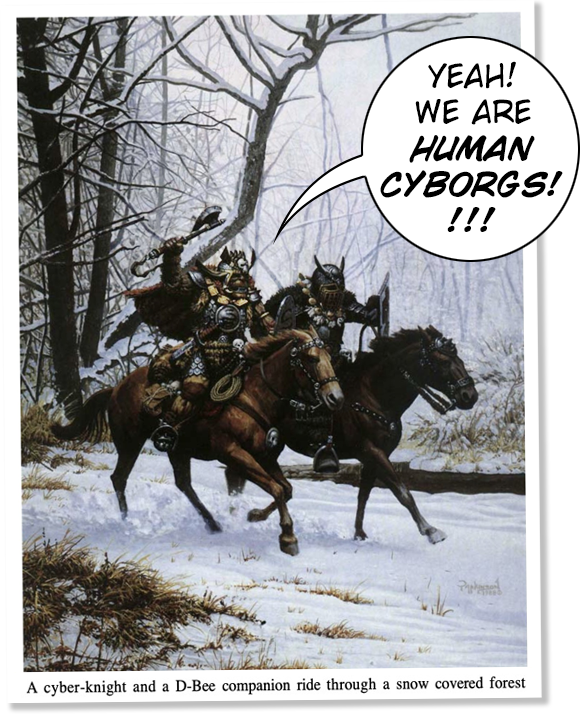
The rest of the book is dedicated to lists of equipment, some details filling out the world, and a few full-color pages, some of which are clearly reproduced from Palladium’s earlier books. Oh, this is a Cyber-Knight and companion? Fuck you, that’s a couple of fantasy orcs.

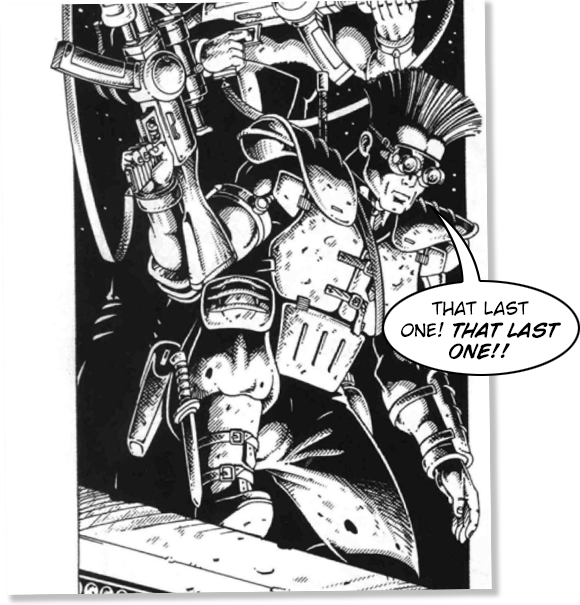
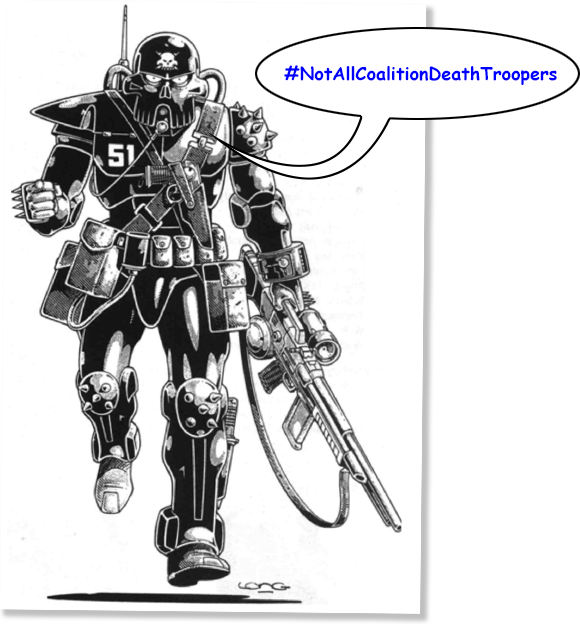
There’s also a lot of space dedicated to detailing the Coalition, the Nazi-esque human supremacist government that rules a big chunk of North America. In a misguided attempt at subtlety, Siembieda repeatedly states that not ALL Coalition soldiers are monsters. But come on, look at these guys. They look like a mean-spirited boardwalk caricature of Nazis, if such a thing were possible.

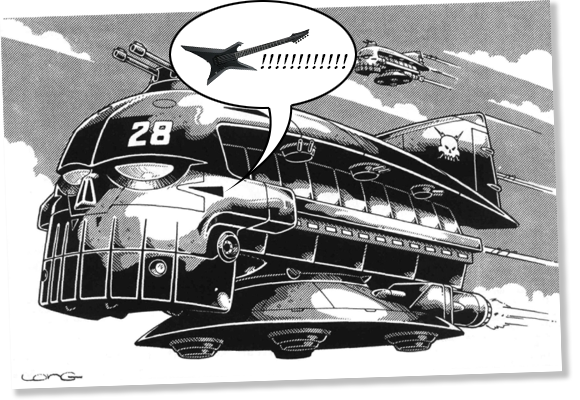
It gets better, though. Behold the Coalition Death’s Head Transport!

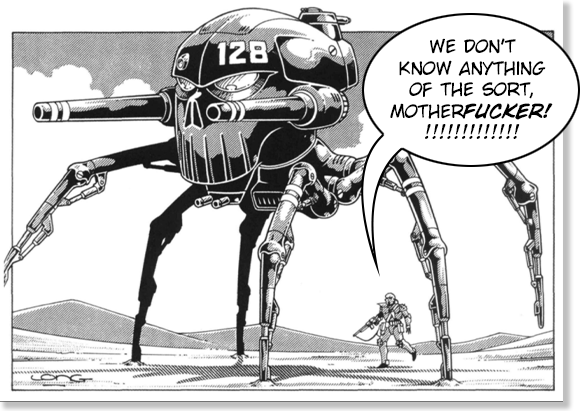
And if you really want to get wild, check out the Coalition Spider-Skull Walker. My favorite thing about it is the Editor’s Note in the first sentence of its description that says “Yes, we know spiders have eight legs.)”

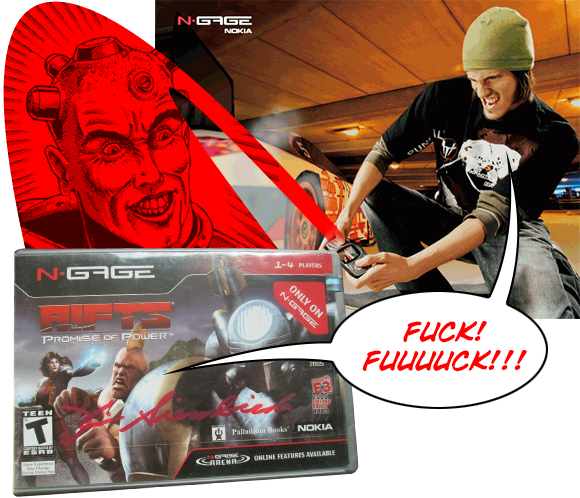
You might be thinking, hey, Rifts has magic, aliens, robots, cyborgs, steroid-enhanced maniacs — this would make a great video game! Well, as it turns out there actually was a Rifts video game. On the Nokia N-Gage. Yes, the platform that made sidetalking a reality also played host to a Rifts RPG. God, do people remember sidetalking? Does anyone even remember the N-Gage? I can’t believe that 2005 was nearly 20 years ago. Fuck, I’m going to age and die just like everyone else!

Anyway, Rifts on the N-Gage is apparently not bad, but nobody actually played it because it was on the N-Gage.

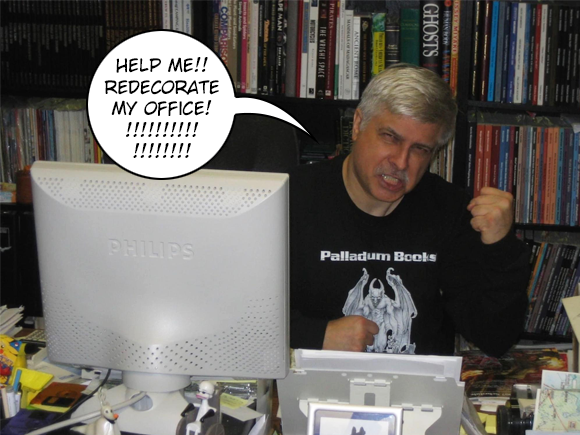
Sadly, Kevin Siembieda’s troubles did not end with betting on the wrong horse for his video game. By all accounts, the man is something of a control freak and bad manager. This all culminated in what he called the “Crisis of Treachery,” which was Siembieda-speak for Palladium being in dire financial straits due to a series of poor decisions on top of alleged theft and embezzlement which he claimed totaled around a million dollars. A former sales manager eventually took a plea bargain for theft from the company and was ordered to pay about fifty grand in restitution. What’s weird, though, is that the theft apparently wasn’t detected until years after the fact, because what was stolen wasn’t regular inventory but random geek memorabilia that Siembieda had left around the office.

To recoup his losses, Siembieda sold signed prints and urged fans to buy books directly through their online store. If it weren’t done by a self-aggrandizing maniac who was essentially emotionally blackmailing his audience over the theft of his Kenner Star Wars figures, this would almost be touching.

Today, Palladium Books is inexplicably still around. They were last in the news when they launched a Kickstarter for a game based on the Robotech anime license, which raised nearly $1.5 million but failed to deliver rewards to a number of backers. Palladium eventually lost the Robotech license in 2018. When even a company like Harmony Gold doesn’t want to work with you, you have incontrovertibly fucked up.

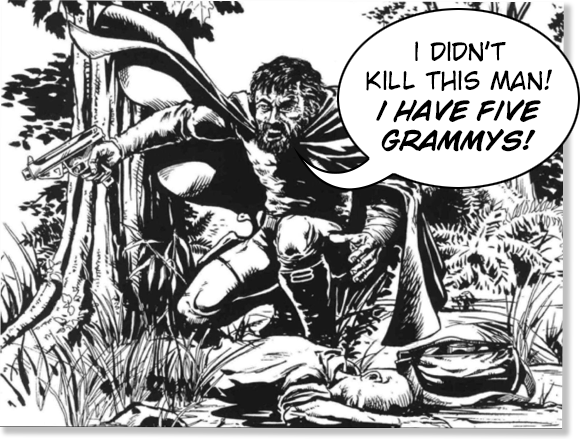
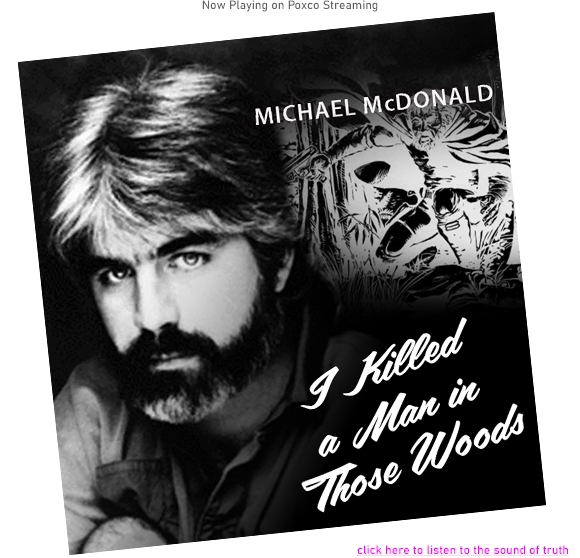
The legacy of Rifts is mainly one of mockery and derision, and maybe I’ve only contributed to that with this piece. It was nearly impossible to play, had the world-building of a kid smashing action figures together, and was badly written. In the modern RPG landscape there are hundreds of better-designed games to choose from. Still, while Rifts was an absolute mess and Kevin Siembieda is at best a bad businessman and at worst an egotistical maniac who alienated nearly all of his collaborators and fans, he did give us this drawing of wildman Michael McDonald running through the post-apocalyptic wilderness with a laser pistol.


This article was brought to you by our fine sponsor and Hot Dog Supreme: David Shull, who multi-classes as a Dark Samurai Paul Hogan Laser Mech.

Categories
NERDING DAY

Nerding Day: Sky Dancers and Dragon Flyz 🌭

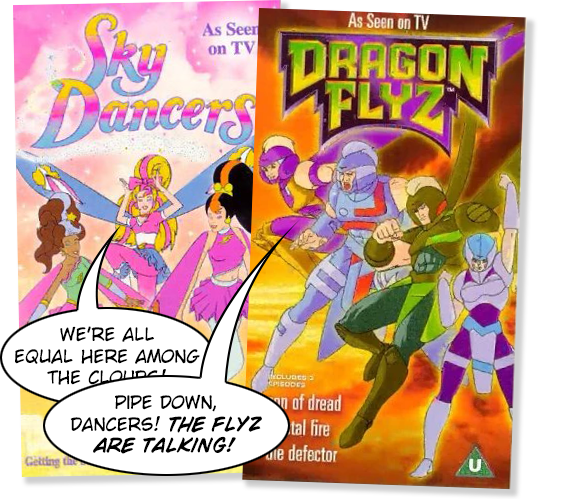
In the 1990s, gender roles in American toys were much more rigid and inflexible than they are today. With few exceptions — board games, Slip ‘n’ Slides, misplaced handguns — there were Girls Toys and Boys Toys, and never the twain should meet. Girls played with Barbies, The Littlest Pet Shop, and all things fluorescent pink. Boys played with Transformers, NERF guns, and all things gross and grimy. This presented a problem for the enterprising toy merchant: your product would likely only ever target half of all children. Unless, that is, some beautiful genius found a way to market the same gimmick to both girls and boys. And folks, our friends at Galoob and Abrams/Gentile Entertainment — yes, the Van-Pires people — did just that.

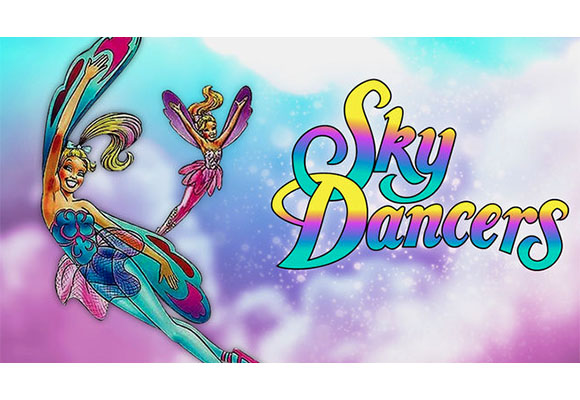
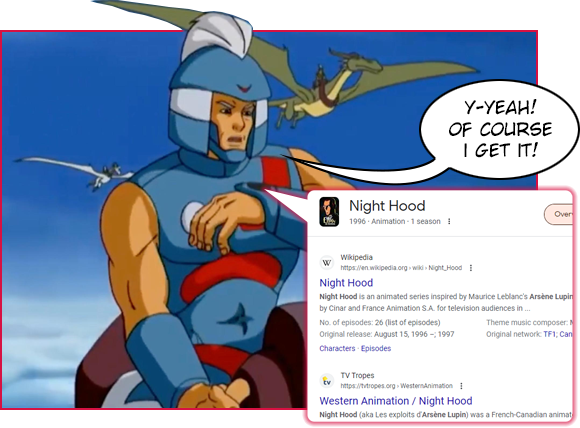
Like you knew at first glance, Sky Dancers and Dragon Flyz were toy lines advertising cartoons and vice versa. Sky Dancers — the girl version — premiered first, with the toys launching in 1994. Dragon Flyz, the flying Toys For Boys, came in 1995. Both toy lines got animated series in 1996, courtesy of AGE and the Gaumont Film Company, meaning they have that particular French cartoon look of the 90s. You know what I’m talking about, right? Like Sherlock Holmes in the 22nd Century or Night Hood, the show that’s best known as “the other animated series based on the Arsène Lupin books.”

The concept of selling two different gendered versions of the same gimmick to boys and girls didn’t start with Sky Dancers and Dragon Flyz, of course. Polly Pocket was invented in 1989, and Mighty Max — the boy version — was introduced in 1992. But the fact that Sky Dancers and Dragon Flyz were two separate product lines might be the single strongest piece of evidence for how deranged the ’90s were about gender. I mean, we’re talking about toys that fly. They could have made them Disney-esque cartoon characters, or hell, just birds! Who doesn’t love birds? Even in the ’90s, birds transcended gender.

But for reasons best known to the amphetamine-snorting marketing execs of that decade, instead of something like that we instead got two paradigmatic toy/cartoon lines, one about dancing and friendship and beauty for girls and another about fighting and dragons for boys.

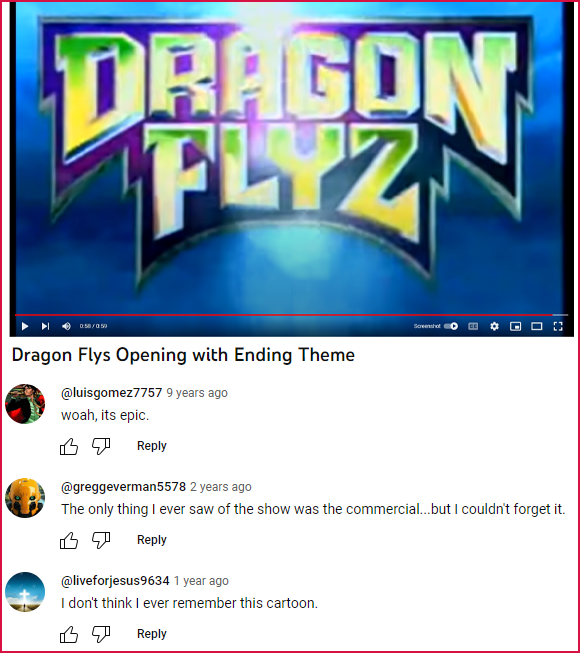
Of course, “birds” probably wouldn’t be as compelling as two separate shows about men and women with helicopter necks. Both Dragon Flyz and Sky Dancers got 26 episode runs, which is far more than either of them deserved. Is anyone nostalgic for these shows? Well, if the YouTube comments are any indication, then yes. God, if you ever want to get really depressed, browse the YouTube comments on old cartoons or commercials. My generation’s brains have been permanently damaged by the deregulation of children’s television in the ’80s.

Anyway, Dragon Flyz inexplicably opens with a siren, followed by a nuclear bomb going off and destroying a major metropolis. I’m sure I didn’t see this as a kid, because it would have seared itself into my memory. It’s as close as you could get to doing the nuclear bomb scene from Threads in an opening to a ’90s kid’s show. (Warning: do not look this up.)

Immediately after the city has been reduced to ruins, we go into a montage of dudes with wings flying around, riding on dragons, fighting guys, and so on. It makes a decent try at rad, but Skeleton Warriors this emphatically is not. Its opening theme song doesn’t even have lyrics. If a cartoon hasn’t shrieked its name forever into every corner of your mind by the time it’s started, it did something wrong.

Apparently, there was a “great cataclysm” in the 40th century, scouring most of humanity from the face of the Earth. To escape this unpleasant state of affairs, humans somehow tamed dragons — which I guess existed? — and fled to the skies, where they built a giant hot air balloon city called Airlandis after the worst possible name for a helicopter tour company.

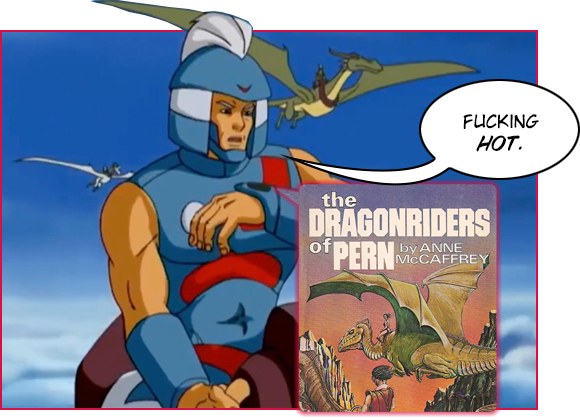
Meanwhile, the polluted surface is ruled by “Dreadwing,” (played by Jonathan Davis, who also voiced Tracula in Van-Pires) a sort of dragon man who also rides dragons. Fucking everybody rides dragons in this show, that’s the whole bit. It probably would have been called “Dragon Riders” if AGE’s lawyers didn’t think it would get them sued by Anne McCaffrey.

The Dragonators (aviators + dragons, natch) spend their time flying around looking for Amber, a resource found on the surface that they need to power their floating city, and fighting Dreadwing and his ridiculous minions. It’s pretty typical ’90s cartoon fare, with not a whole lot to recommend it. But there are a couple of fun storylines throughout the 26 episode run, like when Dreadwing finds a bunch of pre-Cataclysm ballistic missiles and tries to use them to wipe out humanity, or when Dreadwing puts the Dragonators on trial for crimes against mutantkind. On the whole, though, it’s pretty boring. Dragon Flyz isn’t the kind of show you’d rush home to watch after school — it’s the kind you’d see on a summer afternoon when it was too hot to go out and there was nothing else to do, and even then you’d probably rather page through some old Garfield books or find a second misplaced handgun.

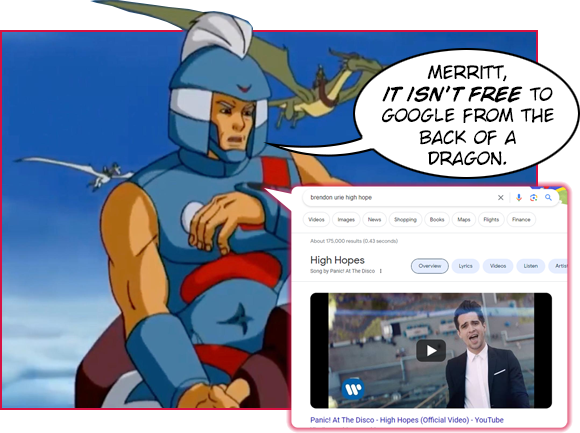
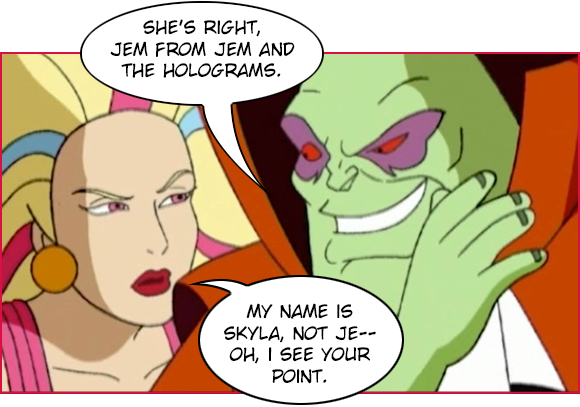
Sadly, the Sky Dancers cartoon does not take place in a shared universe with Dragon Flyz. How sick would that be, though? If it was about humans trying to preserve pre-collapse knowledge through dance? Instead, the show follows students at the High Hope Dance Academy (no relation to Brendon Urie) as they and Queen Skyla defend the “Wingdom” from Skyla’s jealous brother-in-law, “Sky Clone.”

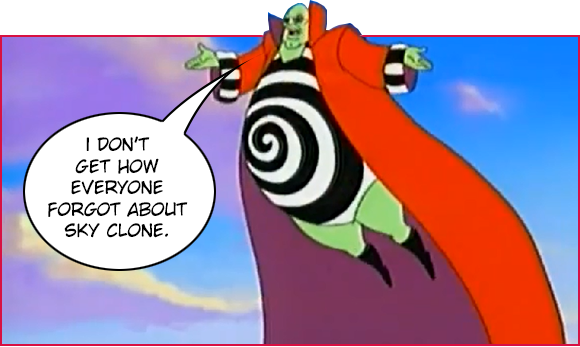
Here I feel the need to point out that “Sky Clone” is not a clone, it’s just an awkward half-pun based on Cyclone I guess, but that’s already an air thing! It’s the kind of totally unnecessary wordplay we’ve come to expect from a Abrams/Gentile production, though. Remember, these are the people who named a character “Van He’ll Sing.” Then again, they also gave us a car vampire named “Tracula” with a son named “Alucart,” so I guess it’s not all bad. Just mostly bad. Like 99% bad.

In the first episode of Sky Dancers, Skyla reveals to her students at dance school that she is the Queen of an invisible cloud kingdom and trauma dumps on them about her dead husband. She then enlists these kids to fight against Sky Clone, because her kingdom is apparently populated exclusively by people less useful in a fight than random dance academy students. And so, Skyla empowers her diverse group of pupils with the ability to fly along with an assortment of other superpowers. One of them gets cloud magic, another gets control over time, and of course they gave the Native American kid power over “wind, rain, and magic.” It’s kind of like Captain Planet only with dancing instead of environmentalism, and the kids are defending a tiny, alien kingdom full of pacifist fairies instead of their own planet. So I guess it’s not really anything like Captain Planet at all, which is sort of what I’m saying: no matter how uniquely insane the show gets, it never manages to feel like anything other than a bad knockoff.
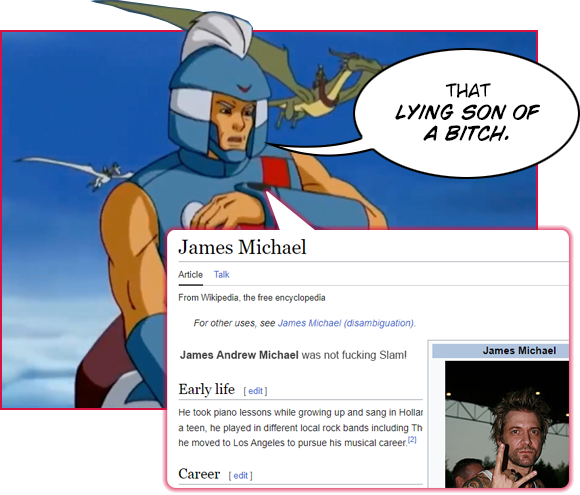
Despite always feeling like a bad imitation of something, there’s definitely more meat on the metaphorical bone in Sky Dancers than Dragon Flyz. The boys got their 27th show about fighting while girls got a superhero dance school in the clouds. Unfortunately, they really cheaped out on the animation, a fact made extremely obvious by how it’s supposed to be a show about dancing, the thing they almost always decided was too expensive to draw. Plus, most storylines again boil down to protecting a magic glowing rock. One of the Sky Dancers, “Slam,” is voiced by James Michael, the lead singer of Nikki Sixx’s side project Sixx:A.M, whose Wikipedia page strangely doesn’t mention this.

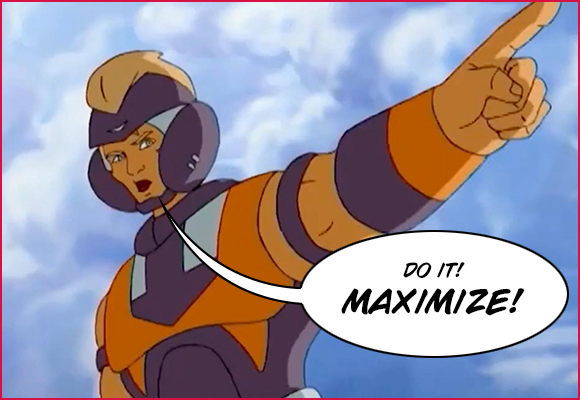
Oh, and remember how Dragon Flyz doesn’t have an opening theme with lyrics? Well, Sky Dancers has THREE, presumably because girls like music more than boys. Also, while Dragon Flyz only had a generic instrumental for its opening, I should note that it did have lyrics for its end credits, and they are fucking incredible. You need to listen to them in their entirety, but let me just break off a little piece of flavor for you: the song opens with a man soulfully intoning “In the future all of us shall know / Men once walked upon the Earth below / And now we fly at mega height / Long live Airlandis, Flight is might!” Incidentally, “flight is might” is one of the Dragonators’ catch phrases. The other one, which also features in and appears to be the title of the song, is simply “Maximize!” Sure.

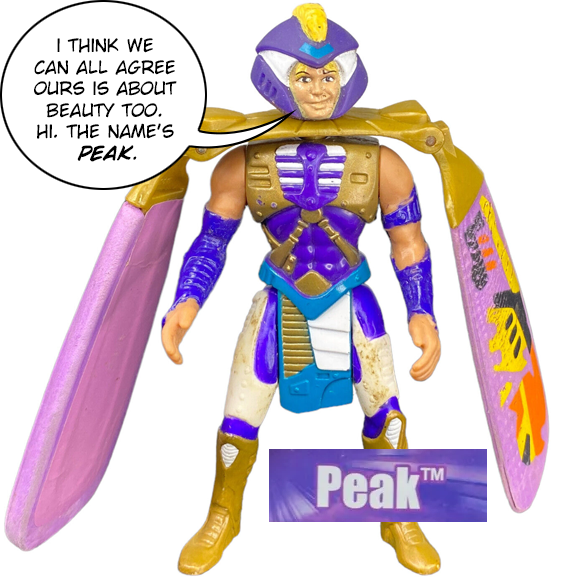
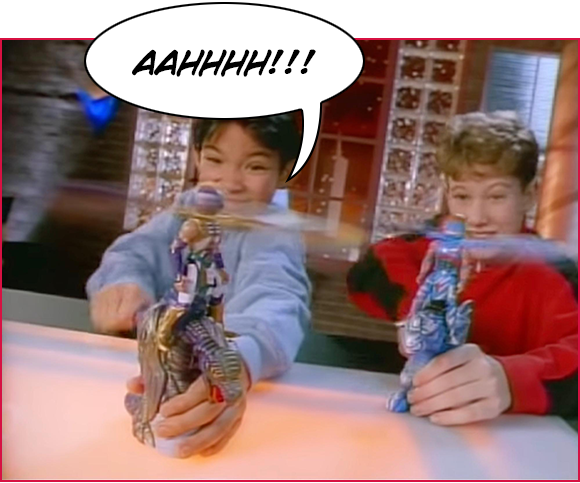
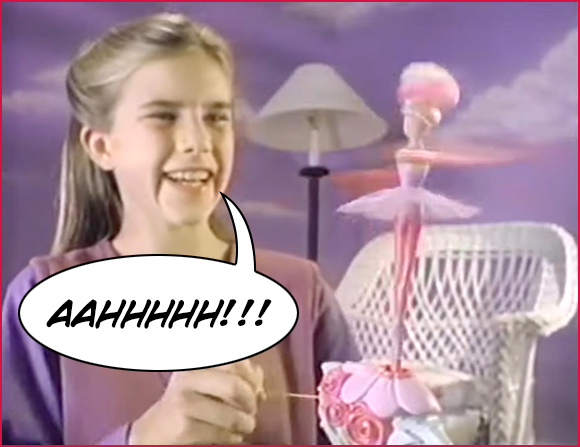
So the shows were nothing special, almost aggressively nothing special, but the toys definitely stood out on store shelves. Dragon Flyz and Sky Dancers are functionally identical, differing only in their theming. They consisted of characters modeled with wings which sit atop launcher bases — though the Sky Dancers look a lot more natural, en pointe on swans and pods of dolphins, whereas Dragon Flyz awkwardly straddle their dragon mounts like they stole them from He-Man.

The launchers have a ripcord attached, which, when pulled, fires the character into the air. They then spiral through the air before landing softly on the ground. Again, the Sky Dancers look a lot more elegant — their wings are attached to their arms, allowing their entire bodies to spin. Conversely, the Dragon Flyz have their wings awkwardly sandwiched between their heads and their bodies, so when they’re launched it’s just their heads that whirl around.

It’s a neat idea for a toy, and it was evidently pretty successful for a while. They made tons of these things throughout the late 90s, with a couple of different Dragon Flyz lines and dozens of Sky Dancers. There were mini-Sky Dancers, Sky Dancers Happy Meal toys, even horrific animal-human Sky Dancers hybrids.

There’s an obvious problem here, aside from each horse Sky Dancer harboring an actual demon: in the hands of children, Sky Dancers and Dragon Flyz were effectively miniature weapons platforms.

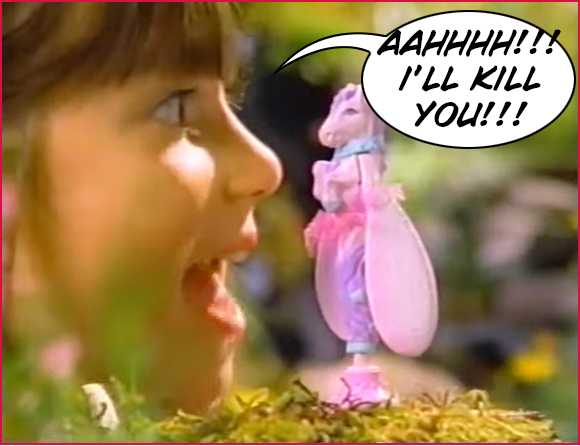
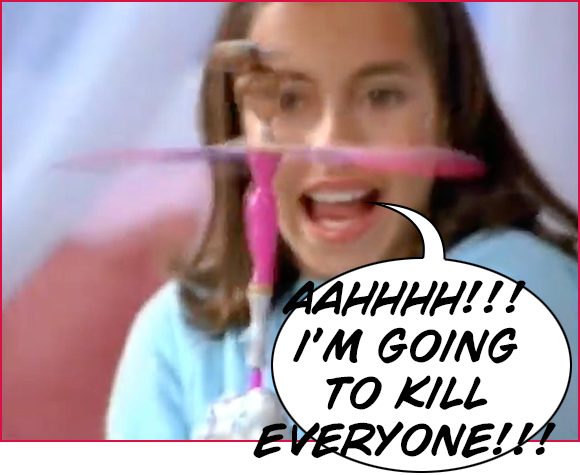
In 2000, the US Consumer Product Safety Commission and Galoob Toys announced a recall of Sky Dancers after 150 reports of injuries. The injuries included scratched corneas and temporary blindness, broken teeth, a “mild concussion,” a broken rib, and “facial lacerations that required stitches.” Thankfully, neither me nor my sister was ever injured to such a degree by these ballistic ballerinas, but I do recall at least one incident where our Sky Dancers were taken away from us after we enlisted them in a sibling civil war.

As for Galoob, they settled with the CPSC for $400,000, denying they had violated the Consumer Product Safety Act. Oddly, I can’t find any information about a similar recall of Dragon Flyz. Maybe Dragon Flyz weren’t on store shelves long enough to trigger a recall, or maybe they were more safely designed. Or maybe — conspiracy time — parents and the CPSC simply expected boy toys to hurt people, while the same injuries from flying ballerinas were seen as surprising and unacceptable. Here’s what I’m saying: it’s sexism that girls weren’t allowed to cause temporary blindness and mild concussions with Sky Dancers.

Dragon Flyz crashed and burned, but Sky Dancers were retooled and put back on the market in the 2000s. There was a game based partly on the show for the Game Boy Advance in 2005, nearly a decade after the show came out, which seems weird until you realize there was a game based on Gumby for the handheld in the same year. Seriously, think of a children’s TV series and there’s almost definitely a shitty platformer based on it for the GBA.

Like it was for a lot of things, the sad GBA game was the last gasp of the franchise. And so, until such time as the Hollywood IP milking machine sees fit to make a live action Sky Dancers/Dragon Flyz cinematic universe, we say goodbye to our winged friends. We will always remember them as the toy line that somehow caused more documented injuries (among girls) than Snailiens.


This article was brought to you by our fine sponsor and Hot Dog Supreme: John McCammon, who is innocent in the rotary blinding of 76 curious, stupid children until proven guilty.

Categories
NERDING DAY

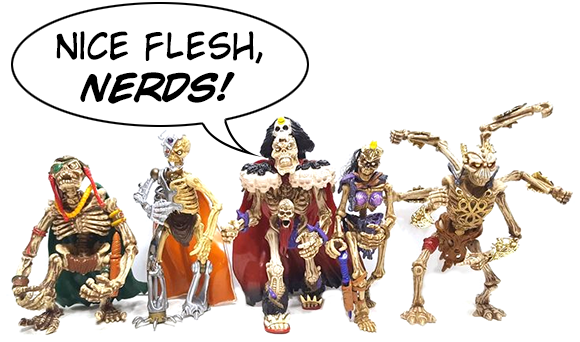
Nerding Day: Skeleton Warriors 🌭

The ’90s were, as you know, the most extreme decade of all time. The day-glo colors and hair metal of the ’80s pupated and metamorphosed into in-your-face, gross-out, over-the-top action, giving us the ascendance of Nickelodeon, Power Rangers, and the X-Games. So what do you get when an experienced producer and the director of the Masters of the Universe movie launches a new transmedia franchise squarely in the middle of the ’90s? You get Skeleton Warriors, a property about evil, animate bone monsters and the milquetoast fleshy heroes who oppose them.

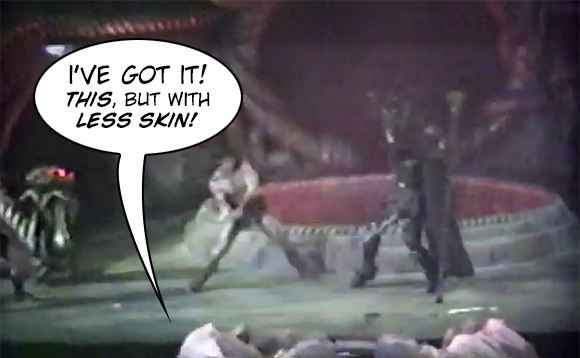
Created by industry veteran Gary Goddard, Skeleton Warriors launched in 1994, with the toys coming out a little before the 13-episode TV series. According to some sources, Goddard claims that he was inspired by the Conan the Barbarian live show at Universal Studios, in which the titular beefcake does battle with skeleton warriors. Hm, Goddard must have thought, skeleton… warriors… that gives me an idea!

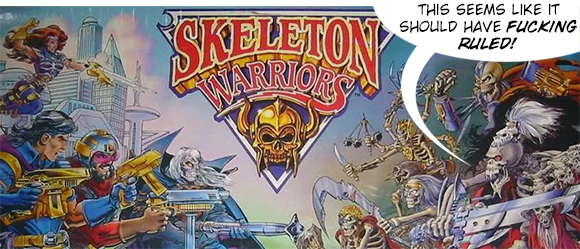
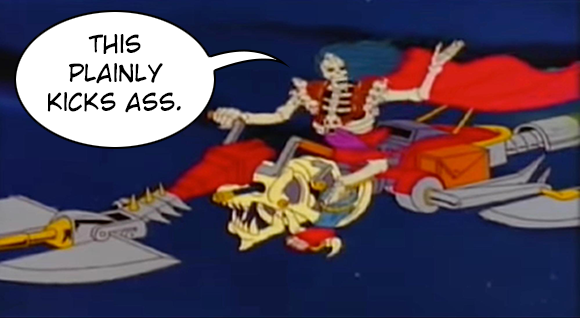
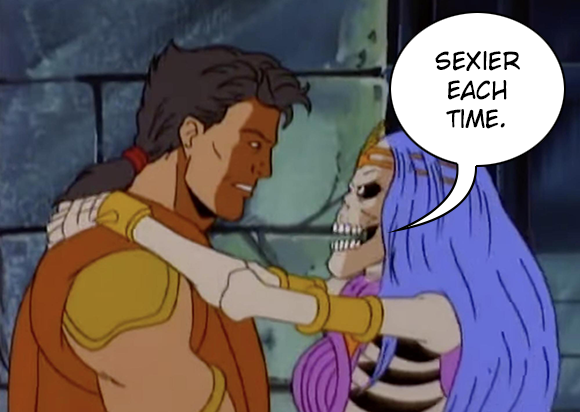
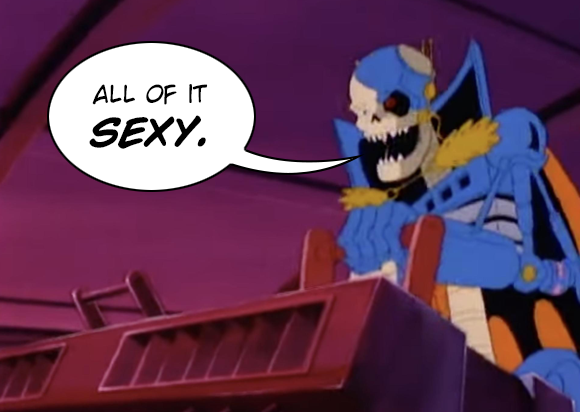
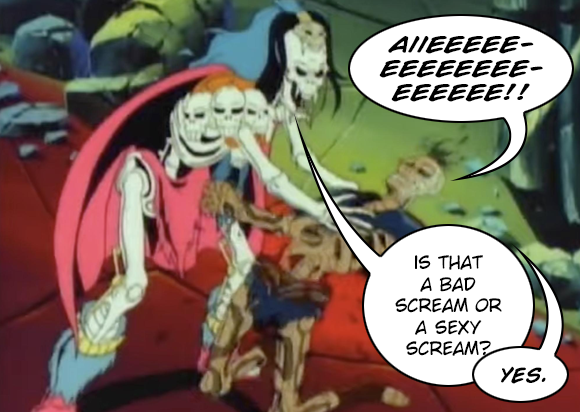
Like the previously-discussed Van-Pires, Skeleton Warriors is named after its antagonists rather than its heroes. Unlike Van-Pires, its antagonists aren’t lame gas guzzlers but fucking cool demonic skeletons who look like the ancestors of Da Share Z0ne. The property started with the toys, developed as a line of skeletal abominations that stood out amongst the GI Joes and other standard fare of the time. And seriously, these guys looked sick.

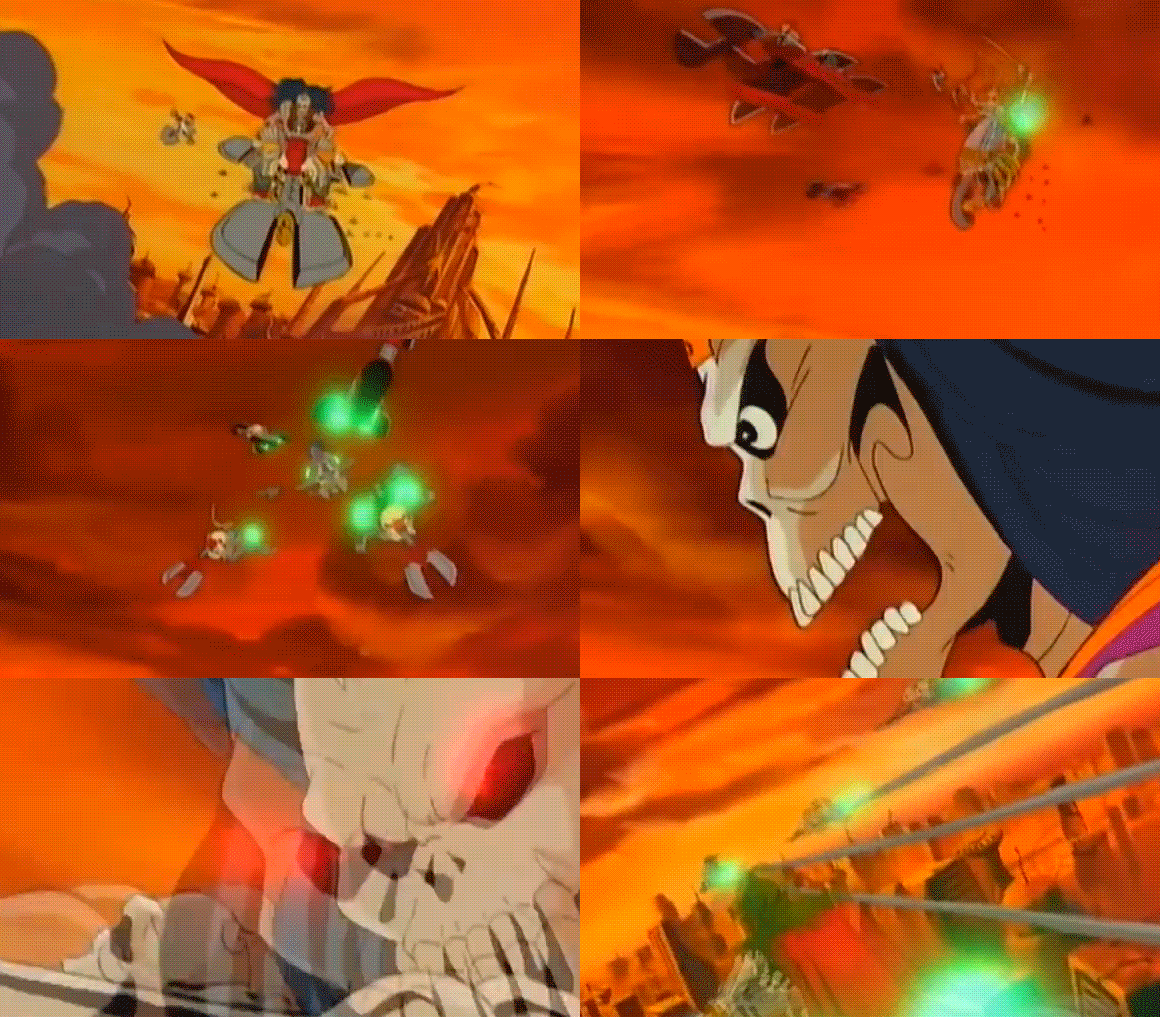
It wouldn’t be a ’90s kids property if there wasn’t a cartoon to bolster toy sales, and Skeleton Warriors received a 13-episode run depicting an epic battle between good (which is dumb) and evil (which is skeletons). There is nothing about its intro that isn’t completely sweet:

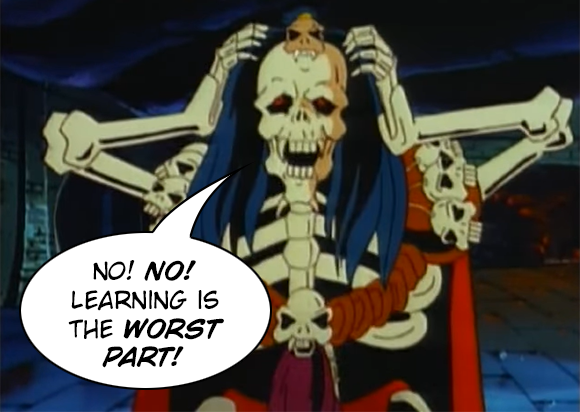
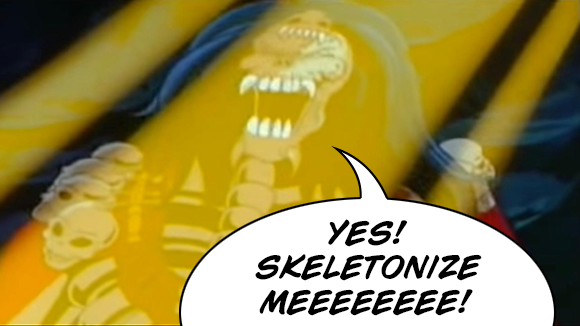
The show opens with a giant golden CGI skull talking directly into your face, which would be badass enough, but the skull is also voiced by Tony fucking Jay. Having your cartoon open with the voice of Megabyte from ReBoot and the Elder God from The Legacy of Kain games spitting vague exposition about the nature of good and evil at the viewer is a gutsy move, and if anything it sets the bar a little too high. It kind of makes you wish the whole show was just a CGI Tony Jay skull ruminating about the balance between light and dark. Sadly, the skull dips out for most of each episode and only reappears at the end, to offer some kind of summation of what we’ve learned.

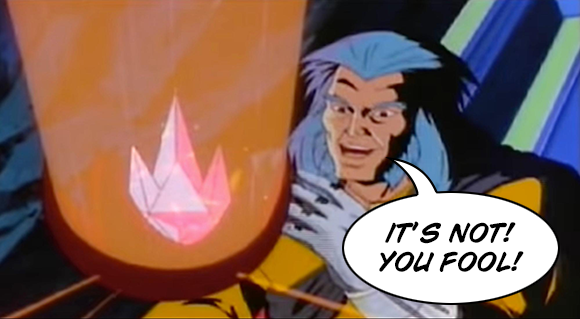
When Skeleton Warriors begins, we learn that the king of Luminicity has disappeared on an expedition, leaving eldest son Prince Justin in charge. His younger brother, Joshua, is pretty ticked off about this. In his frustration, he turns to a guy named Baron Dark, who ropes him into a plan to gain access to the Lightstar Crystal in the castle that powers the city. Really, Josh? This makes Joshua seem like a pretty gullible asshole, but to be fair to him, this is a fantasy world. Maybe dudes are named stuff like Baron Dark or Duke Crime all the time. Maybe it’s normal to be called Baron Dark in the Skeleton Warriors world.

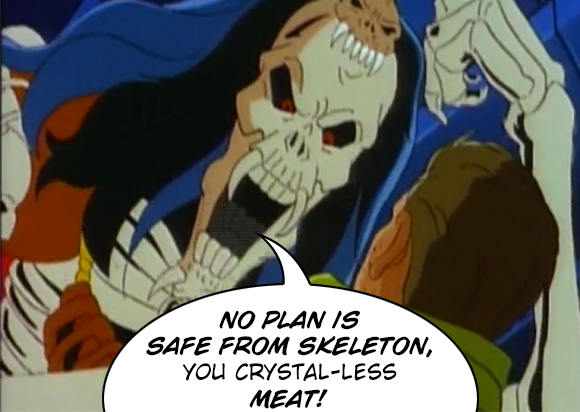
Anyway, Baron Dark betrays Joshua because of fucking course he does. He tries to steal the crystal for himself, but it splits into two in the process. The Baron’s half turns him into a living skeleton monster, while the other half empowers Justin, Joshua, and their sister Jennifer. Each of the three gains unique powers, while the Baron becomes basically immortal and able to turn those with darkness in their hearts into unkillable skeletons like him in a process the show straightfacedly calls “skeletonizing.”

He immediately transforms his goons into a boney band of evildoers and lays siege to the city, which is already in pretty bad shape thanks to the loss of the Lightstar Crystal, which was apparently powering their entire civilization. No contingency plans for us, our easily-accessed magic crystal will keep us going forever! The party’s never going to end!

The three royal siblings flee to their uncle’s place, where he gives them all cool new nicknames and — oddly — skeleton-themed outfits. This always struck me as kind of strange, even as a kid. If you’re fighting skeletons, why are you dressing up in gear with skulls and bones all over them? Like, are you trying to reclaim skeletons from the living bone monsters who want to exterminate humanity? I guess we’ve all got skeletons inside of us, so maybe there’s something to that.

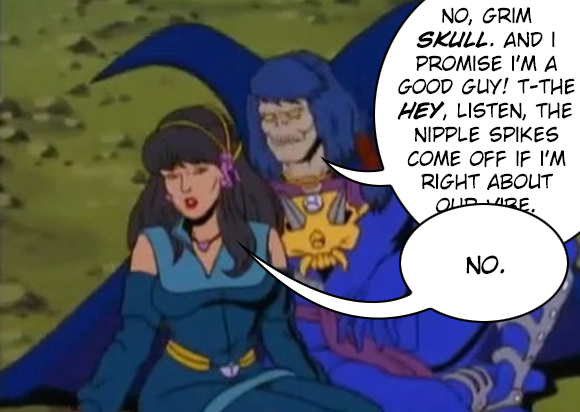
Justin is dubbed Lightstar, with the power to shoot energy beams from his hands. Jennifer, who has gained the power of flight, becomes known as Talyn. And Joshua, who can teleport from shadow to shadow and also has a fucked up zombie face because the Lightstar Crystal apparently detected that he was kind of a dick, receives the moniker of “Grimskull.”

Hey, “Grimskull” sounds kind of like Grayskull from He-Man, doesn’t it? Weird. Probably nothing.

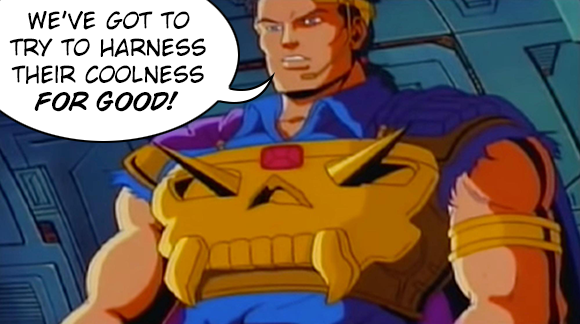
With their uncle, who Justin decides to call “Guardian,” the three royal siblings form the Legion of Light. Together, they fight back against the Skeleton Warriors in a series of battles that involve a lot more hovercycles than you might expect. Seriously, a huge part of Skeleton Warriors is people flying hovercycles around or getting into hovercycle crashes. Again, it was the ’90s, the decade that brought us Renegade, so you can’t be too surprised that they took one of the most x-treme forms of transportation and found a way to make them even more In Your Face and To The Max.

The Skeleton Warriors cartoon is actually pretty good for what it is. Most episodes revolve around the heroes desperately struggling to gain an advantage against their unkillable adversaries while also dealing with internal strife within their ranks. One episode features the people of Luminicity wanting to execute Grimskull for his role in, you know, ruining their entire society. Another depicts the trauma of a normal man who faced the Skeleton Warriors in battle and later became one, the cowardice in his heart enough for Baron Dark to make him into one of his deathless minions.

Having your villains be essentially indestructible, able to reform themselves after each defeat, was a pretty good call narratively. It sidesteps the need for faceless rank-and-file goons like Power Rangers’ Putties, since the heroes can blow the named skeleton warriors to pieces and they can just keep coming back.

And Baron Dark’s crew has some real choice weirdos, too. There’s Shriek, the token evil lady who maintains her crush on Lightstar even post-skeletonization; Doctor Cyborn, who I was disappointed to realize is not called, as I thought, “Doctor Cyborg”; and Aracula, a man-spider who we later learn is a member of a whole race of man-spiders who hate humans. There’s a lot going on in the Skeleton Warriors world.

Midway through the series, the Legion of Light learns that they can de-skeletonize people. Some are glad to be freed of Baron Dark’s control, but his core minions, when reverted to flesh and blood, crave a return to their skinless state. And why shouldn’t they? They have skeleton parties where they dance and feast — whether they get anything out of the latter act or if it is merely a grim parody of life is left to the viewers’ imagination. Skeleton Warriors really wants you to know that while being magically stripped of your skin and organs is agony, being an evil skeleton freed from both flesh and the limitations of human morality feels fucking great. And must we not endure pain to taste true pleasure?

The whole thing is brought to life by some solid voice acting, too: Jennifer Hale (Commander Shepard from Mass Effect) is Talyn, Jeff Bennett (Dexter’s Laboratory, Gargoyles) is Lightstar, and Philip L. Clarke (Doom 3) is Baron Dark. You kind of wish they’d gotten Tony Jay to voice Baron Dark, but maybe he was too busy menacing Mainframe at the time. The point is, we flesh-users really blew it by ignoring this show.

And Skeleton Warriors wasn’t limited to just a TV series and action figures, oh no. Like the creator of Balloonatiks, Gary Goddard was dreaming big — though that’s perhaps understandable, considering he was peddling living skeletons instead of balloon superheroes. There were Skeleton Warriors comics, trading cards, lunchboxes, t-shirts, housewares. There was a Skeleton Warriors video game for the Saturn and PlayStation 1, which featured CGI graphics closer to the look Goddard had wanted for the show itself and a soundtrack by none other than Tommy “I Was On MTV Cribs” Tallarico. And yes, there was a Skeleton Warriors float (though that word might be generous here — it was a little rocket-shaped car) in the 1994 Macy’s Thanksgiving Parade, alongside other pop culture icons of the era like Sonic the Hedgehog, Lamb Chop, and Kenny G.

At this point you might be like, “Ok, Merritt, Skeleton Warriors was a minor footnote in ’90s pop culture history. It seems fine, and certainly a lot better than the crap you normally cover here. So why are we talking about it?” Well, remember what I said about the character Grimskull earlier? That his name sounds an awful lot like Grayskull, the name of the castle in He-Man? I don’t think that’s a coincidence.

See, Skeleton Warriors wasn’t Gary Goddard’s first rodeo. He co-founded Landmark Entertainment Group in 1980, and it was a pretty successful operation, creating a number of rides for Universal Studios. Goddard also created a few other shows, including the ’80s series Captain Power. He even has a directing credit to his name. What movie did he direct? Why, the live-action adaptation of a massively popular ’80s cartoon and toy franchise — the 1987 box office flop Masters of the Universe.

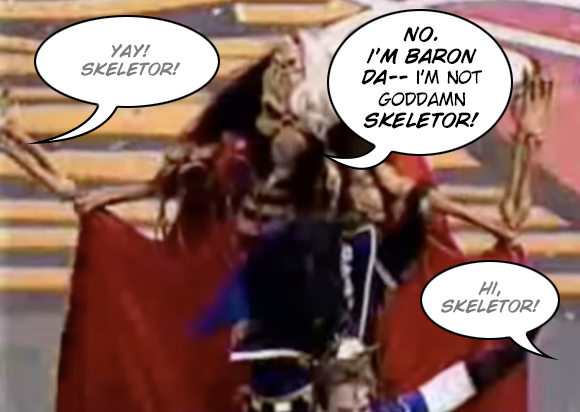
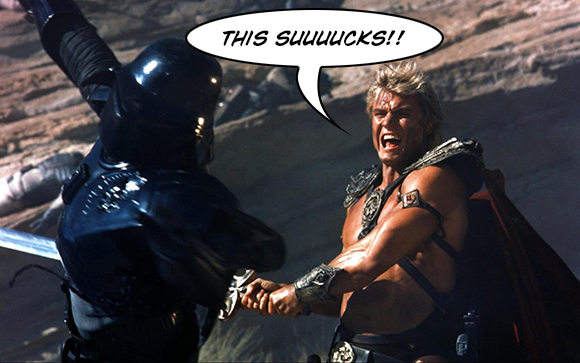
For those who aren’t familiar, Masters of the Universe tells the tale of the heroic He-Man (alias Prince Adam) and his endless battles in the techno-magical world of Eternia with the villainous Skeletor, who, as his name suggests, has a skull for a face. So we’ve got a prince fighting an evil skeleton man in a world of technology and magic. Sounds a lot like Skeleton Warriors, huh? Or much worse, if you’re going by number of skeletons, and you should be.

Here’s my theory: Goddard got a taste of Masters of the Universe and didn’t want to let go. After the movie failed to recoup its budget, he was likely out of the running for any future MOTU projects. Besides, the franchise had basically run its course by the end of the ’80s and mostly laid dormant until the early 2000s. But Goddard still had the industry pull to do his own thing. He had the resources to realize the dream of many a geek: he could make his fanfiction real. And that’s essentially what Skeleton Warriors is: a “what if” scenario in which Skeletor gets the secrets of Castle Grayskull in the first episode and destroys the kingdom, forcing He-Man and his allies to fight a hopeless guerilla war against him.

Don’t believe me? The Skeleton Warriors theme song says of Lightstar, “he has the power!” You know who else went around saying “I have the power?” He-Man.

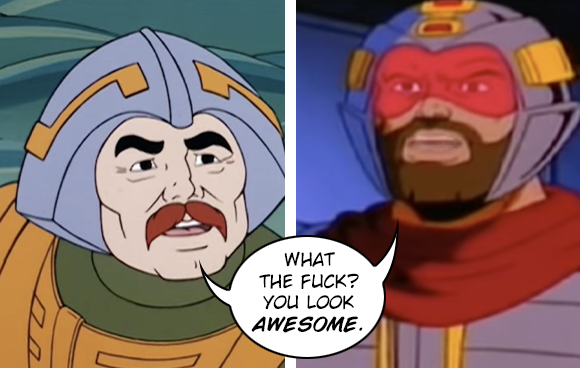
Not enough? Just look at Man-at-Arms from Masters of the Universe and Guardian from Skeleton Warriors, both of whom are wise, older soldier/inventor types with weird helmets and facial hair. Goddard didn’t exactly reinvent the wheel here. “Oh, I was inspired by a Conan the Barbarian live show I saw one time.” Bullshit. You wanted another shot at He-Man. This is He-Man with extra Skeletor and nothing else.

So why didn’t Skeleton Warriors succeed when its undeniable inspiration was such a cultural phenomenon? Maybe the focus on the villains left the human heroes feeling limp and uninteresting. Maybe the toys were too edgy for concerned parents, who were fine with their kids playing with violent superheroes but drew the line at the undead legions of the night. Or maybe the ’90s were just an oversaturated entertainment market and there were bound to be losers in the war for kids’ attention and parents’ money.

But at least Gary Goddard went on to— hang on, I’m being told that Goddard was a close collaborator of disgraced director Bryan Singer and was accused of sexual assault throughout the 2010s by a number of men who worked with him when they were minors, and that he “took a leave of absence” from his design firm, the Goddard Group, in 2018, which then changed its name to Legacy Entertainment. Ah well, nevertheless.


This article was brought to you by our fine sponsor and Hot Dog Supreme: Cerril, whose very flesh is a skeleton prison.

Categories
LEARNING DAY

Learning Day: Van-Pires 🌭

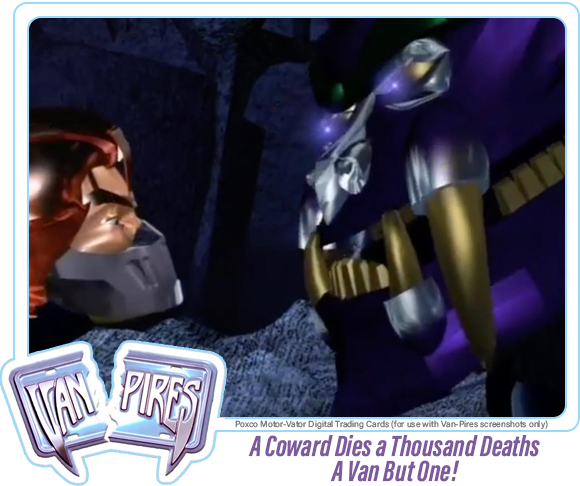
You may recall that the previously-discussed Snailiens at some point came under the ownership of a company called Abrams Gentile Entertainment. Founded in 1986 by John Gentile, Anthony Gentile, and Marty Abrams, AGE was a toy and media company that was the successor to the Mego Corporation. They created the Power Glove, the Visionaries, and a number of other children’s properties throughout the ’90s and 2000s. But one of these properties was uniquely deranged: Van-Pires. The brainchild of founders John and Anthony Gentile, Van-Pires is more than just a shitty pun tossed out during a late-night office coke sesh that became a live action/CGI hybrid Power Rangers cash-in. Van-Pires intertwines a tale of rock music tragedy, some challenging intergenerational/interspecies romance, and a mystery that remains unsolved to this day.

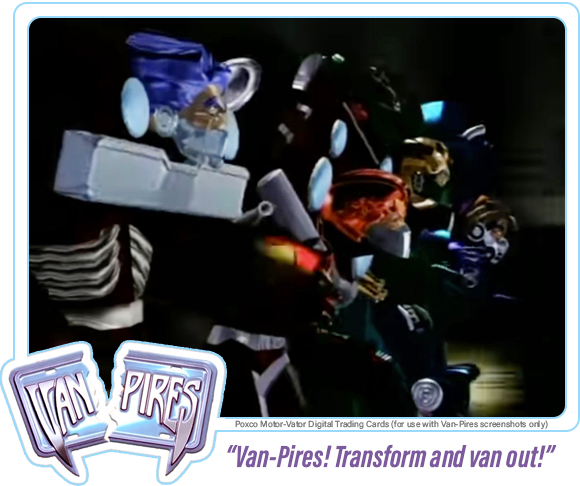
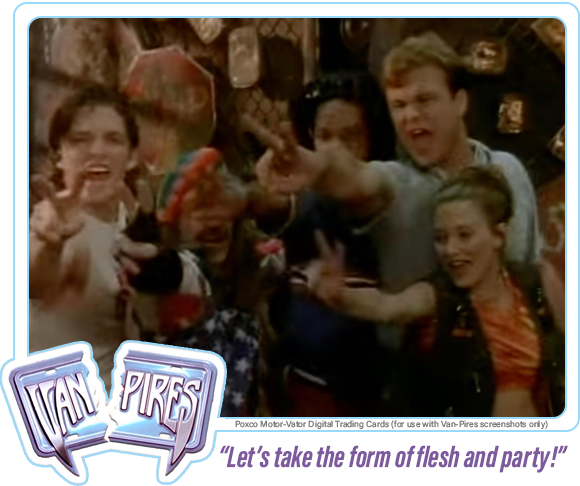
So what the fuck is Van-Pires? It’s a tale as old as time, really. Four car-obsessed teens who hang out in a junkyard run by a British hippie witness a meteor crash into a pile of trash, from which rise living cars who feast on the gasoline of innocent vehicles. Those teens are transformed into similar creatures themselves, looking kind of like a child made it halfway through converting an Optimus Prime and got bored. Our heroes devote themselves to waging war against the automotive forces of evil, which include a maniacal ice cream truck and a killer lady ambulance. Straightforward stuff.

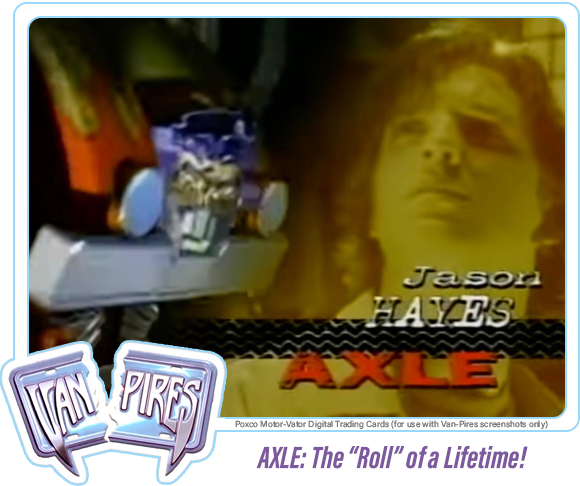
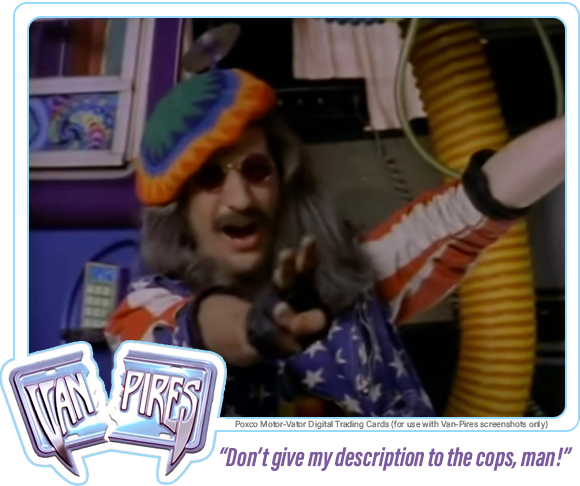
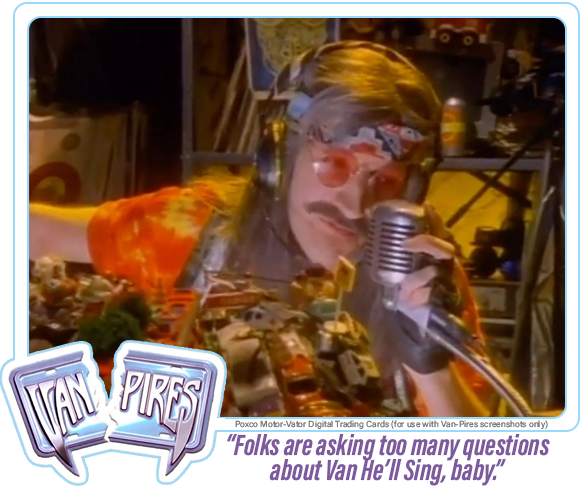
Our main cast is composed of Axle, The Leader; Nuke, The Dork; Rev, The Girl; and Snap (yes, he’s called Snap), the Black One. Their mentor, the aforementioned British hippie, is named Van He’ll Sing. Why? Because, uh, it’s kind of a car thing, but also kind of a Dracula thing? In the first episode, Van explains that he got his name when he was a roadie for The Rolling Stones and Mick Jagger fell ill, leading Mick to point to him and say “he’ll sing,” which is an insanely tortured explanation for a joke that barely qualifies as comedy. Van hates MTV because “you don’t watch music, man” and in the first episode tells the teenage children he hangs out with, “I’ve got everything you need in the van, man!” He almost certainly moved to the US because he was on the sex offenders list in England.
If you thought they exhausted their car puns on the main cast, don’t worry, because— fuck, I started doing it now! Exhaust is a car thing! Fuck!

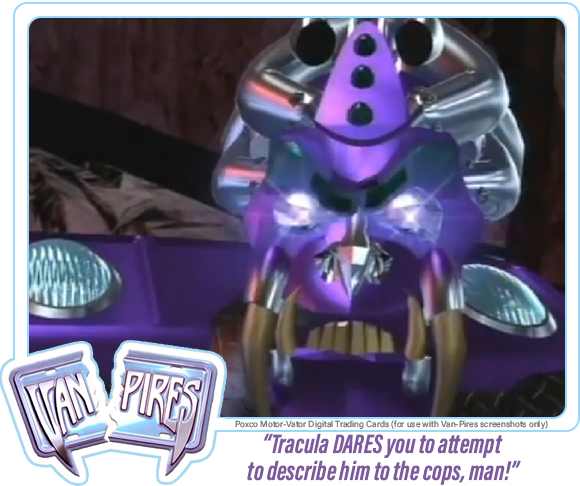
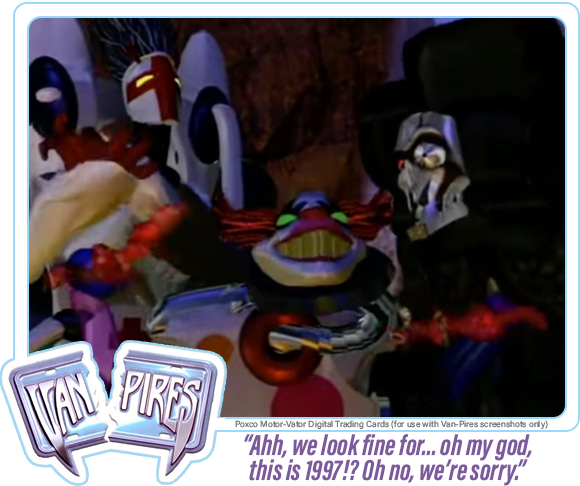
As I was saying, the title “Van-Pires” doesn’t refer to the protagonists. It in fact describes their foes, the mythical car mutants who live at the center of an underground network of highways. They are led by Tracula, a bargain bin Megabyte whose goons are named things like “Cardaver” and “Automaniac.” At one point he even creates a son named “Alucart,” which I am begrudgingly forced to admit is actually a pretty good bit.

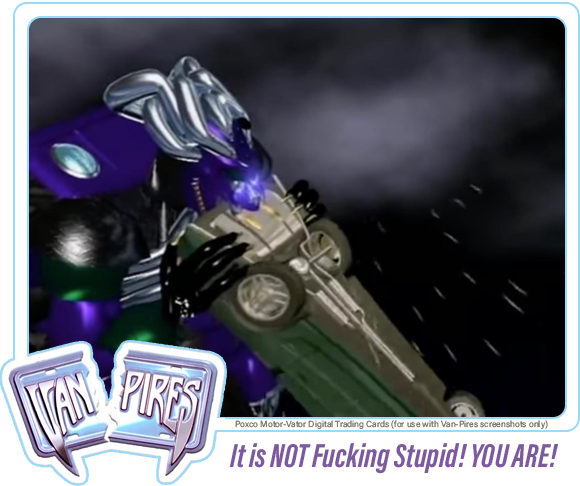
Tracula’s motivation is to take over the world or something, but in the meantime he and his coven of NOSferatu roam about at night, biting and sucking the gas out of cars and kind of making them deflate in the process. It looks extremely weird, and it’s framed as a serious threat to humanity. Like their bloodsucking namesakes, the Van-Pires also can’t go out during the day.

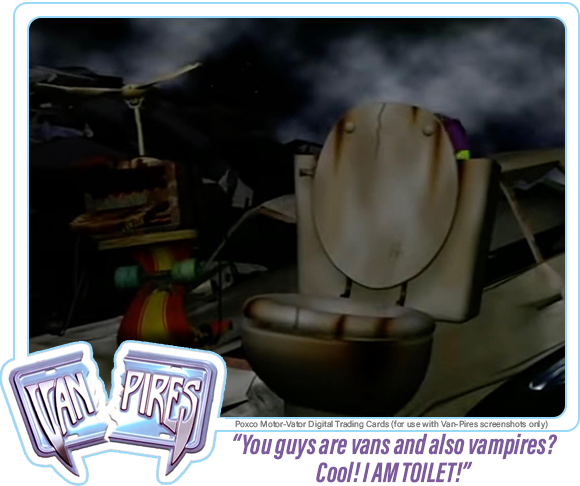
Among Tracula’s minions are an animate toaster and toilet, who the meteor apparently also brought to life. In any other show, these would be the comic relief characters, saying things like “you nincom-poop!” and “stop loafing around!” And those remarks might approach something like funny if literally every character in the show didn’t talk like this. I’m not kidding. This is a show where no one gives a second thought to a faceless toilet crawling out of a junk pile and joining a conversation.

Listening to the dialogue in Van-Pires is like getting beaten in the head with a socket wrench. The car puns are almost literally every line. Characters say things like “Snap’s got the roadmap,” and “we can’t just idle forever!” At one point, someone says “we got to keep it real” and another replies “you mean keep it wheel!” The people who wrote this dialogue had seemingly never met or even ever been a teen.

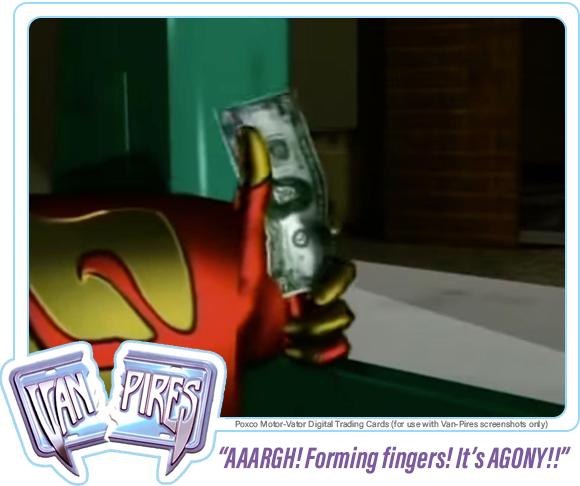
Speaking of the teens, what’s kind of interesting about Van-Pires is that the protagonists are effectively Van-Pires themselves. However, they can transform to and from their mutant car forms by leaping into their “carfins.” And if you were hoping for any kind of tortured drama over their need to drink the blood of other vehicles in order to fuel their fight against evil, well, you’re asking for a lot from a show that was created by two business majors with the express intention of getting some of that Saban-Levy money. The “Motor-Vaters,” as they’re dubbed by Van He’ll Sing in the first episode, actually go to gas stations, fill themselves up at a pump, and then leave cash behind. They won’t even steal gas, that’s how lame these kids are.
You might think that these teens would be horrified by the prospect of becoming deformed automotive gas-guzzlers, but in fact they’re pretty jazzed about it. See, despite their obsession with motor vehicles, none of them are old enough to have a car of their own — but there’s no law that says a teen transmogrified into a car monster by a magic meteor can’t drive! Van He’ll Sing, too, is fucking stoked out of his weed-addled mind that the kids he spends every evening hanging out with are freakish superheroes now.

Anyway, in the first episode the Motor-Vaters meet and do battle with the Van-Pires, and the limits of the cut-rate CGI become apparent immediately. You know how when you go back and watch a show like ReBoot or play an old video game, it looks way worse than you remember? That’s how Van-Pires looked when it aired.
But not to be outdone by the visuals, the writing really pushes the envelope too. Tracula confronts Axle and does what any reasonable ’90s villain would do: gives him a “we’re not so different” speech and asks him and his fellow teens to join his army of mutant car freaks. I reproduce the dialogue that follows here for posterity:
AXLE: Sorry, motor-mouth! No drinking while driving!

TRACULA: Says who?

AXLE: Says me!

[they fight while flying, which is apparently a thing that godless car vampires created by a magical meteor can do]

TRACULA [about to smash Axle into the ground]: If you don’t stand for something, you’ll fall for anything.

Later in the first episode, Van He’ll Sing repeats this last line to the teens when he dubs them the Motor-Vaters. Was this intentional? Did the writers just not notice? It’s impossible to know.

There were thirteen episodes in all of Van-Pires, and I have to be honest here: I only made it through three of them before I wanted to join Tracula’s crusade against humanity. In episode two, the Motor-Vaters encounter their musical idols, the real-life hair metal band “Starr.” Remember, this was 1997. It would have made more sense for these kids to be obsessed with a grunge band or a rapper, but the creators of Van-Pires were probably too coked out to notice it wasn’t the 1980s anymore.

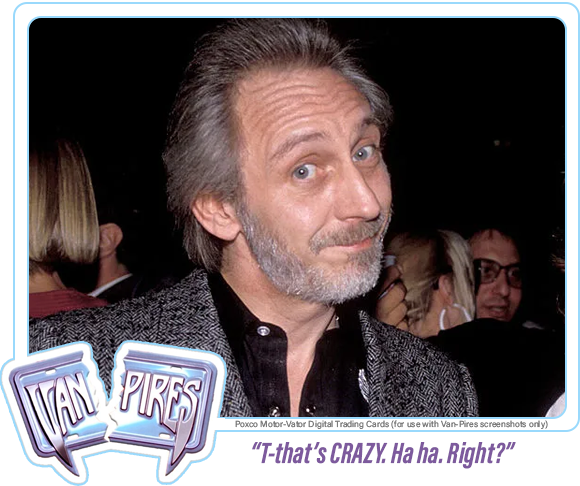
But Starr was not the only musical act associated with Van-Pires. None other than John Entwistle, bassist for The Who, composed much of the show’s soundtrack. Yes, The Ox himself was involved in this trainwreck. How did this happen? I’m not sure. Maybe the Gentiles had some dirt on him, or maybe he just needed the money.

Apparently, in order to fulfill his contract to write thirteen tracks and a theme song for the show, he resorted to digging into his old demos. One of those songs, “Bogey Man,” was originally penned for the 1978 The Who album Who Are You, but the band thought its kazoo solo was “too silly.” There’s a lesson here — never throw away your shitty first drafts, because you might be able to recycle them twenty years later for a TV show about teenage car vampires.

Do you want to know the really tragic thing about all of this, though? Entwistle released an album called Music from Van-Pires in 2000, featuring “Bogey Man” and the other songs he produced for the show. It was the last album he ever released, as he died in 2002 from a cocaine-induced heart attack after going to bed with a stripper at the Hard Rock Hotel in Paradise, Nevada. He was only 57 years old, but already had severe heart disease from smoking 20 cigarettes a day.

Entwistle’s involvement in Van-Pires may have gone beyond recording the show’s soundtrack. See, there’s a weird little mystery connected to this unassuming and terrible kids’ show. The opening credits tell us who plays each of the Motor-Vators — and fun fact here, the guy who played Snap is apparently friends with Uwe Boll and has been in a couple of his movies — but one character gets a different treatment. Van He’ll Sing is billed as being played by “himself.” This is a deranged choice for a character who is ostensibly a human man rather than like, a talking dinosaur or something, and it’s spawned a number of theories about the identity of the car-loving druggie Brit.

For a time, some Van-Pires fans (Fan-Pires?) seemed to believe that Van was played by the prolific Gary Oldman. And while they do kind of look similar, the theory doesn’t hold up to scrutiny. Why would Oldman be cast in such a lemon, and if he were, why wouldn’t they advertise his involvement? I suppose it’s possible that he threatened to sue when he saw how bad the final product looked, but I have another theory.

I propose that Van He’ll Sing was in fact played by John Entwistle. Perhaps in a desperate bid to buy more time to put together the soundtrack he drunkenly agreed to compose, he volunteered to don the gag wig and glasses of the Motor-Vaters’ mentor. He demanded, however, that the producers not name him in the credits, and faked a terrible English accent in order to throw viewers off the scent. The perfect crime!

Sadly, we may never know who played Van He’ll Sing, because in all likelihood, I am the only person who actually cares. I emailed Van-Pires creator John Gentile, inquiring as to the identity of the actor, but my email was never delivered. John Gentile may no longer even be alive. It’s in fact possible that anyone who knows the truth may have taken it to the grave.
And the grave is, of course, where Van-Pires belongs. Did I mention there’s an episode where Tracula hypnotizes and attempts to marry the 15 year old girl car monster? She calls him “master” and he replies “that’s a good girl” and it made me want to crawl out of my skin. At that moment, I wished to shed my fleshy mortal form and become a pure machine of steel and oil, one who roams the streets night after night in pursuit of the fuel of the innocent, caring nothing for the works of man. In conclusion, Van-Pires sucks and it gave me gas. Did I mention that the Motor-Vaters literally get gas when they turn back into humans? I have to go.


This article was brought to you by our fine sponsor and Hot Dog Supreme: Sarcophski, who was not provably the Van-Pire called Chryslayer.

Categories
NERDING DAY

Nerding Day: Snailiens 🌭

As we’ve established, everyone wanted a piece of that delicious Ninja Turtles pizza pie in the early ’90s. So the creators of Snailiens must have thought, ok, what made the turtles so huge? They’re little green guys with shells… what else is small, green, and has a shell? Snails! It’s snails, goddamnit it! And uh… they’re aliens! Snailiens! We’re gonna be rich! By god, boys, in a year’s time we’ll be doing lines off a novelty coffee table shaped like a giant snail.

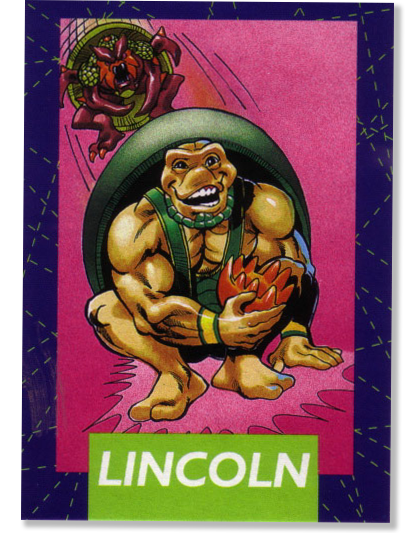
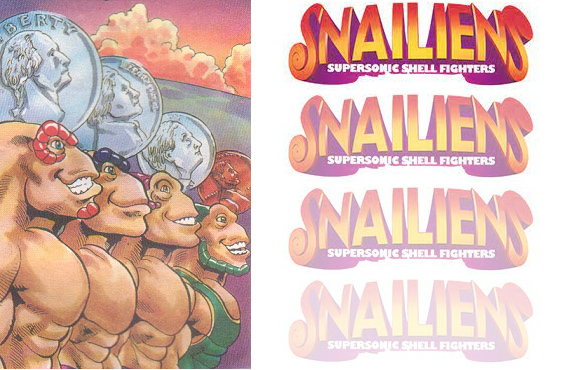
And so, the Snailiens were born. The influence of the Ninja Turtles is obvious in their designs, being four muscular green dudes with no noses. Rather than masks, the Snailiens have color-coded facial hair. Only it’s not hair, exactly, it’s sort of like a bony protrusion. Which is the closest they get to having shells. Honestly, they don’t look anything like snails. They look like weightlifters who were transporting barrels of acid and had a terrible accident. The fact that the Abraham Lincoln one is wearing a singlet only furthers this impression. Oh, that’s right, there’s an Abraham Lincoln one:

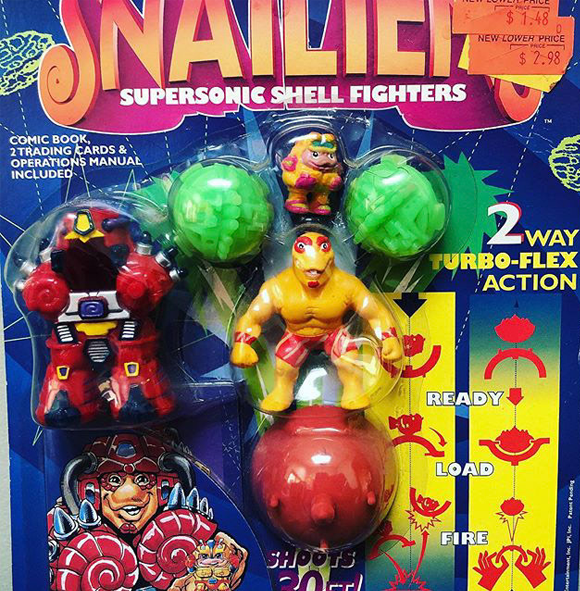
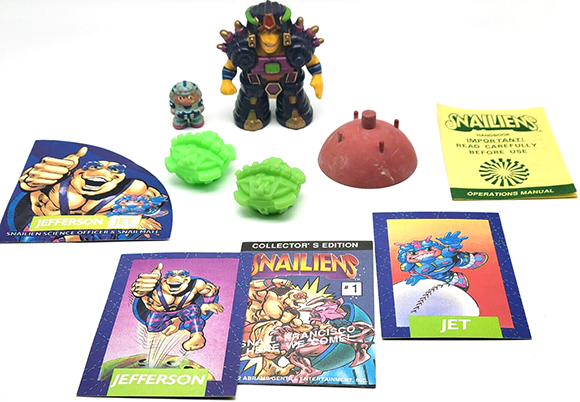
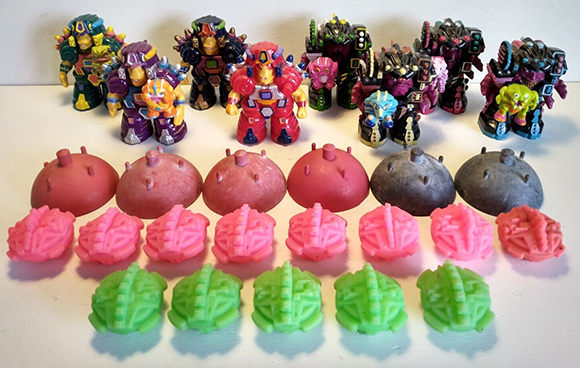
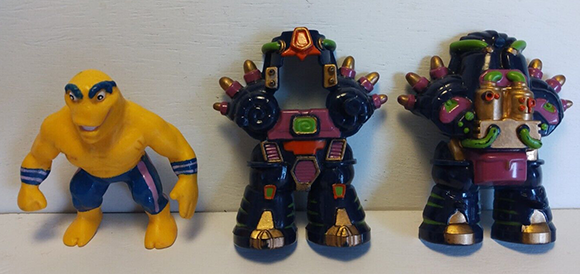
Sold as cheaply-made rubber figurines, Snailiens were compelling not for their inherent quality but for the boatlands of garbage they came with. My grandmother bought me one of these things from a Toys ‘R’ Us in the early ’90s, and it included a veritable deluge of plastic crap to inspire the imagination of lonely and socially maladjusted children. In addition to the figure, you got snap-on armor, a little sidekick, two rubber “satellite” projectiles, and a hard rubber half-sphere called the “Turbo-Flex Shell.” (Everything was Turbo, it was the ’90s.) What it looked like was an undressed maniac, a non-working diaphragm, and the baby they made:

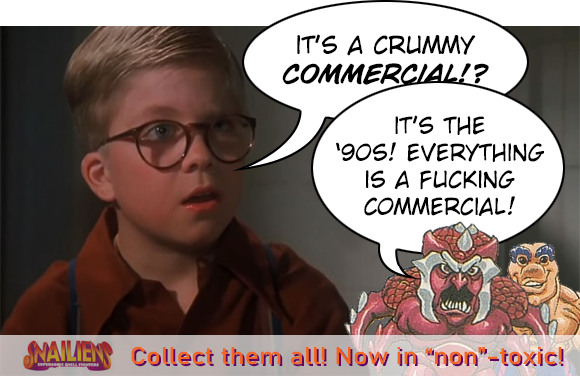
By turning the shell inside out then placing the sidekick figure or the satellites inside, you could then invert it and launch the projectile at some hapless Snailien’s enemy. The packaging insisted that you not aim the shell at animals or people, and rightfully so — it was effectively a small rubber bullet. Hell, the generic versions of these toys are actually called “eye poppers.” Imagine: a ’90s remake of A Christmas Story where Ralphie shoots his eye out with a Snailien. Ah, what could have been.

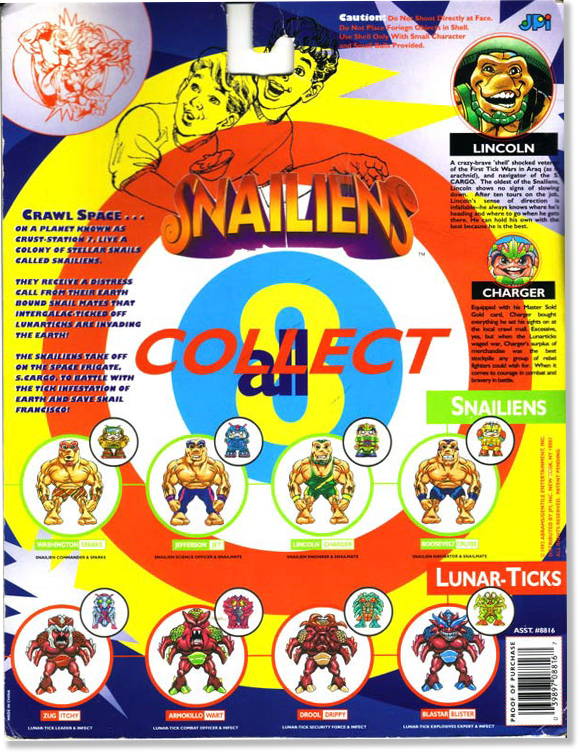
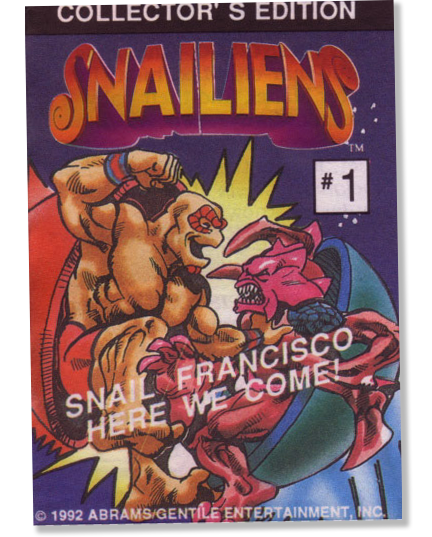
The Snailiens also came with trading cards and a comic book explaining their backstory. See, there’s another dimension six feet below San Francisco, there’s a war going on down there, and it’s explained across this pile of debris:

The hideous Lunarticks and their leader Zug plot to invade Earth and have selected the tiny city of Snail Francisco as their first target. Whether there’s another outer space in the dimension under San Francisco or they’re coming from another planet in our dimension is kind of unclear. Who cares! We’ve got aliens, dimensions, kids love all that horseshit.

The Lunarticks and their allies, the short-statured “Infects,” begin their assault on Snail Francisco. The city’s occupants, who are, as you might expect, snails, put out a distress call. The Snailiens, who I guess are aliens but also live in the subterranean dimension under San Francisco, respond and fly their ship, the S. Cargo (boooo) to help out the besieged citizens.

But while they’re kicking Lunartick ass, one of the kids who lives in the regular human San Francisco finds their spaceship, thinks it’s a cool shell, and takes it to his room. The Snailiens are thus stranded on Earth, where they help the citizens of Snail Francisco resist the Tick invaders. Said citizens “knight” them with names found on coins that have fallen into their world because they can’t pronounce their “Snailienese” names, and they become Washington, Jefferson, Roosevelt, and Lincoln. Because they’re not just another Ninja Turtle knockoff. They’re more like a local car dealer’s President’s Day Sale parody of a Christian parody of the Ninja Turtles.

The toy line included the four Snailiens as well as four of the Lunartick villains: Zug, Armokillo, Drool, and Blastar. Each Snailien and Lunartick had their own little buddy who could be fitted into the Turbo-Flex Shell and sent careening across the room, or simply be attached to the character’s armor like a stupid little baby. The commercial did its best to make them seem cool, with animated depictions of the characters throwing their rubber shells around and a song describing them as “Supersonic Shell Fighters,” but this looks like single Go-Bot dads trying to identify a testicle in a police lineup. This fucking sucked and every kid knew it.

“Give them a bounce, they’ll blow you away,” the ’90s toy commercial announcer excitedly intones, as a Snailien’s little buddy is seen smashing through a window. Immediately after, we see kids cowering in fear from the supersonic shell onslaught. Sure, there were warnings not to point these things at other people, but they knew what they were doing.

It seems like a silly and cheap attempt to cash in on a trend now, but I have to admit that I adored the Snailiens as a child. I only ever had the one, but how many toys came with their own comics with elaborate backstories involving subterranean dimensions populated by insect people? Maybe a dozen? How many toys had cool plastic armor suits you could snap on and off, giving your non-articulated Snail man essentially two different outfits depending on the social and/or combat situation that your imagination placed him in? Still a lot, sure! But how many snail-based superheroes were there? Only these. And I loved these little bastards.

But despite all of this — the comic, the high potential for injury, the term “Turbo-Flex Shell,” the Snailiens, very much unlike a snail climbing up a wall, didn’t stick. They were relegated to the memory hole of history, never even receiving a cheaply-produced animated TV pilot to be discovered by someone with a VHS ripper and a self-hosted website in the early 2000s. So thoroughly has history forgotten the Snailiens that there are zero results for “Snailiens” on every major illustrated pornography search engine. There are over 100 results for Street Sharks on e621, but zero for Snailiens. Hell, there’s art of the Creepy Crawlers television series on Deviantart — god, I’m going to have to get into that sometime — but none of Snailiens. Is it because of all the mucus? No, no, I’m seeing a lot of results for that.

Woe unto the Snailiens! Woe unto Washington, Jefferson, Roosevelt and Lincoln, the defenders of Snail Francisco! Woe unto these musclebound mollusks, these gastropods with gains. Are there none who wish, within their secret hearts, to feel their strong yet tender embrace? Nay, there are none. And so, their story ends. Here lie the Snailiens — nobody wants to fuck them.

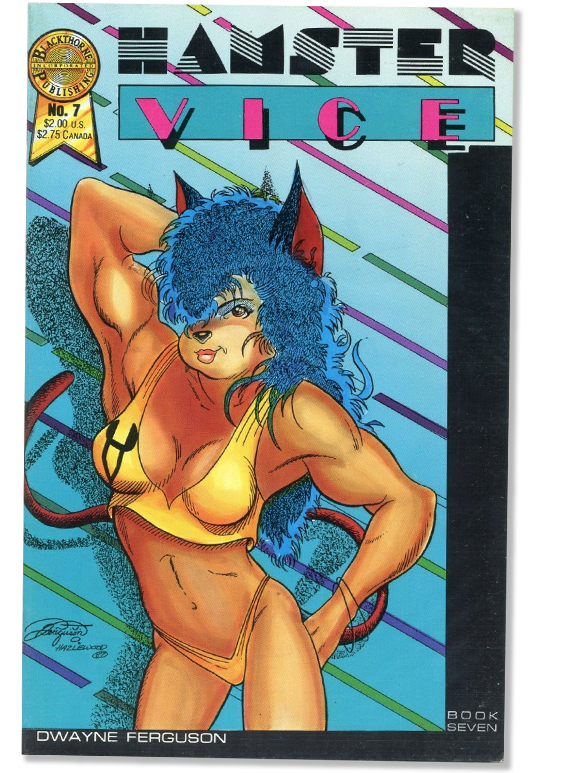
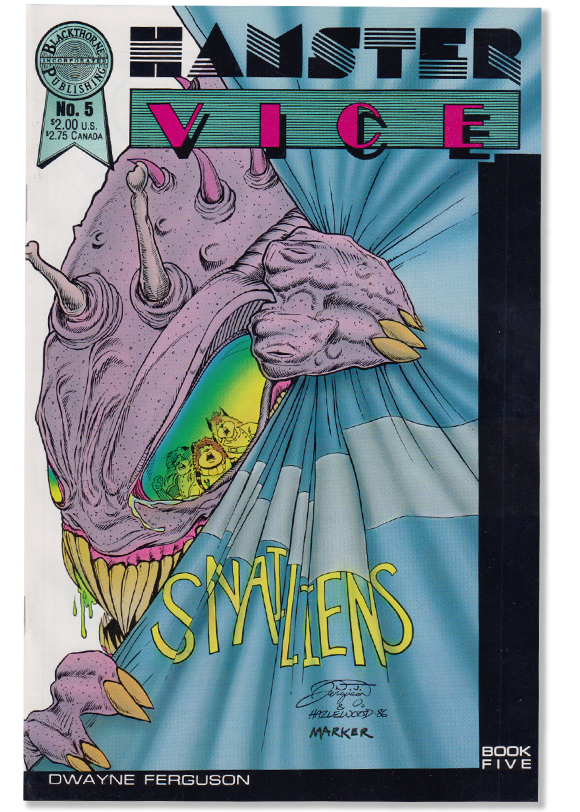
But here’s where things get really weird. Nowhere in the thriving Snailiens online fandom seems to mention this, but like TMNT, Snailiens were based on a comic. And while the Ninja Turtles were changed slightly in the process of becoming Saturday morning cartoons, the Snailiens became utterly unrecognizable from their source material. See, according to artist Dwayne Ferguson (art director on the ’90s Mutant League TV series), the Snailien toys were based on characters from his Hamster Vice comic, a series about hamsters with guns and sometimes also breasts.

In a parody of Aliens, he had his protagonists travel into space to rescue kids captured by the “Snailien Queen.” Ferguson wanted to get some toys made, ended up working with a company called J.P.I. International Corp, and the Snailiens as I and six other people now know them were born. Here’s how the original looked:

Ferguson points out that the toys bore little resemblance to his original work and notes this kind of thing happens all the time in comics adaptations. For instance, how Rogue became a lot younger in the X-Men films, or how Harley Quinn turned into a camgirl. But in this case it really does feel like some toy company executives liked the name “Snailiens,” realized how big the Ninja Turtles were, and decided to dump everything but the title. In popular comic terms, it would be like if the first Spider-Man movie had been about a terrifying arachnid monster that kidnapped children to feast on their bone marrow instead of a kid who makes homophobic remarks to Macho Man Randy Savage.

At some point, Snailiens were acquired by a company called Abrams Gentile Entertainment. I’m not sure whether this company even exists anymore, but they seem to have bought up a number of children’s properties that were popular to varying degrees in the ’80s and ’90s. In describing Snailiens, AGE’s site says that it “takes the classic ‘snail out of water’ backdrop and places our intergalactic team of out-of-the-world Snailiens on Earth’s insect populated Snail Francisco where they match wits and kicks against the nefarious Lunar-Ticks.” Snail out of water? Fuck off, man.

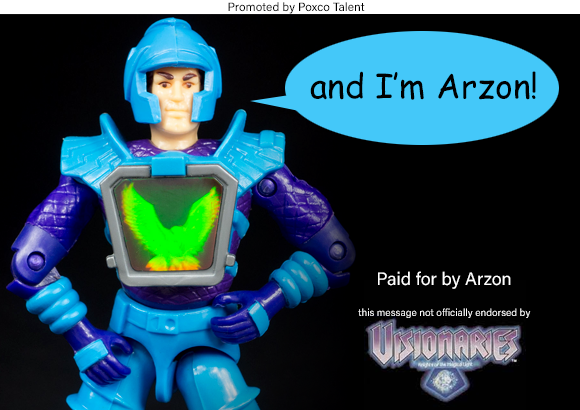
In addition to Snailiens, their website boasts their ownership of Sky Dancers, Bucky O’Hare, Van-Pires (god, there’s another I’m going to have to cover someday), and even Visionaries, which they claim has a live-action film in development from the producers of Transformers. Remember the Visionaries? They were action figures with holograms in their torsos. Not really surprised that franchise failed to make a resurgence with the ’80s cartoon revival of the 2000s. Given how hard Michael Bay’s Transformers was to look at, can you imagine what he’d do with characters made of fucking holograms?

Today, if you’d like to own a Snailien of your very own, you can expect to pay many times the original retail price on eBay. The rubber used to make the Turbo-Flex Shells have rotted and cracked, the plastic pins on the armor suits have snapped off, and the vast majority of the trading cards and comics have since been discarded and recycled into toilet paper or those communist newspapers they hand out on college campuses (the toilet paper of Freedom).

But the Snailiens live on. In an often misattributed quote, existential psychologist Irvin Yalom says you die two deaths — one when your heart stops beating and another when someone speaks your name for the last time. In writing this piece, then, I have kept the Snailiens alive a little longer. They may crave death, these supersonic fighters, but they cannot taste its sweet fruit. Not while I’m around, anyway. Live, unfuckable snot monsters! Live!!


This article was brought to you by our fine sponsor and Hot Dog Supreme: AnAndy, also known as the Visionary with a mustache.