Categories
NERDING DAY

Nerding Day: Captain Power 🌭

In 1987, producer and future accused child molestor Gary Goddard was on top of the world. He was directing the yet-to-bomb He-Man movie and was positioned to take a commanding role in the children’s entertainment industry. With He-Man and GI Joe winding down and the coke-fuelled exuberance of the decade giving way to the depressive slimy haze of the ’90s, Goddard partnered with Mattel to create a new children’s property. The pitch was pure evil genius: a merging of toys and television on a level never before imagined. Rather than simply be a 25 minute ad for its tie-in toys, Goddard’s brainchild would actually interact with them. It was called Captain Power and the Soldiers of the Future.

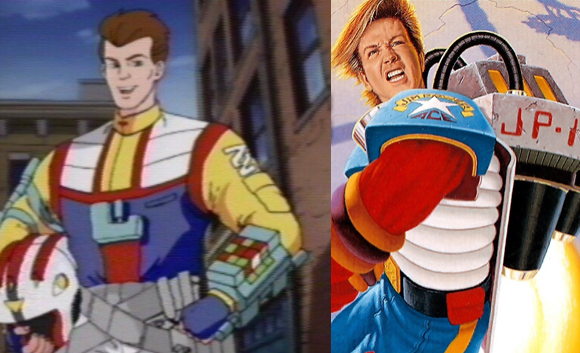
A live-action series following the struggles of the titular Captain and his friends against the evil Lord Dread and his feared Bio-Dread Empire, Captain Power is set in a post-apocalyptic world where machines have destroyed human civilization. The show follows the plucky resistance fighters who battle against faceless goons and primitive CGI robots using their “power suits,” wicked techno-armor that looks like something off the cover of a Nintendo game.

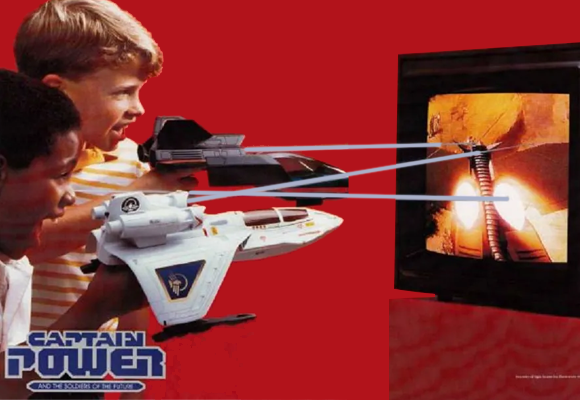
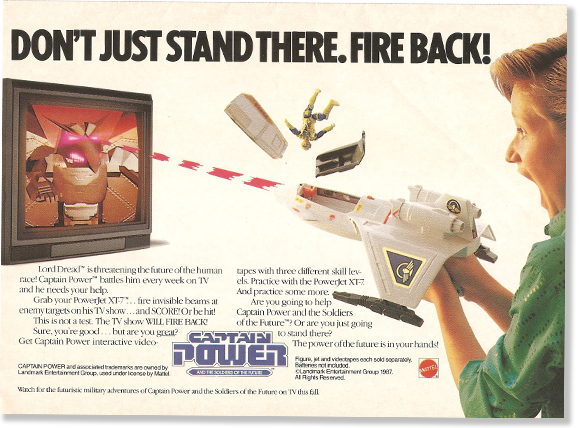
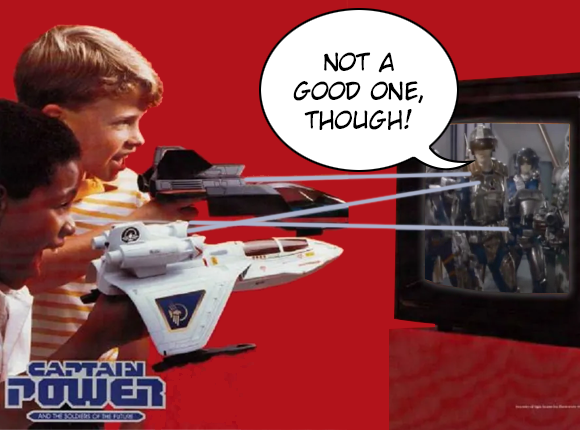
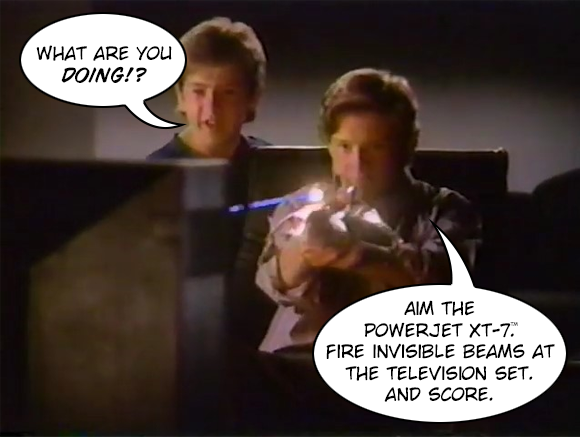
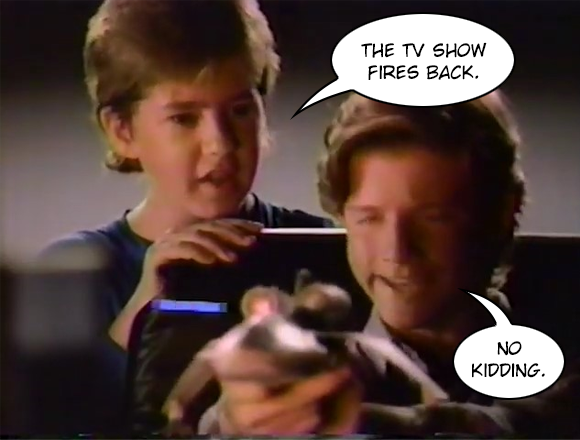
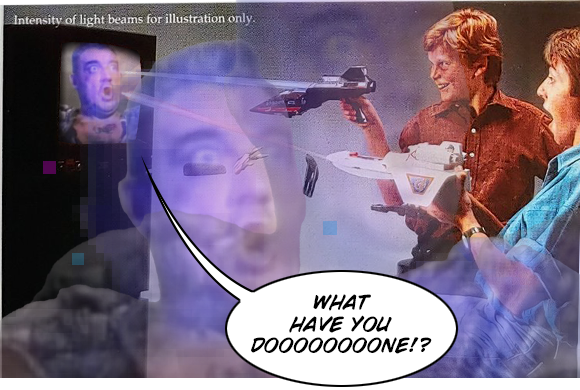
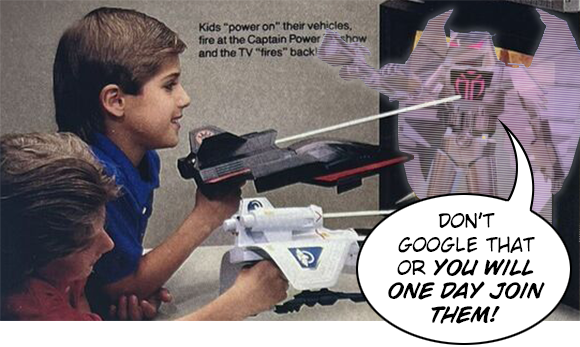
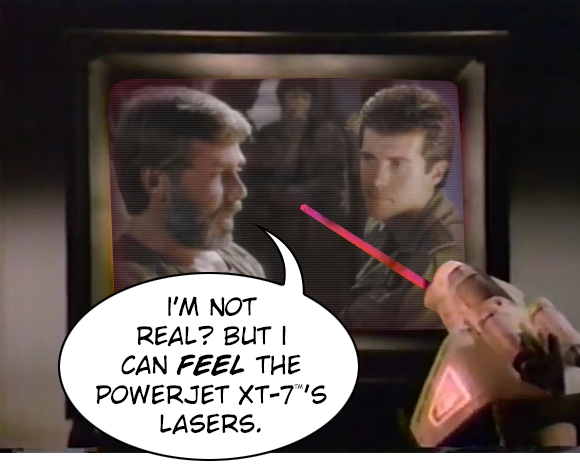
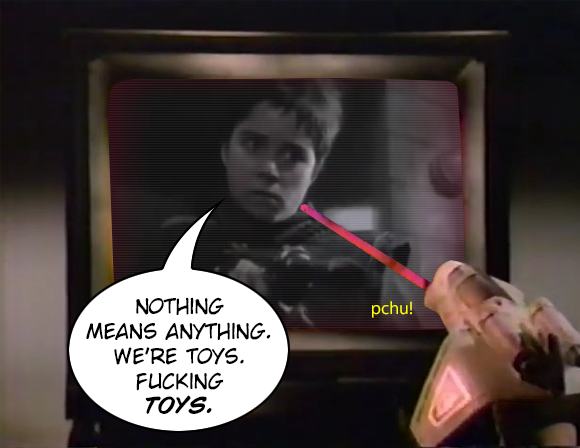
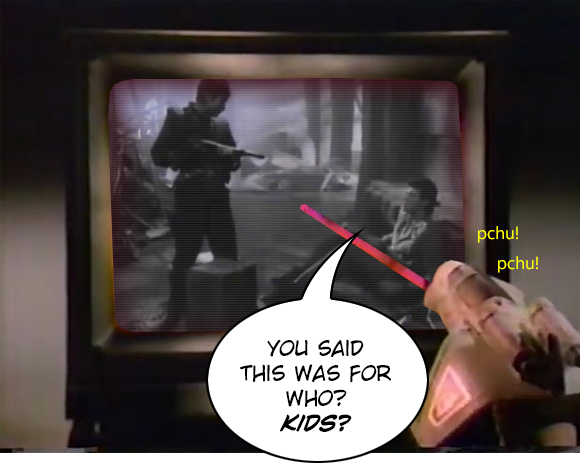
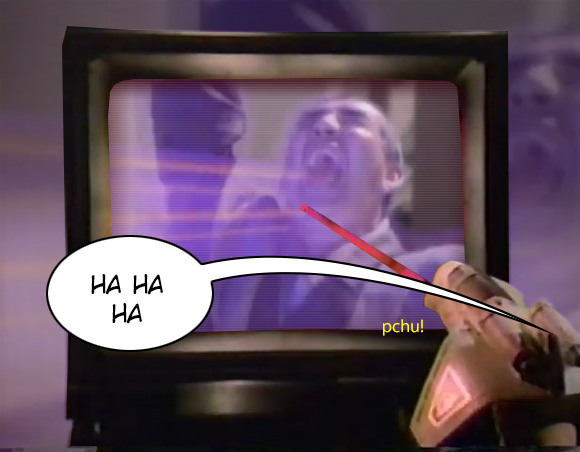
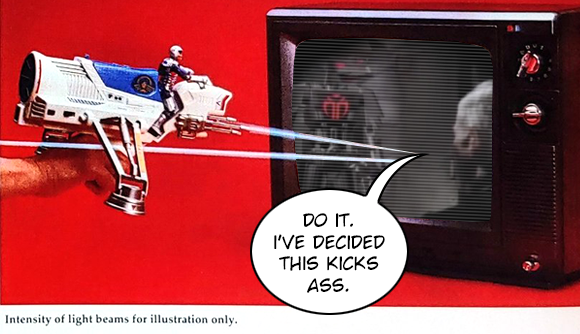
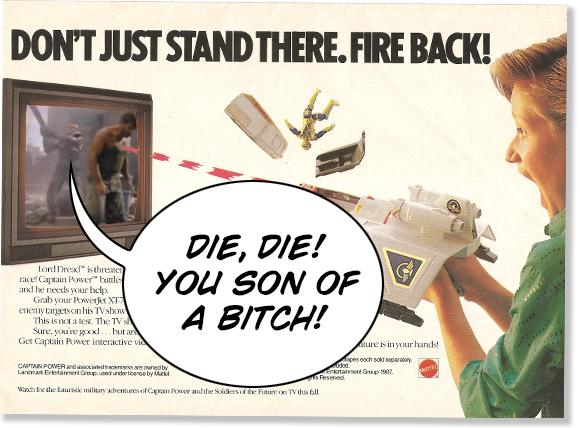
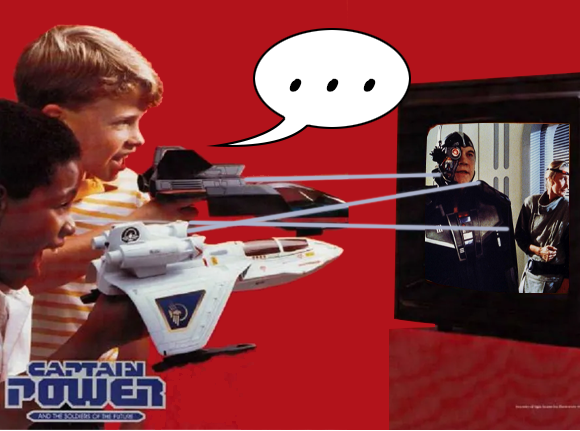
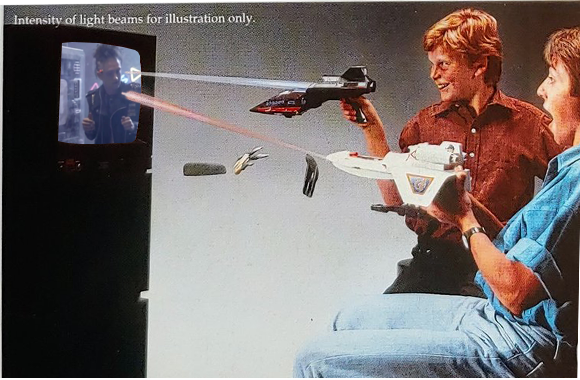
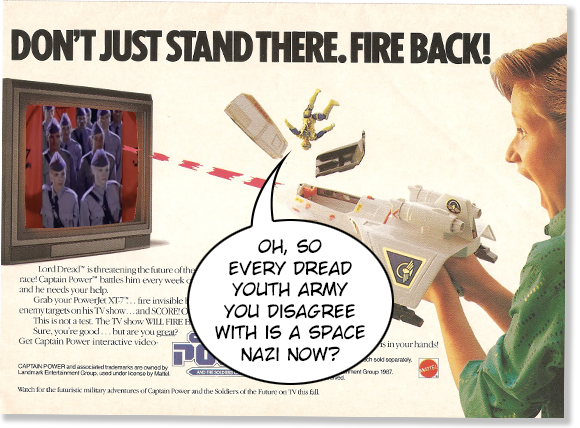
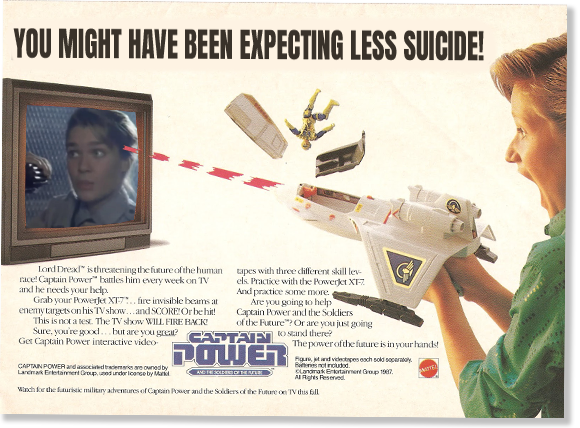
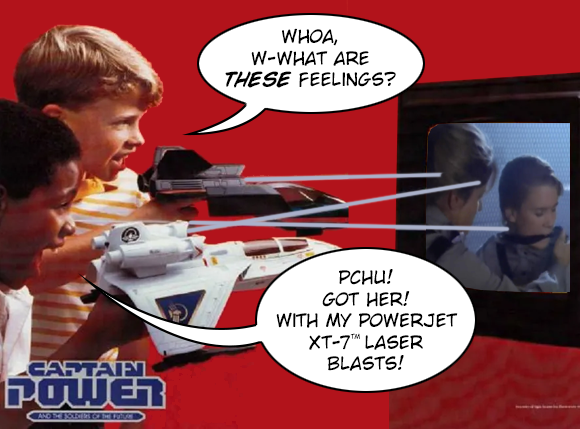
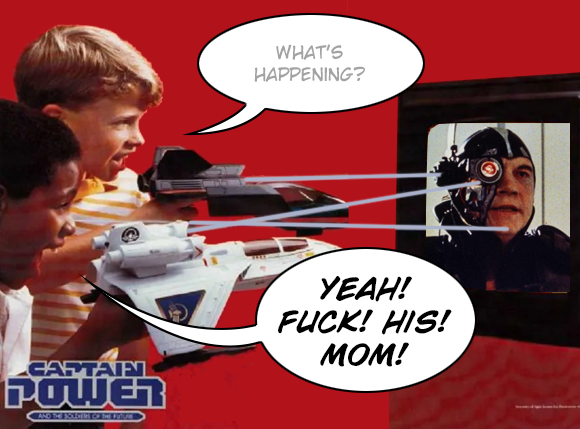
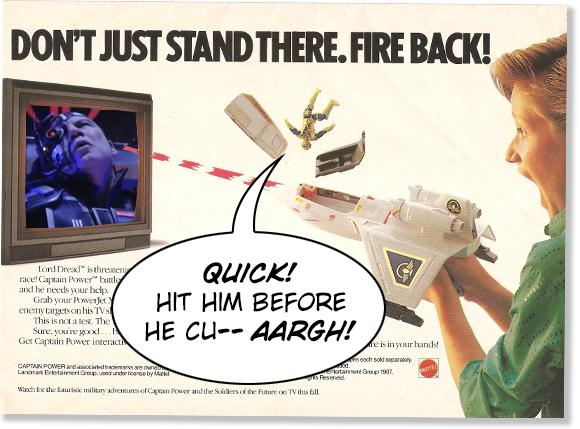
Mattel’s Captain Power toys included your run-of-the-mill action figures, but they also produced ships which were Zapper-style light guns. These ships could interact with the show through the large, flashing lights displayed on the enemy soldiers. Hitting them racked up points, while having the ship pointed at the screen during enemy laser blasts could cause the figure in the cockpit to be violently ejected. Despite outrage from parent and consumer groups, you didn’t really need the toys to watch the show. The kids in the commercial don’t even look like they’re having much fun.

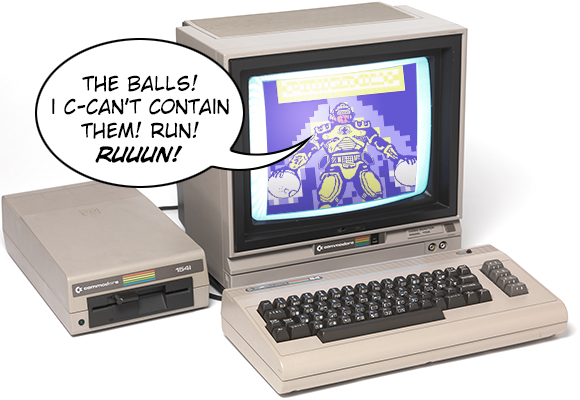
They also sold some VHS tapes alongside the light guns, in a package that truly stretched the limits of the term “video game.” There actually was a real Captain Power video game for the Commodore 64, but let’s be honest, if you were seven years old in 1987 you’d rather shoot at real people on-screen and pretend you were having an impact on the proceedings than play this:

So far, so good. Pretty standard stuff we’ve got here — good versus evil, lasers, power suits, things of that nature. But there’s a bit of a quirk to Captain Power. See, it’s a live-action show, and you can’t just have people getting shot to death on screen constantly. So people don’t die if they are killed in Captain Power. Instead, Lord Dread’s minions “digitize” them. As the name implies, this process converts a person into digital data — they’re out of the picture, and there are no bullet-riddled or laser-roasted corpses to deal with.

But, you might ask, what happens to a digitized human in the world of Captain Power? Are they held captive by Dread’s forces as bargaining chips? Are their minds preserved for any useful information they might possess? Possibly, but I have another idea: digitization destroys the physical body but creates a perfect simulation which is then tortured for eternity within the virtual realm.

Think about it. If you were a guy who had the literal brass balls to name himself “Lord Dread,” would you really be satisfied with simply wiping humanity out with admittedly awesome laser-wielding computer-rendered pterodactyl robots? Or would you want them to know what a folly it ever was to oppose you? Wouldn’t you want to make the dream of Roko’s Basilisk real?

So you would construct elaborate programs — simple tortures at first, then moving onto psychological techniques, maybe then letting the foolish humans think they’d escaped, or that their whole nightmare existence was just a dream, and that actually they were working for a comedy website writing about the children’s television series Captain Power, which is NOT REAL, and all the doctors keep telling you that none of it is real.

Haha that would be crazy, right? That’s like the kind of detail you’d get in a gritty reboot of an ’80s kids series, not the source material. I- wait a minute, I’m reading here that all of that is exactly what happens in the 1987 children’s television program Captain Power and the Soldiers of the Future.

In the first episode of the show, Captain Power is lured out to the ruins of a city by a woman he knew before the Metal Wars (played by Ann-Marie “Acclaimed Canadian Lesbian Novelist” MacDonald). When he arrives, she ambushes him and tells him she’s going to kill the both of them in the same kind of tone that Don Cheadle tells his wife to kill herself and their children in Hotel Rwanda to spare them the sight of their parents dying.

“They wiped us out…,” she tells Captain Power as she explains why she’s going to do a murder-suicide rather than bring him in to Lord Dread. “Most of them. The lucky ones. Inside the machine, you can feel it touching you. It’s wires and metal, but it touches you. And it knows every secret. Every shame. Every hate. Every love. It knows, and it tortures you with them.”

Again, this is in the very first episode of the show. This is like a highly-acclaimed mid-series Star Trek: Deep Space 9 episode dealing with the horrors of war. Are we having fun yet, kids?

You may be wondering, is the process of digitization itself painful? Yes, unspeakably so. “Every cell within your body implodes when you are digitized,” Lord Dread tells a man he has captured for information in a later episode. “Then when you are reformed, these same cells explode.” Neat!

This, in fact, is Captain Power at its core — a horrific, post-apocalyptic narrative where the enemy is just as frequently one’s fellow man as it is the cold, unfeeling forces of mechanized death. It really seems like the creators were chafing under the requirements of producing a children’s television series, because the pilot episode isn’t an exception — it sets the tone for the twenty one episodes to follow.

Episode two has an insane military commander awaiting orders from the long-dead President. He kills his own men for trying to flee his base and then captures Captain Power and one of his buddies and tortures them on screen. When he becomes lucid near the end of the episode, he orders his men to retreat from an oncoming robot attack and sits quietly at his desk contemplating a photo of his dead wife and singing softly to himself before a cyborg dinosaur smashes the door in and implodes every atom in his body.

In episode three, a genetically-engineered madman takes women and children hostage with plastic explosives and calls out Captain Power’s teammate and fellow genetic freak Tank (portrayed by Sven-Ole “Evil Space Cop in Jesse Ventura vehicle Abraxas” Thorsen). By the time they finally come to blows, they aren’t even fighting with lasers, just smashing cinder blocks and flaming pieces of wood into each other’s brains.

Tank later mentions that the two of them came from the “Babylon 5” facility. That’s weird, huh? Well, it turns out that one of the lead writers on the series was none other than J. Michael “I Always Have to Look Up the Spelling of His Name” Straczynski.

What about Lord Dread and his Bio-Dread Empire, though; the ostensible villains of the series? I mean, they get up to some shit, sure. Dread himself is kind of a proto-Borg figure, a bald cyberman who sits in a big revolving chair looking menacing. He’s the type of guy who delegates, rather than getting his hands dirty, and he’s definitely the most interesting and fun character in the show.

We get to see him doing shit like dictating his own new version of the Bible, waxing over the perfect world he’s bringing into being, and getting into spats with Overmind, the supercomputer with which he merged his brain and now acts as an Emperor Palpatine to his Darth Vader.

But again, more often than not, the real monsters in Captain Power don’t have robotic eyes or crudely-rendered jet engines. They’re just ordinary people, people who truly seem to loathe Captain Power and everything he stands for. Or, if nothing else, they’re willing to sell him out for their own ends. Sometimes, this is presented as a morally complex if ultimately wrong move, as when a secret human society hidden away from the war tries to use Power as a bargaining chip to get Dread to leave them alone.


But then there are the truly fucked up little freaks who will inform on human resistance fighters for nothing more than their own selfish pleasure. Seriously, an episode where Captain Power has to enter the “cyber web” to access some information features a creep who calls up Lord Dread to tell him where his nemesis is.

What does he ask for in return? That Lord Dread directly stimulate the pleasure centers of his brain with electrical impulses. This is the kind of plotline William Gibson would write if you held him at gunpoint, forced him to consume a large quantity of amphetamines, and demanded that he tell a story appropriate for seven year olds. Sadly, we never got a “drug dealer who sells out his kin for a hit of that sweet daddy lightning and kind of resembles Rob Schneider” action figure.

Neighbor selling out neighbor in the face of the implacable march of evil — where have we heard that before? What if I told you that Lord Dread has a standing army of children called the Dread Youth? In one episode, we get to see him deliver a speech in which he promises, if they give him “their blood, their trust, and their minds,” to bring about a “New Order.” It’s not exactly subtle. If Captain Power aired today people would be calling it woke for teaching kids that Nazis are the enemy.

We learn partway through the series that the female member of the Soldiers of the Future, Pilot, was once a Dread Youth herself. One episode has her infiltrating one of their bases in her old uniform. I guess good on her for the foresight, but you’d think that burning your outfit would be one of the first things you do when you renounce robo-Nazism. Regardless, Pilot has an encounter with a younger Dread Youth member (Laurie “Criminally Underused in the X-Files” Holden) in whom she sees herself. The girl is so devoted to the cause that she threatens to blow herself up with a grenade to stop Pilot.

I’m imagining the writers getting notes from the network saying “listen, we love the bleak atmosphere, the cheapness with which life is depicted in the grim future, but we need MORE murder-suicide threats!”

Also, Pilot ties up and gags the girl after shooting her. This image absolutely became the sexual origin story of someone who spends thousands of dollars monthly commissioning art of blonde on blonde lesbian cyber-Nazi BDSM. Not me. Someone else.

Later, Pilot is placed on trial by a bunch of villagers for her participation in the burning of a human settlement. This one kid is screaming for her blood because his parents died in the fire and when the townspeople decide that ultimately she wasn’t responsible — because she was just a kid herself and, whoops, someone else sold out the settlement after being tortured — the kid’s still furious. The judge hands him a gun and tells him to exact his judgment and we all learn an important lesson about how punishment doesn’t actually undo the harm caused by the perpetrator. Again, this is something that would happen to Major Kira in DS9, not Optimus Prime or He-Man.
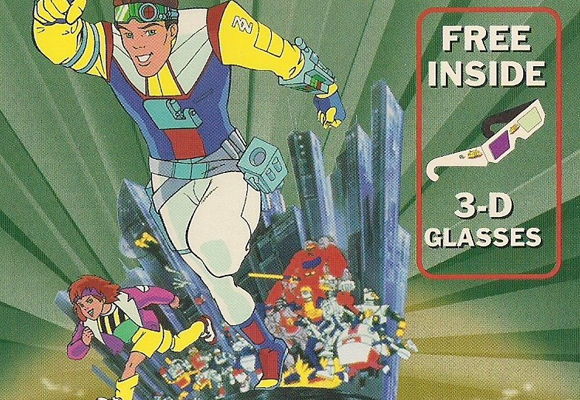
Oh, and in the very last episode of the series, Pilot blows herself up to stop Lord Dread’s goon Blastarr from getting his hands on Captain Power’s secrets and technology. Her last words are “go to hell” when the robot asks her to surrender.

Script synopses for a planned but never produced second series of Captain Power were posted online years ago, and they seem to mostly continue the grim tone with one major exception. According to series writer and story editor, Larry DiTillio, one of the episodes was written by Howard the Duck creator Steve Gerber and featured Lord Dread getting a new assistant named Morgana, who was actually the mind of Captain Power’s mother in a robot body. The episode allegedly would have featured the first cybersex scene in television history, because you can only include so many Nazi rallies and suicide bombings in a children’s series before you need to dig up that old hoary trope of the villain fucking the hero’s reincarnated mom in cyberspace.

So that’s Captain Power, a relic of the late ’80s awkwardly sandwiched between commercial interests and artistic intent. Nothing quite worked when it came to this show — the toys were crummy, the narrative was too scary for kids and too goofy for adults, and the whole thing feels like you threw Star Wars, Star Trek, and Terminator into a blender and breathed in the resulting toxic powder before watching Downfall. If nothing else, though; we got this bitching music video out of it, made by the show’s music editor and screened at the wrap party. We can only guess at how the cast and crew felt when they saw it. Proud? Ashamed? Aroused? Aroused.

This article was brought to you by our fine sponsor and Hot Dog Supreme: Burrito, who really fires back! WHO REALLY FIRES BACK!

Categories
PUNCHING DAY

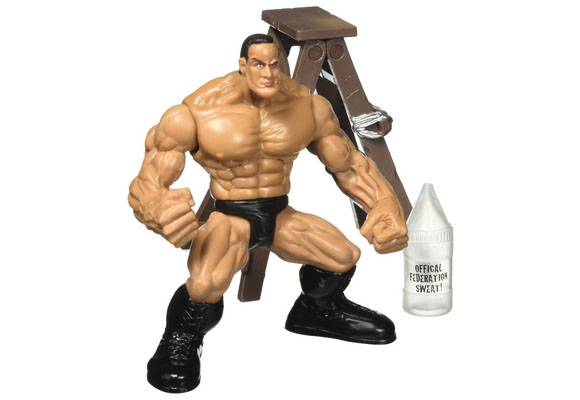
Punching Day: WWF’s Maximum Sweat

To view this content, you must be a member of 1900HOTDOG's Patreon
Already a qualifying Patreon member? Refresh to access this content.
Categories
PUNCHING DAY

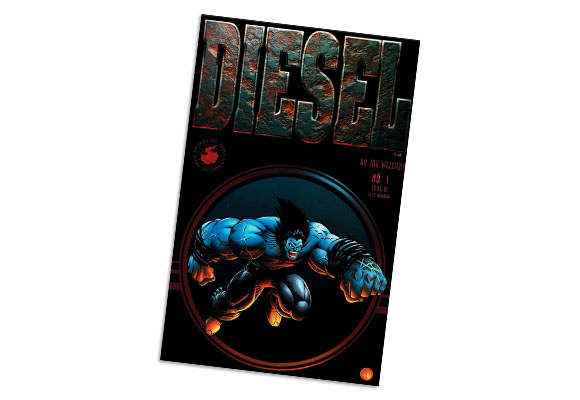
Punching Day: Diesel 🌭

In the 1990s, anime was a mere rumor whispered of in the basements of hobby shops. Past the Magic cards and pogs lay a secret, semi-forbidden world of “Japanimation” or animé, a realm of animation beyond what our minds reared on the thin gruel of Real Monsters and Dougs could possibly conceive. It’s hard to imagine, if all you’ve ever known is a world in which it’s considered perfectly acceptable for, say, a high-powered businesswoman or a busy househusband to proclaim their love for a bosomy anime protagonist, but there was a time when anime was more or less underground in these United States — quite literally, in the case of the aforementioned anime basement that was whispered of at my school in the same hushed tones as the copy of Wild Things that someone’s divorced father let them rent from the video store. Seriously, they used to run ads on late-night TV with the tagline “This ain’t no Mickey Mouse!”
Anime had a mysterious allure to it in those days, and not just because it was hard to access. Putting aside the Pokemons and Sailors Moon which trickled over to Western channels, it was widely understood that anime was grown up stuff — the domain of older brothers with subscriptions to Wizard Magazine who were almost old enough to grow facial hair. Rumors circulated around the playground about Japanese cartoons where people got cut in half, where naked breasts were on full display, and where tentacles quested into orifices traditionally considered the preserve of married heterosexual couples.

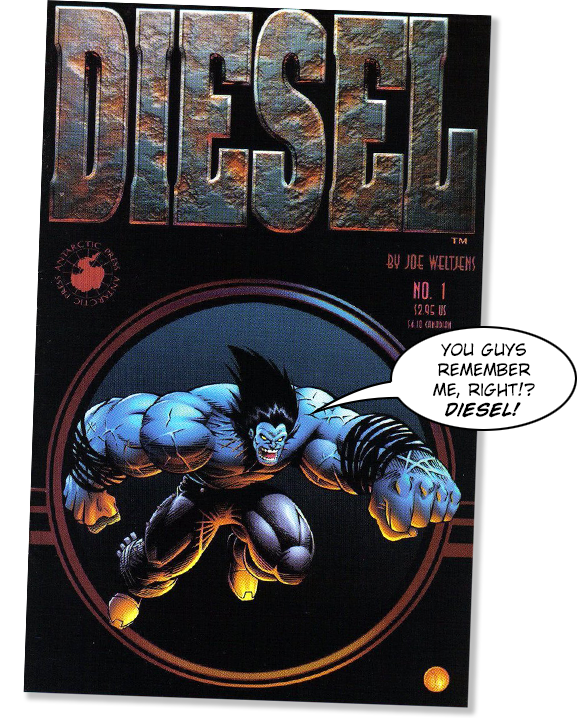
This is the context in which comic artist Joe Weltjens first discovered the manga-turned anime called JoJo’s Bizarre Adventure. Coming across a fan-subtitled videotape, as was the style at the time, Weltjens’ encounter with the beautiful creation of Hirohiko Araki would blossom into that most sincere form of flattery, imitation, after he attempted and failed to get the rights to bring the series to the west. “To hell with it,” Weltjens must have thought, “I’ll make my own anime! With Star Wars references! And I’ll call it Diesel, after the most popular brand of jeans on the market today, in 1997!”

For the uninitiated, JoJo’s Bizarre Adventure is a manga series that’s been running more or less continuously since 1987. Trying to describe the plot is sort of a challenge, but here’s my best shot: it’s about a Victorian orphan with daddy issues named after metal legend Ronnie James Dio becoming the world’s sexiest gay vampire thanks to an ancient Aztec mask and taking revenge on his adoptive family in various ways over the course of several decades. The series takes its name from the protagonist of the first part: Jonathan Joestar. From then on, every protagonist had a name that followed the same scheme: JOseph JOestar, JOtaro KuJO, and so on.

JoJo started out as a pretty typical action-adventure story, with a serious and noble protagonist learning mystical martial arts secrets from a flamboyant Italian man and using them to harmlessly punch frogs, but Araki eventually realized that his true passions were prog rock and making his increasingly slutty, twinky lead characters dress in more and more absurd couture, have child-like arguments about the interactions between their superpowers, and drink piss.

So what does Joe Weltjens’ Diesel take from all that? Well, not much. Basically all it borrows is the core concept of “Stands.” In JoJo, Stands are weaponized tulpas. They’re called Stands because they “stand” beside you, except for all of the many, many instances in which they don’t because they’re your hair, a sword, or an entire cruise liner. The prototypical Stand is a humanoid figure that engages in fighting on the part of the character who wields it, making them basically a means of showing fights with superpowers in more interesting ways than characters just shooting lasers out of their eyes or whatever.

You can’t really blame Weltjens for that, though. The single issue of Diesel he produced adapts an encounter from late in the third part of JoJo called Stardust Crusaders, the only part of the manga that had been committed to animation in the ’90s and thus probably all that he had exposure to back then. While things do start to get weird in part three as Araki starts to explore the themes he would build on throughout the series — there’s an extended magical fight between a dog and a bird, a man named Vanilla Ice cuts off his own head, two of the protagonists get their dicks stuck together with magnets, and so on — it’s still in many ways a pretty straightforward adventure story.

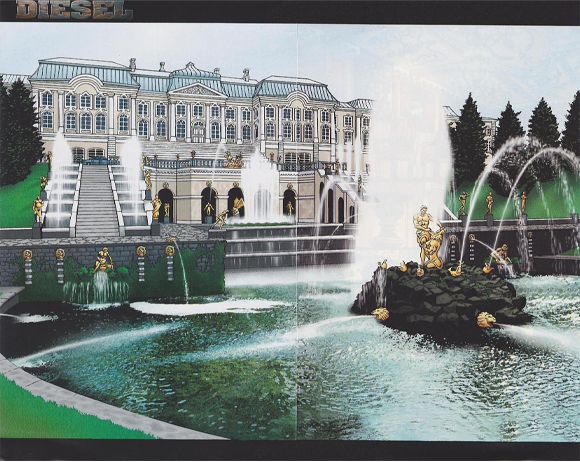
Anyway, Diesel opens on an enormous, gaudy mansion complete with golden fountains spraying water into an oddly photorealistic-looking pool that seems to clash with the rest of the art. You can really feel the frustration in this mess. It’s how a hungover freshman would just barely not get an F in a mixed media class. It might as well say, “Whatever. Drawing fountains fucking sucks.”

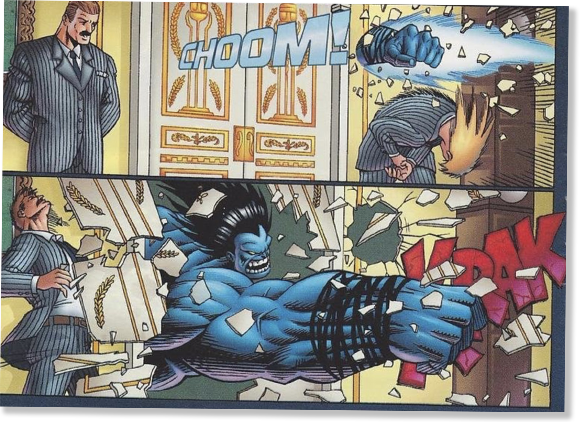
Inside the mansion, a man named Mr. Botha (deez nuts) sits at the end of a preposterously long table drinking wine like Dracula when suddenly, a gigantic monster that looks like the love child of the Hulk and a Dragon Ball Z character bursts through the door, killing two goons and swiftly dematerializing behind its Stand user. This is the introduction of our protagonist, Tom Diesel — yes, Thomas Diesel is his god-given name — and his Stand, “Meta Hammer.”

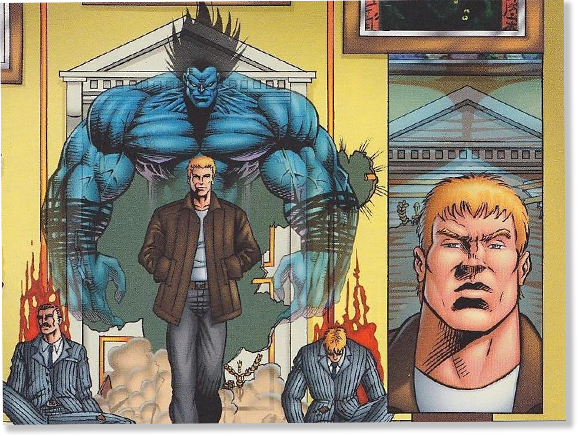
And sure, having your lead character bust into the villain’s lair and effortlessly dispatch his henchmen is a decent way of getting the reader to think he’s a real cool guy, but can we talk about his character design? Tom Diesel looks like a loaf of Wonder Bread was granted his wish to be a man.

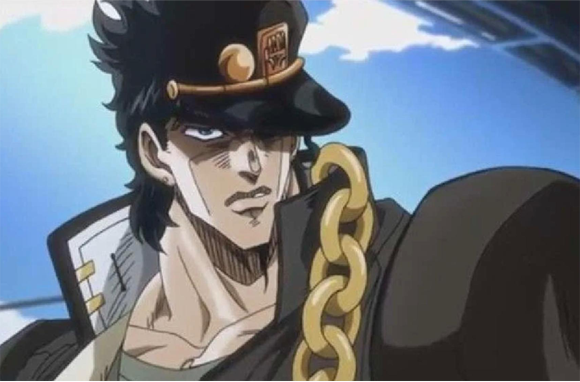
He’s literally a nondescript blonde white guy wearing a t-shirt, pants, and a featureless jacket. The human eye is incapable of focusing on him, sliding off in search of anything of visual interest to linger on. This man could walk right out of a store with a TV and your statement to the police would be, “Something shapelike took it, it might have had legs.” In contrast, look at the character Tom’s based on in JoJo, Jotaro Kujo.

Is his hat part of his hair? Are those chains part of the standard school uniform? Why does he look like a thirty-year-old bodybuilder instead of a 17-year-old high school student? Who knows, but at least his design raises questions, unlike Tom’s.

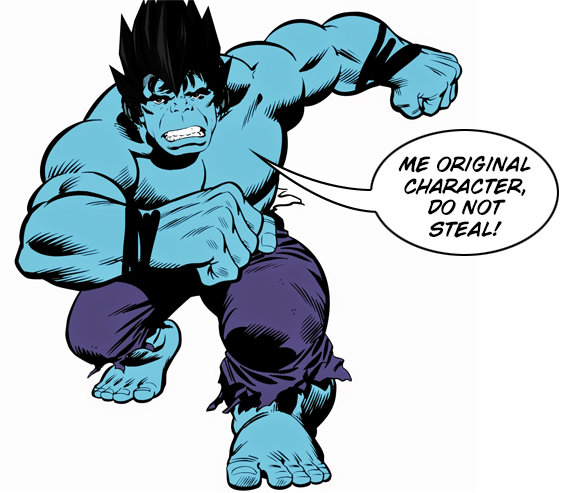
Ah, but maybe Tom is meant to be pretty plain so the real focus is on his Stand? Again, though, Meta Hammer looks like someone put Vegeta’s hair on the Hulk and changed the color of his skin. Look, I’ll prove it.

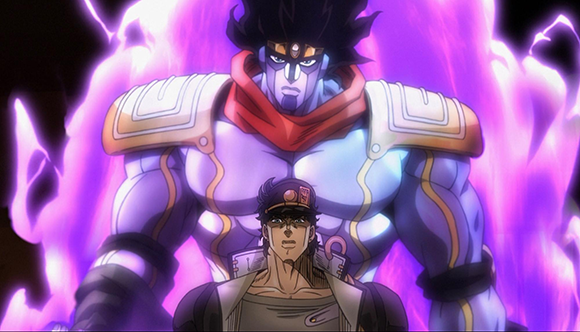
And compare Meta Hammer to Star Platinum, the Stand it’s based on. It’s still just a weird guy at its core, but it at least has some other stuff going on.

Regardless, as you might expect, Mr. Botha is displeased by the intrusion of the world’s most present white man and his blue ghost warrior, but we’re not going to get any resolution, because we’re immediately thrust back in time three months. We get a flashback between a Mr. Evans and Mr. Botha in which Weltjens temporarily forgets how speech bubbles work.

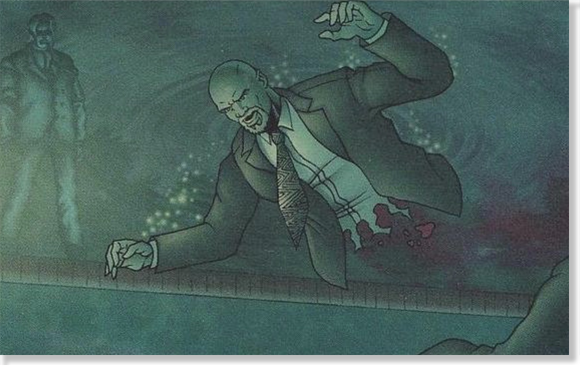
Then Mr. Evans gets cut in half by Mr. Botha’s mysterious powers and lands in the pool with an expression that looks less like one of utter agony and more like an ape watching a card trick.

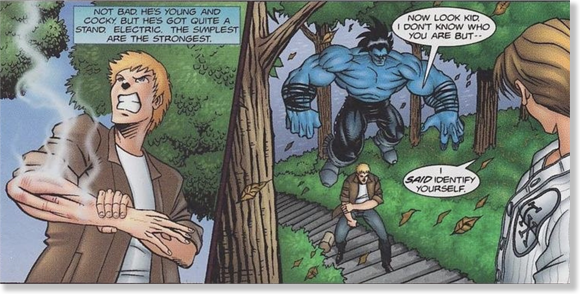
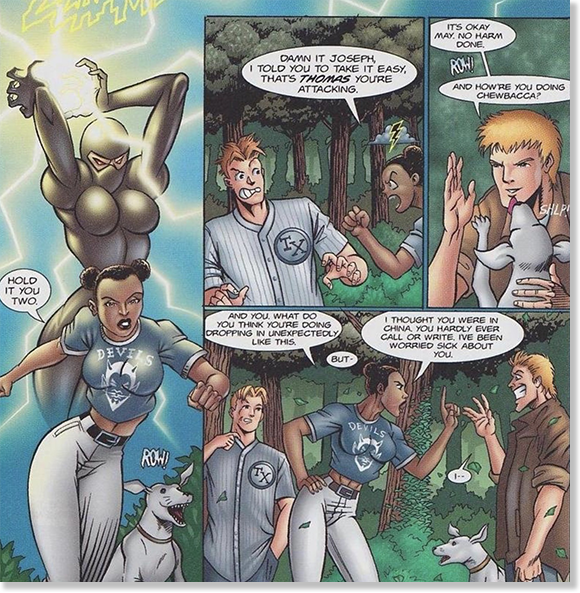
Now we’re in England. Gosh, we’re really just jumping all over time and space, huh? Tom Diesel returns home to see his adoptive sister May and is attacked by an overzealous guy with an electric Stand before she’s able to calm things down with the power of her own Stand, Mrs. Tits.

This is a good time to bring up one of the weirdest things about Diesel — the art. It’s all just slightly off in that “How to Draw Japanimation” kind of way. You remember those books you’d find at Borders in the ’90s seemingly put together by a guy who’d seen half an episode of Ranma 1/2? It’s like that, only Weltjens can’t seem to fully commit to the bit. Most of the time, characters’ faces look like Platonic ’90s comics guys — the kind of faces you’d see in a good American book like Bloodstrike or Ultraforce. But every once in a while, they’re struck with Weeb’s Syndrome, a condition which manifests in muscle spasms that radically alter the shape and placement of your facial features. Also they sometimes get little storm clouds over their heads. That’s an anime thing, right? Maybe?

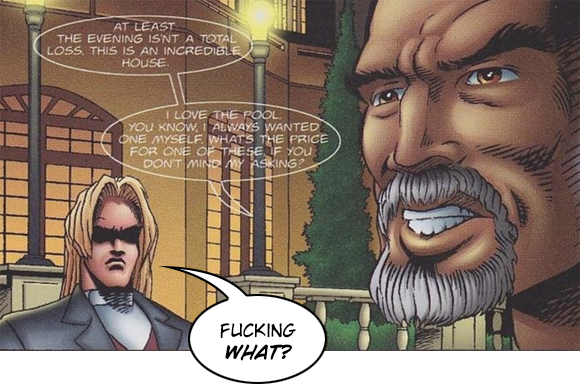
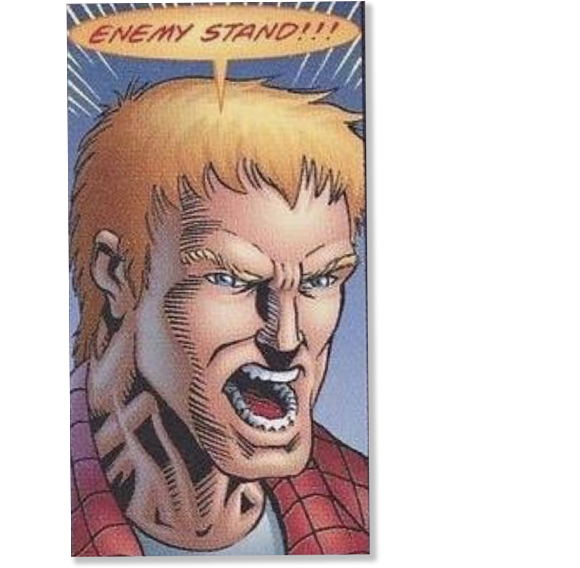
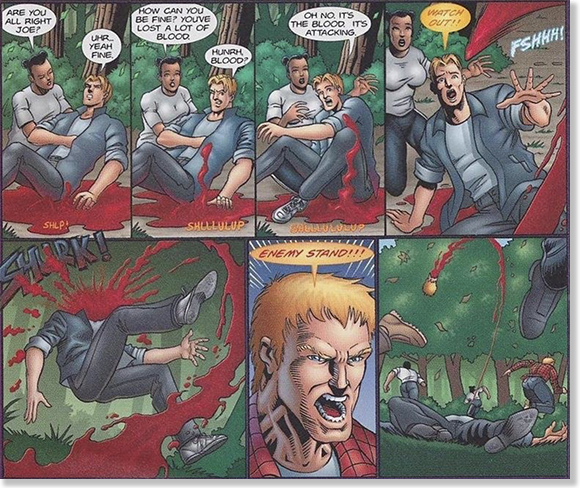
Well, Tom finds out that Mr. Evans was killed by Mr. Botha (deez cheeks) and wants revenge. Before that can happen, though, the gang is attacked by… wait for it… an:

This is probably the most famous panel in Diesel. Tom Diesel’s American-ass face hollering about an enemy Stand perfectly encapsulates the futility of creating an Americanized JoJo. Like the cursed attempts to develop an American Peep Show, it was never meant to be, and transplanting the concepts and terms from their home culture to that of the United States simply makes everyone involved seem like howling maniacs.

That said, the focus on that particular panel has allowed the utter madness surrounding it slip into obscurity. I mean, look at this.

That’s a character getting his head knocked off by animated blood, which then sends his noggin flying in a comical arc before it finally comes to rest next to his corpse. Also, credit where credit’s due: this is a semi-original idea from Weltjens. In the original manga, the gang fights a similar blind Stand user who attacks from a hidden location and tracks via sound, but he controls water rather than blood.

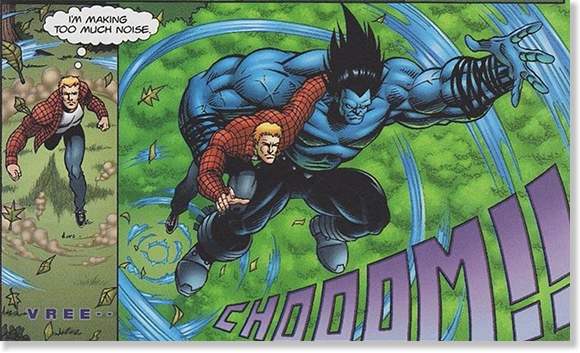
Well, Tom does the big damn hero shtick, sending his friends away so he can take on the enemy mano-a-blue Hulko. He even sort-of flies by having his Stand leap into the air and carry him, making him look like a child getting dragged out of a candy store. This is supposed to be our main character and he looks like an NPC in a game called Hulk League Humanball.

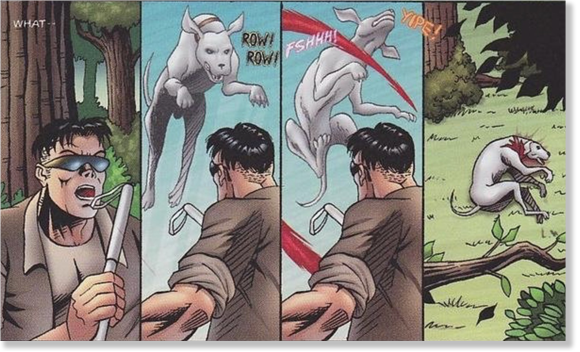
Because the guy is hiding like a dirty blind coward, Tom uses his dog to locate him. And here, I have to admit that Diesel actually gets something right about JoJo — there’s a running joke that Araki has a difficult time drawing dogs, and that, perhaps as a result, he takes his frustration out on them in his narratives whenever he gets the chance. If a dog or other small animal shows up in JoJo, it’s probably about to explode. And sure enough, when Tom sends his dog Chewbacca to root out his enemy in the woods, the dog gets its fucking throat slashed.

Probably not the kind of detail I’d commit to including in my adaptation, but to be fair I’ve never really had to draw a dog for work before. Maybe it really makes you hate them.

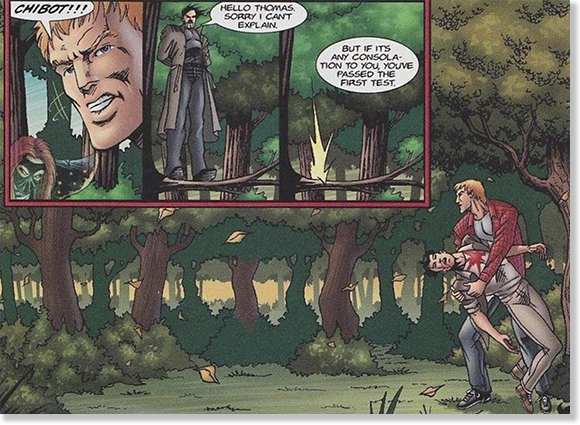
Before Tom can get any information out of his foe, the guy is stabbed by another Stand belonging to a man standing perfectly straight on a tree branch like a really cool dude. He’s named Chibot, I guess, and he tells Tom he’s passed the first test. Presumably the first test was exploding your beloved childhood dog? Or maybe it was having a blind man die in your arms from samurai sword-inflicted wounds. Who knows, and who cares. This is a half-finished knockoff by someone who screwed up every ingredient except the dog murder.

Possibly the funniest detail in this entire comic is that on the very last page where the publisher had the temerity to include the line “No similarity to any character(s) and/or place(s) is intended, and any similarity is purely coincidental.” Of course this is just a boilerplate “don’t sue us” message included in pretty much any work of fiction, but in this case it’s absurd. It’d be like making a comic based on Star Wars, changing the main character’s name to Doug Petrol and giving him a stupid jacket, but still talking about the Force all the time.

And so ends the first and only issue of Diesel, a comic created because an artist couldn’t consummate his love for a Japanese manga and so resorted to satisfaction through his own hand. It’s beautiful, in a way. It was the kind of thing that could only really happen in the late ’90s, in that brief period after anime began to make its way to the west but before it became a mass culture phenomenon, when American teens were just beginning to swoon over bishonen and have arguments about whether Goku or Superman were stronger. (Neither: it’s Mr. Botha. (deez dicks (Mr. Botha has two dicks.)))

One last thing. Throughout all of this, I haven’t mentioned the single weirdest thing about Diesel. We already know the creator is named Joe Weltjens. But “Joe’s” full Christian name is actually Jochen. JOchen “JOe” Weltjens. That’s right: he is, himself, a JoJo, and I wish him luck on whatever bizarre adventure he’s on right now.

This article was brought to you by our fine sponsor and Hot Dog Supreme: EveryZig, whose stand is Kajagoogoo, a bashful chaise lounge that turns panties into scorpions.

Categories
NERDING DAY

Nerding Day: C.O.P.S. 🌭

2020 was a strange and difficult year for everybody. Who today can forget the battles that raged throughout Empire City between the forces of law and powerful criminal gangs which saw robotic dogs and laser-wielding cowboys take on brain-damaged strongmen and cyborg weasels? Or so it would have been in a different world, a world in which the story of C.O.P.S. was real.

No, not that COPS. I’m talking about the Central Organization of Police Specialists. You know, C.O.P.S., the clunkiest backronym since the PATRIOT Act! They’re fighting crime in a future time! You know the deal at this point, right? If I’m writing about it, then it’s almost certainly a late ’80s cartoon series cranked out to capitalize on a toy line, unless it’s one of the jankiest RPGs ever written or whatever Balloonatiks was.

C.O.P.S. actually predates the other show with the same name by a year and the pitch for it was basically cops and robbers-flavored G.I. Joe in the future. It’s one of those cartoons that I’ve never heard anyone discuss in my adult life. I mean, garbage like Rubik the Amazing Cube and Dinosaucers were at least memorable for various reasons — the absolute gall of toy executives and instilling in its viewers a psychosexual obsession with anthropomorphic dinosaurs, respectively — but I’ve never heard anybody talk about C.O.P.S. ever, maybe because the premise is so thin. Literally the only thing I remembered about it myself was how wide the main character was.

That’s Baldwin P. “Bulletproof” Vess, by the way. He’s the leader of the C.O.P.S. and has a bitchin’ cyborg body, because he got into a car crash and RoboCop had just come out the year before, so why not make him a cyber guy? It’s the future times! Bulletproof is joined by a variety of law enforcement specialists from around the country with various one-note gimmicks. They include “LongArm,” who has a long arm/grappling hook, “Taser” (well before “don’t tase me bro” had tarnished the reputation of his weapon of choice), and the extremely unfortunately named cowboy “Sundown,” who, I guess, enforces racial segregation? “Sundance” was right there, guys! I bet Sundown secretly bristles at having a black guy for a boss.

Opposing the C.O.P.S. are the C.R.O.O.K.S, which weirdly doesn’t seem to stand for anything. Maybe that’s appropriate, though, since they’re criminals. Get it? Because they don’t stand for anything but their own selfish enrichment? Or maybe the writers just got lazy. They’re led by “Big Boss” (no, not that one) who is, in the grand tradition of cartoon criminals, a fat corrupt businessman who looks like Kingpin from Spider-Man and Limburger from Biker Mice From Mars got merged together in a telepod accident. Bullying is bad, kids, but the only fat people you’re ever going to see on TV are villains! Figure that one out.

Big Boss is joined by weirdos like “Berserko,” “Ms. Demeanor” (that’s her Christian name, Stephanie Demeanor), and “Doctor Badvibes.” I guess maybe he’s supposed to be the opposite of Doctor Feelgood? He had an exposed brain and made a skintight catsuit out of a lab coat.

There’s also a guy named “Buttons McBoomBoom.” What would you guess his gimmick was? If you guessed “a hollowed out torso with two mounted tommy guns he reveals by unbuttoning his shirt,” you’re right and also should probably be checked by a doctor for acute brain damage. Not Doctor Badvibes, though.

So anyway, the C.O.P.S. fight the C.R.O.O.K.S. in Empire City, foiling schemes like “inventing a special suit that lets you go really fast,” “opening a new spa to drug the mayor and force the C.O.P.S. to become garbage collectors,” “robbing a charity dinner on a blimp,” “holding an iceberg for ransom,” and “getting a little person to pose as a baby to infiltrate an orphanage for unclear reasons.”

God, how fucking easy would it have been to be a kids’ TV writer in the ’80s? Uh, yeah so this is a show about dog people who fight cat people in space… the dog people are called D.O.G.S. (Deputies Opposing Grim Schemes) and the cat people, they’re called C.A.T.S. (Criminally Aggressive Terrorist Scum). Boom, done. Three seasons ordered.

Well, at least C.O.P.S. had a black team leader AND an in-universe black woman president, which is more than you can say for G.I. Joe.

Speaking of, by now, everyone is probably familiar with the public service announcements that followed each episode of the original G.I. Joe series. As a sort of penance for the act of permanently warping children’s brains with 23-minute toy commercials and turning them into the kind of adults who would earnestly argue that an all-female Ghostbusters movie was “raping their childhood,” the show’s producers bolted on PSAs about issues like fire safety, talking to strangers, and, of course, the simple delights of porkchop sandwiches. But G.I. Joe wasn’t the only cartoon to run PSAs. He-Man did them, Captain Planet did them, and you know who else did them? C.O.P.S..

I thought it would be easy to discuss the C.O.P.S. PSAs, strangely titled “C.O.P.S. For Kids,” (implying that the show itself isn’t?) but it turned out to be a grim odyssey that left me feeling like I’d just battled Buttons McBoomBoom. I’ll be honest, I just wanted to get “Buttons McBoomBoom” in there again. Buttons McBoomBoom.

So while the C.O.P.S. PSAs are mentioned on the show’s Wikipedia page, they’re not in any of the episodes available on Amazon Prime, or even in any of the ones people have uploaded to YouTube.

Seriously, even the newer releases of the DVD don’t have them — I had to buy a used copy of the 2006 version on eBay to get access to them. And then I realized, wait, I don’t actually have a DVD player except on my old PS4, because it’s 2023. So I hooked that up to my capture card, then realized that they won’t let you play DVDs on the PS4 without copy protection mode on, which prevents you from using a capture card.

I say all this merely so that you know how much I had to suffer to bring these relics to you, and also to explain why all of the images from here on are so terrible. I took them with my phone, because there’s no easy way to grab stills from a DVD you bought with your hard-earned 80s cartoon riffing money. That’s the world we’ve built for ourselves. That’s the world we wake up everyday and choose to live in.

So why is it so hard to watch the C.O.P.S. PSAs? Have they simply not aged well? Or is there, perhaps, some more nefarious reason for their removal? Well, let’s find out.

“I tell my son Brian to stay out of dark alleys,” the first PSA begins. Fair enough, I guess. In the world of C.O.P.S., any number of gigantic men might be lying in wait to harm your freakishly buff kid.

But the lesson does not end there. The voiceover also informs kids they shouldn’t take “deserted shortcuts,” which can be dangerous. Again, if you’re living in a world of superpowered meat mutants who walk around in open daylight in their old-timey striped prison digs swinging around a ball and chain, then that’s probably good advice.

Next, we’re told about the dangers of playing near cars. Here, the robot character Waldo stands in for a small child, nearly getting run over twice. Possibly this is because they didn’t want to show a kid getting run off the road, but I choose to believe the writers just fucking hated that robot. The second time doesn’t look like an accidental near miss to me, it looks like that driver was gunning for that little shit.

In an unusual twist, some of the C.O.P.S. PSAs are narrated by the villains. Rock Krusher, the big goon haunting the abandoned shortcut from the first one, here tells us a harrowing tale of how as a child, he joined a gang. What does being in a gang entail? Mostly wearing matching headbands and walking down the street snapping like you’re in the world’s worst community theater production of West Side Story. Rock Krusher was lucky, he says — he only went to jail instead of getting killed.

Which ok, sure, you want to tell kids not to join gangs. But this is a cartoon show where there are no permanent consequences for the villains, otherwise they couldn’t come back every week. So there’s a bit of mixed messaging going on here. Rock Krusher is in jail now, but he’s going to be out robbing a Thanksgiving Day parade with a giant magnet or something soon. Joining a gang is a land of contrasts.

Big Boss himself gets to narrate one of the PSAs. In a segment titled “Don’t Flash Your Cash,” he and his goon Squeeky Kleen are hanging out at a mall when the latter decides to whip out his wad in plain sight of some ’80s punks and promptly gets a nunchaku lashing for his hubris.

Again, I guess this is pretty good advice, but shouldn’t we be suspicious of anything a villain tells us? Are we meant to believe that on this particular issue, Big Boss is trustworthy due to his vast business holdings? Or is this merely one of his twisted schemes to get kids to keep their cash in their pockets, where his trained bands of money-grubbing weevils can purloin it? That was a real thing the bad guys did on C.O.P.S., by the way. One of the weevils was named Gaylord.

The fact that all of these PSAs are so abrupt makes some of them feel extra horrific. Like, in a few of them a kid gets the warning against smoking meth or juggling chainsaws before anyone can lose a limb or overdose, but in others someone else pays the price as a sort of martyr — a death on the PSA cross to redeem all children from their sins. There’s one with the character Longarm — whose thing, again, is that he has a long arm — about the danger of drunk driving. Two people pull up in a car next to a kid, clearly drunk out of their minds, and ask if he wants to get in.

Here, Longarm doesn’t even swoop in from just out of frame to prevent this from occurring. Instead, the kid remembers a previous speech Longarm gave him about the risks of riding with someone who’s been hitting the sauce.

So either this is constantly happening to this kid or Longarm just wanders around telling random children not to accept rides from their soused friends. Bad risks, Longarm muses, are for people who like to lose. Stick with good risks, he says, like trying out for a team you’re not sure you’re good enough for, or eating an expired can of mushroom stems you found rattling around in a dumpster in one of Empire City’s many dark alleyways. Anyway, the kid turns the ride down and the driver speeds off, immediately crashing into a wall off-screen and presumably killing both himself and his passenger. Life is cheap in C.O.P.S. PSAs.

There are a bunch more of these covering bike safety, saying no to drinking and smoking, and not playing in the road, but who cares. I bet you degenerates are reading this while weaving in and out of traffic on your bikes, guzzling malt liquor and spray painting walls as you pass them. Did you know that’s wrong, by the way? Mace told you so in his PSA on vandalism, where he explained that graffiti is bad because it’s against the law.

But then, if things are only wrong because they’re illegal, does that mean the law is the only arbiter of morality? Does that mean that slavery only became immoral when it became outlawed? Are we to believe that the police are the ultimate guardians of right and wrong rather than simply the protectors of property rights?

[merritt was pepper sprayed by Mace for these questions]

This article was brought to you by our fine sponsor and Hot Dog Supreme: James B.O.Y.D., which stands for Boys on Yard Duty, sworn protectors of R.E.C.E.S.S.

Categories
NERDING DAY

Nerding Day: Superhuman Samurai Syber-Squad 🌭

Everyone wanted in on that sweet Power Rangers heat in the ’90s. And while Saban Entertainment cranked out their share of shows based on Japanese tokusatsu to capitalize on the craze for spandex-clad warriors battling bug-eyed monsters like VR Troopers, Masked Rider, and the horrifying Big Bad Beetleborgs, they weren’t the only ones with their eyes on the prize.

In 1994, DIC Productions, who put out at least half of the American cartoons produced in the ’80s and ’90s, partnered with Tsuburaya Productions to create Superhuman Samurai Syber-Squad. If you’re unfamiliar, I bet you’re picturing a Power Rangers-like team of samurai-themed guys. If so, you are wrong. This is a show about four kids in a band called Team Samurai who occasionally go inside their Compaq brand computers to kill monsters devised by a socially awkward outcast classmate and brought to life by Tim Curry.

Sam(urai) Collins and his bandmates Tanker, Syd, and Amp are drawn into battle against the evil Kilokahn, a military AI gone rogue, when a power surge turns Sam into a video game character of his own creation. Sam is played by Matthew Lawrence, who was also Shawn’s brother on Boy Meets World and one of the kids in Mrs. Doubtfire (the one who sees his dad pissing in drag).

Sam’s friends Tanker and Syd were portrayed by Kevin Castro and Robin Mary Florence, respectively, who are best known for… Superhuman Samurai Syber-Squad. Amp was played by Troy Slaten, who was in Parker Lewis Can’t Lose and is now a lawyer interested in “ending the scourge of mass incarceration, ending the jail turnstile and ending the school-to-prison pipeline.” Hey, that’s actually pretty cool! Chalk one up for child actors.

But, of course, the real draw of the cast is Tim “Hexxus in FernGully” Curry as Kilokahn. He looks like a cyber-Shredder, he calls human beings “meat-things,” and he craaaaaves power. (Hi daddy.)

Kilokahn makes a deal with Malcolm Frink: Malcolm designs “mega-viruses,” and Kilokahn brings them to life to mess up Sam’s chances with their shared love interest, Jennifer. Of course, Kilokahn also wants to subjugate all of humanity, so Malcolm maybe isn’t thinking this all through, but who can judge what the young do for love? I once allowed a girl I had a crush on to pierce my ears with a sewing needle, and at least Malcolm isn’t getting staph from teaming up with a genocidal computer program.

How does Malcolm fuck with Sam? In the first episode, he creates a virus to stop Sam from calling Jennifer and asking her out. But uh oh! Kilokhan shuts down the entire world’s telephone lines. Sam is sucked into his computer after a power surge and becomes Servo, an Ultraman-looking hero who kicks the virus’s ass, and telephonic communication is saved.

Sam decides to keep all this a secret from everyone except his bandmates — not because he’s worried about the potential dangers or the government tracking him down to weaponize his ability to physically enter computers and do karate stunts, but because he’s embarrassed about it and doesn’t want people to think he’s a computer geek.

Sam sucks. He is, by his own admission, only interested in playing rock music to attract women. He tricks Jennifer into giving him her phone number. And he’s completely uninteresting, a vacant-eyed indictment of the emptiness of American youth culture in the ’90s.

Contrast him with Malcolm — a creative, driven young man who is computer-savvy, a talented artist, and has a cool put-on British accent. Malcolm is the kind of kid who probably got the shit kicked out of him throughout high school for being overly theatrical and wearing black all the time, then landed a great job working for a game developer and realized that he was never all that into Jennifer anyway.

Maybe his rivalry with Sam and his willingness to partner with the computer devil stemmed from his sublimated desires for his all-American classmate whose easy charm and circle of friends represented everything that Malcolm wanted but felt was denied to him because of how different he felt from his peers.

And maybe one day he’d meet someone, a programmer with a shy smile named Jake who could give him what neither Jennifer, nor Sam, nor even Kilokahn could — love and understanding. They would be happy, Malcolm and his husband. There would always be nights when he would wake up in a sweat, feeling sick to his stomach at the horrors he had wrought in his youth: the time he set up an impenetrable wall around half the world to stop Sam from getting to a gig; the time he forced Syd to go on a crime spree by putting a virus in her wristwatch; the time he tried to roast everyone in the school alive by raising the thermostat and locking the doors; the time he nearly made Sam go insane from isolation by trapping him in his video camera; the time he turned the city’s entire water supply into hydrochloric acid. That’s not who you are anymore, Jake would remind him. You’re the man I fell in love with.

And on occasion he might think of Sam, wonder where he was since they’d last seen each other at graduation, made eye contact across the stage and silently nodded, the last gesture of recognition on the part of two worthy rivals parting ways.

Meanwhile, Sam is still living in his mother’s basement and swearing that he’s going to “make it” any day now. Jennifer is a dream from long ago, and when Tanker and Syd come back to town to see their families, they smile weakly when he talks about the open mics he’s playing and how close he thinks he is to getting a record deal. Nobody has the heart to tell him to give up, that it’s not going to happen.

Sorry, I think I just started writing the world’s only Superhuman Samurai Syber-Squad fanfiction. But I digress. Aside from the humans, the monsters, and Kilokahn, there’s another character in SSSS: Compaq Computers.

Whenever a character is shown looking at something on a computer screen — which happens a lot — the Compaq logo is prominently visible on the monitor. This seems like a really odd choice for product placement in a show aimed at kids. Was the idea that children would think that Compaq computers had the capabilities to transform them into digital superheroes so they’d beg their parents to buy one rather than a Dell or Gateway?

Or was the idea just to establish brand recognition so that when the target audience was grown up and shopping for a home computer, they’d have some flash of recognition, some positive association with Compaq machines they couldn’t explain? Am I overthinking this and the Compaq executives just went to the same strip clubs as the DIC guys and they made a seemingly senseless, coke-addled deal one night? Yes.

Unlike a lot of similar shows, SSSS is actually pretty close to the Japanese series it draws its action footage from. Gridman the Hyper Agent is also about a bunch of teens who fight virtual monsters with the help of a cyber superhero. In that show, the viruses are also created by a misfit fellow student and brought to life by evil program Khan Digifer. Of course, in the original version Khan Digifer wasn’t played by Tim Curry. Can you imagine? What do the Japanese think of Tim Curry, anyway? Do they think of him as the Copy Machine Wizard because of that time he was in a Xerox commercial?

Unfortunately, Gridman ended with the protagonist dying in its 39th and final episode. That meant that SSSS had to get creative with their material around the same episode mark. After a dramatic finale in which Malcolm turns face and helps save Christmas from Kilokahn (real, that really happened), we got a number of episodes featuring all of the hits of the desperate screenwriter trying to make things work. There’s a mirror universe episode where Malcolm is nice and Jennifer is a nerd! There’s an amnesia episode where everyone forgets who they are! There’s a clip show where it’s revealed that one of the core cast members is an alien who has returned to his home planet!

And of course, there were toys. I only ever remember seeing them at the hardware store and they were marketed with the phrase “SAMURIZED FOR YOUR PROTECTION.”

What the fuck does that mean? I would have asked my dad when he was done shopping for screws or whatever, but one time my family went to stay in this cabin out in Atlantic Canada and my sister and I found a wrapper over the toilet that said “sanitized for your protection” and we thought it was the funniest thing in the world, like the toilet had been sealed off to protect us from the horrors within. Anyway he got pretty annoyed at how hyper we got about it and snapped at us, so I wasn’t going to risk bringing up that memory again.

What was I talking about? Oh, right. A show where the kid from Mrs. Doubtfire (not Mara Wilson or the other girl) fights the digital mind creations of a friendless and possibly closeted goth brought to life by Dr. Frank-N-Furter.

I watched a number of episodes of the show to jog my memory for this piece, but I also referred to the Wikipedia article, which is… extensive. Once again, I’ve stumbled onto a subject obsessively remembered by like six people and forgotten entirely by the rest of the planet. To put things in perspective, the Wikipedia article for beloved and accomplished actor and musician Tim Curry is about 4,600 words. The article on legendary German character Faust, which is linked in the plot section of the SSSS article to describe Malcolm Frink’s deal with Kilokahn, is 5,200 words. The article on SSSS is larger than both of those put together, clocking in at over 12,000 words long.

It’s a trite observation at this point that Wikipedia articles on subjects of relative inconsequence — such as ’90s television shows about teenage cyberwarriors fighting mutant diamond dinosaurs inside Compaq computers for the fate of the earth — receive far more attention than those which most people would agree are more critical to the collective store of human knowledge. I don’t care, I’m going to say it anyway. Hideo Kojima was right in Metal Gear Solid 2. The internet was a mistake.

Ironically, that seems to also be the prophetic message of Superhuman Samurai Syber-Squad, a message we failed to heed. And that might be the most interesting thing about Superhuman Samurai Syber-Squad — it accurately predicted how fucking terrible the internet and a world of connected technology would be. Now, if you’ll excuse me, I have some fanfiction to post to Archive of Our Own.


This article was brought to you by our fine sponsor and Hot Dog Supreme: Joshua Graves, lead singer of Daddy’s Damp Stockings, Cleveland’s second best Father’s Wet Pantyhose cover band.

Categories
NERDING DAY

Nerding Day: Rifts 🌭

Back in the early 2000s we didn’t have “actual play podcasts” or Matt Mercer’s soothing voice or a vibrant indie publishing landscape for tabletop games innovating on ways to add knives to fish. If you wanted to play a pen and paper roleplaying game you were basically stuck with whatever you could pilfer from your friend’s nerdy older brother’s pile of Battletech manuals, copies of Wizard, and softcore porno mags. In my case, that game wasn’t Dungeons & Dragons, but a bizarre mash-up of every conceivable genre called Rifts, put out by Palladium Books in the early ’90s.

Rifts is set in a post-apocalyptic world where humanity nuked itself to hell and then things got really bad. The simultaneous deaths of billions of people re-energized the magical ley lines crisscrossing the planet, which then started opening the titular rifts to other dimensions, turning earth into an interdimensional crossroads where magic and technology collide. It was kind of similar to cyberpunk games like Shadowrun but had its own unique vibe and immediately became successful despite the comical ineptitude of its creator, Kevin Siembieda. Rifts went on to spawn dozens and dozens of sourcebooks and a few different editions of the core rules, but the first version of the main book is the one that’s the nearest and dearest to my heart. And before we get into what’s inside the book, we have to talk about the cover. The fucking cover! Look at this shit:

Kevin Siembieda, in his infinite wisdom, decided that the single best image to represent his new RPG wasn’t one of the titular rifts (though he did that in a later version), nor any of the iconic player characters from it, but a giant, slobbering tentacle monster whose upper body is totally jacked and whose lower body is a giant party boat upon which several semi-nude women with rockin’ tits brandish sci-fi weaponry. This plainly rules. For the record, neither the Splugorth Slaver nor the Blind Warrior Women, as they were later named, are featured in the core rulebook. This is unrelated art from an unknown van.

But that’s part of the magic of Rifts! Yes, as we’ll soon see, the game sucked, but it had mystique. Kevin Siembieda would just allude to shit without really explaining it, which is one of the best things a science fiction writer can do. Mexico is full of vampires! Dinosaurs roam the swamps of Florida! In Europe, giant robots are fighting an empire of gargoyles! Atlantis is back and it’s been taken over by interdimensional monsters from its original inhabitants, tattooed wizard people! Every adventure you have in Rifts starts by “yes, and”ing a third grader’s least refined idea.

The problem is that keeping any kind of mystery in your fictional world takes restraint, a quality Siembieda is not known for. He would later start filling out every inch of the globe with World Books covering Canada and Germany and Atlantis and Japan and — I’m not kidding here — Quebec specifically, and that’s when the magic started to fade. It didn’t help that he took the laziest and most stereotypical approach possible to every locale Palladium covered. Rifts Canada has demon beavers. Rifts Japan has karate dragon cyborgs. Rifts Australia has Mad Max guys who ride giant mutant kangaroos.

But back to the main Rifts book itself. The first thing you get when you open it is a message found in all of Palladium’s games that was presumably a response to the Satanic Panic associated with Dungeons and Dragons. My favorite thing about it is that it says Palladium doesn’t encourage the practice of magic, implying that magic is real. Their defense is not “Magic isn’t real, Silly.” It’s “All of this works, but we need you to be fucking cool about it.” For God’s sake, readers, do not attempt to cast Summon and Control Rodents, Create Mummy, or Magic Pigeon!

Mechanically, Rifts followed in the footsteps of Palladium’s other games. It’s crunchy, math-heavy, and uses every kind of die that exists. You have piles of stats, skills, gear, and other bullshit and combat regularly takes hours to resolve because of how clunky the system is. It’s truly awful, requiring that you mark down dozens of different penalties and bonuses on your character sheet. There are several pages devoted to the rules for missiles alone.

A lot of the material is lifted straight out of their past books, like the insanity system, which is from their Call of Cthulhu-inspired title Beyond the Supernatural. There are also in-depth rules for alcoholism and drug addiction, which are treated with all of the solemnity you would expect from a role-playing game with borderline tentacle porn on the cover.

Rifts’s main “innovation” versus Palladium’s other titles was the infamous “Mega Damage.” See, regular damage is cool, right? Like when you shoot a gun or punch someone and they take 1D6 damage? Wrong. You know what’s cool? When you shoot a laser gun and it does 1D6 MEGA DAMAGE! Hell yeah, brother!

Mega Damage was supposed to represent the high technology and strength of magical energy of the Rifts setting. Basically, one point of Mega Damage equals 100 points of regular damage. So if you’re an average human and get hit by even the weakest Mega Damage weapons, you’re toast. This means that every self-respecting Rifts character either walks around in full environmental body armor at all times or else is a dragon, cyborg, or other kind of being who can naturally withstand Mega Damage. It was trying to fix a problem nerds already knew to ignore since Superman first met Green Arrow.

But instead of fixing anything, it immediately raised a lot of extremely stupid questions. What happens if you shoot a Mega Damage laser at the ground? Could you take a Mega Damage weapon to a parallel dimension that doesn’t have advanced technology and rule the world with it? Can a Mega Damage dragon that has shapeshifted into a human being have sex with another human without a fatal accident? Also, is that morally ok to do if they don’t know you’re secretly a fire-breathing tactical commando wizard?

Why did Kevin Siembieda think this was a good idea in the first place? Possibly because Kevin Siembieda had a powerful psychic connection to Rifts’ target audience of 13 year old boys, all of whom thought that anything MEGA was fucking awesome. Naturally, all of this was explained in the most breathless way possible, which brings me to another issue.

There is no elegant way to put this, so here goes: Kevin Siembieda is an absolute fucking slut for exclamation points. If this guy could Scrooge McDuck into a giant vault of exclamation marks that would be his greatest fantasy come true. He sucks and fucks for exclamation marks. Remember that Seinfeld episode where Elaine is dating that guy who doesn’t use exclamation marks? He’s the opposite of that guy. He uses them constantly and to the point that your eyes just start to gloss over them. There are 183 exclamation marks in Rifts. I counted.

What kind of characters can you play in Rifts? Basically fucking anything. You want to be a cyborg? Sure. You want to be a psychic who starts Mega-Damage Capacity fires with their mind? You got it. You want to be a drug-fuelled Batman wearing football pads? Be our guest.

They’re called Juicers, by the way, and they fucking rule. The only problem is that the GM can kill you off with a timeskip whenever he wants because your heart explodes after a few years on da juice.

There were a few characters that almost nobody seemed to play in Rifts. For some of them, it was because of the way they were depicted. Like, there’s a class called the Crazy that’s basically a psychic Joker who gets their powers from implants that also gradually melt their brain. It sounds cool, but this is the only piece of art the book gives us.

Actually this guy rules. But what if I told you that there was a class called a Cyber-Knight that has cybernetic armor and can summon a psychic energy sword at any time? That’s gotta be great, right? Well, no. It’s fucking stupid.

There are also characters nobody wanted to play because Rifts is a game about kicking as much ass as possible and who the hell wants to be a “Rogue Scholar” or “Wilderness Scout” when you can be a Techno-Wizard or a Mind Melter? There’s also a class called “Vagabond” that’s just a normal guy, and their claim to fame is that they start with a toothbrush and “several pieces of candy,” which nobody else in the game gets.

On the flip side, there are some characters that are so powerful that most GMs banned outright. The most common was the Glitter Boy, a name that is used without any trace of irony. It’s a guy who drives around a giant robot that has the single most powerful weapon in the game, and it’s called the Glitter Boy because it has mirrored armor that reflects lasers. It’s absolute 8-year-old boy playfighting logic, and I love it.

The rest of the book is dedicated to lists of equipment, some details filling out the world, and a few full-color pages, some of which are clearly reproduced from Palladium’s earlier books. Oh, this is a Cyber-Knight and companion? Fuck you, that’s a couple of fantasy orcs.

There’s also a lot of space dedicated to detailing the Coalition, the Nazi-esque human supremacist government that rules a big chunk of North America. In a misguided attempt at subtlety, Siembieda repeatedly states that not ALL Coalition soldiers are monsters. But come on, look at these guys. They look like a mean-spirited boardwalk caricature of Nazis, if such a thing were possible.

It gets better, though. Behold the Coalition Death’s Head Transport!

And if you really want to get wild, check out the Coalition Spider-Skull Walker. My favorite thing about it is the Editor’s Note in the first sentence of its description that says “Yes, we know spiders have eight legs.)”

You might be thinking, hey, Rifts has magic, aliens, robots, cyborgs, steroid-enhanced maniacs — this would make a great video game! Well, as it turns out there actually was a Rifts video game. On the Nokia N-Gage. Yes, the platform that made sidetalking a reality also played host to a Rifts RPG. God, do people remember sidetalking? Does anyone even remember the N-Gage? I can’t believe that 2005 was nearly 20 years ago. Fuck, I’m going to age and die just like everyone else!

Anyway, Rifts on the N-Gage is apparently not bad, but nobody actually played it because it was on the N-Gage.

Sadly, Kevin Siembieda’s troubles did not end with betting on the wrong horse for his video game. By all accounts, the man is something of a control freak and bad manager. This all culminated in what he called the “Crisis of Treachery,” which was Siembieda-speak for Palladium being in dire financial straits due to a series of poor decisions on top of alleged theft and embezzlement which he claimed totaled around a million dollars. A former sales manager eventually took a plea bargain for theft from the company and was ordered to pay about fifty grand in restitution. What’s weird, though, is that the theft apparently wasn’t detected until years after the fact, because what was stolen wasn’t regular inventory but random geek memorabilia that Siembieda had left around the office.

To recoup his losses, Siembieda sold signed prints and urged fans to buy books directly through their online store. If it weren’t done by a self-aggrandizing maniac who was essentially emotionally blackmailing his audience over the theft of his Kenner Star Wars figures, this would almost be touching.

Today, Palladium Books is inexplicably still around. They were last in the news when they launched a Kickstarter for a game based on the Robotech anime license, which raised nearly $1.5 million but failed to deliver rewards to a number of backers. Palladium eventually lost the Robotech license in 2018. When even a company like Harmony Gold doesn’t want to work with you, you have incontrovertibly fucked up.

The legacy of Rifts is mainly one of mockery and derision, and maybe I’ve only contributed to that with this piece. It was nearly impossible to play, had the world-building of a kid smashing action figures together, and was badly written. In the modern RPG landscape there are hundreds of better-designed games to choose from. Still, while Rifts was an absolute mess and Kevin Siembieda is at best a bad businessman and at worst an egotistical maniac who alienated nearly all of his collaborators and fans, he did give us this drawing of wildman Michael McDonald running through the post-apocalyptic wilderness with a laser pistol.


This article was brought to you by our fine sponsor and Hot Dog Supreme: David Shull, who multi-classes as a Dark Samurai Paul Hogan Laser Mech.