
Superman has the powers and technology to end all life on Earth in minutes. We wouldn’t even know he did it. He could hack every news site to read “EXPERTS SAY EVERYTHING FINE” while he flew through each of us at hyperluminal speed. He could push us into the sun and all we could do is ask why he was doing a handstand on such a hot night. So we’re lucky this immeasurably dangerous being was raised by such wholesome, All-American parents. Or, dun dun dun, was he?
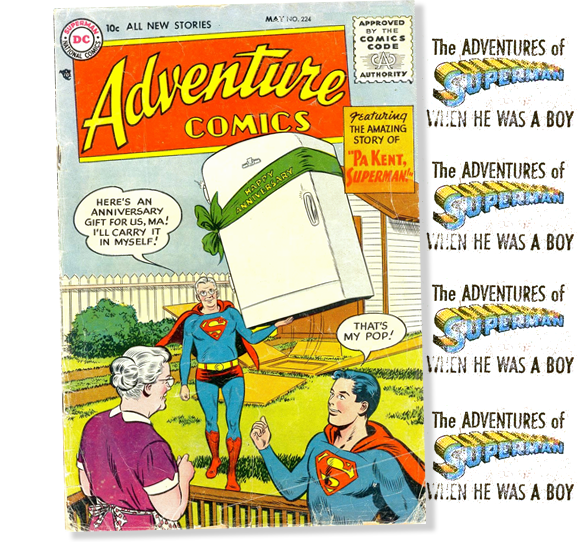
I put it to you, 🌭s, that Superman’s dad is out of his goddamn mind– an insecure idiot who is almost specifically the last person you’d want to be the guardian of an alien god baby. Let’s look at three issues of Adventure Comics (The ADVENTURES of Superman WHEN HE WAS A BOY) where Pa Kent was given superpowers.
In the Silver Age, there were three ways one of Superman’s friends could gain superpowers.
#1: They didn’t. They just put on a costume and went crazy.
#2: They touch or drink some magical or radioactive thing.
#3: They didn’t. It was some stupid robot or whatever.
Adventure Comics (The ADVENTURES of Superman WHEN HE WAS A BOY) #224 is an example of #1. It starts like most Superboy stories– Pa Kent is meeting with an elderly man and agrees to go into his basement to let him shoot some pictures in a skin tight costume.
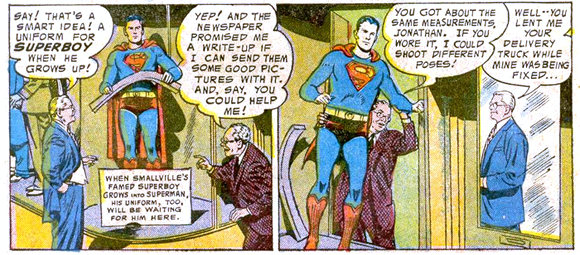
Ha ha ha you thought I was kidding, but no, this plot is based on every single cosplayer’s DMs. This guy made a sexy outfit which will be waiting here for the day Superboy becomes a Superman, his words not mine, and Pa Kent is miraculously the right measurements, so maybe they could, you know, go into his home studio and take a few pictures for his portfolio.
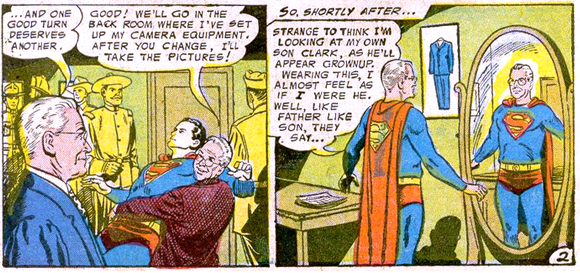
Any woman of any age would immediately recognize the danger they were in, but Pa Kent is a married Christian farmer from Kansas. He gets undressed and wads his body into this affectionate bachelor’s homemade unitard. And of course, the next thing he knows, he’s waking up with an amateur photographer on top of him.
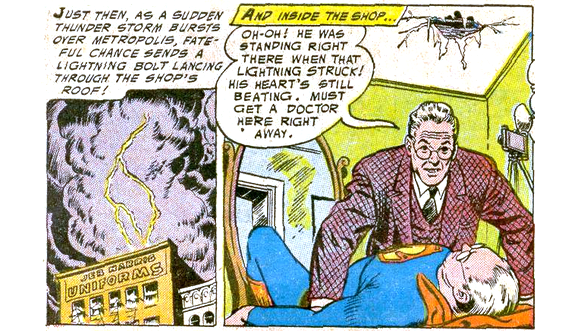
Ha ha ha you thought I was kidding again.
What happened was, a “sudden thunder storm” appeared and shot him with lightning through the roof and three stories of cement building. After the weather suddenly cleared, he woke up, saw he was wearing Superboy’s costume, and decided he must be his own superhero son. I guess for Pa Kent, all this was easier to accept than what really happened.
I don’t have a panel to show you where he processes all this since it happened off camera and was explained to Superboy by the doctor who treated him. Normally you wouldn’t reveal these kinds of things about your patient to a stranger, but the (maybe?) doctor decided the safest thing to do would be for Superboy to help convince his disoriented father he has superpowers.
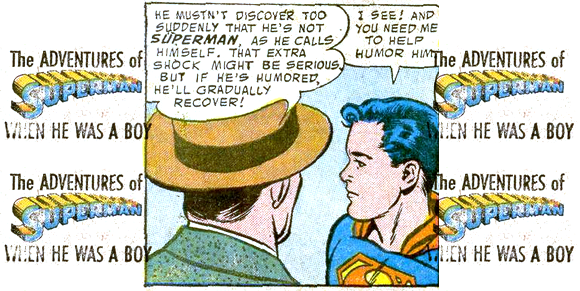
So, okay, it’s a 1956 comic which means we need to take a deep breath and catch up every few panels. This very confused old man, who has recently lost the last of his innocence, has been prescribed some amount of “everybody pretend he’s a superhero” by a pedestrian claiming to be a medical doctor and acting as a psychiatrist. It’s eye-clawing madness. It’s like someone trying to get fired from the Black Mirror writing staff by pitching, “What if we did exactly Batkid, right, but it’s an alzheimer’s patient and we start with some sex stuff?”
Anyway, you might be thinking this sounds unsafe, and you’re right. Pa Kent, humored madman, immediately jumps out a fucking window.
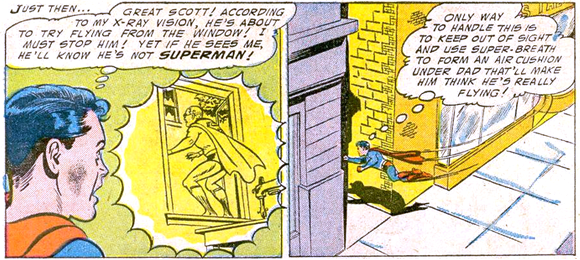
Instead of catching him and saying, “Okay, this shit is over. Dad, you need to get ahold of yourself,” he flies below him, huffing and puffing his poor father into the air with super-breath. Neither of them learn anything. The next thing Pa Kent does is jump in front of a truck.
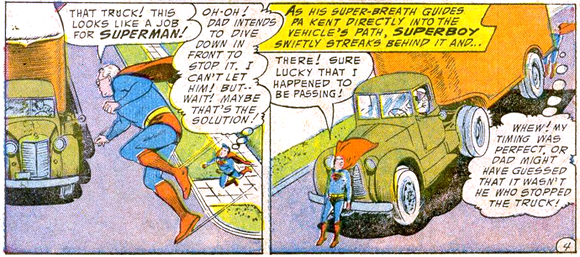
Notice it’s not a truck described as “runaway” or “driverless.” Pa Kent flew in front of a driver minding his own business. And wait, shit, did I say flew? We should remember he’s not really flying. He’s more like a concussion victim riding a burp, which means his son blew him into the grill of a moving truck. And to what end? This driver getting his truck torn in half thinks he’s killed someone! And I don’t think it would have helped if Superboy explained, “Sorry! I’m trying to protect the delicate mental health of a sex crime victim, my da– NOT my dad!” We’ll never know, though; since they just flew off letting this driver forever wonder why two Supermen dropped from the sky to fuck both ends of his truck and leave.
So we’ve established that Superboy is willing to throw his father into danger and terrorize strangers in order to protect this delusion. Following that possible doctor’s experimental psychological advice is that important to him. All he needs to do is keep him alive and pretend to not be Superboy until this passes. Easy. Young Clark Kent does this all day every day with literally every other person on the planet.
So Clark covertly blows his dad home for a nap. Then, in full Superboy costume, shatters wood at hypersonic speed with his bare hands outside his window. “Oh-oh!” Clark thinks when Pa sees his son, Superboy, doing Superboy things and starts to solve the mystery of how he, himself, is not Superboy. Most DC writers liked to work by aiming their face at a typewriter and shrieking until the centipedes eating their brain stampeded out of their mouth.
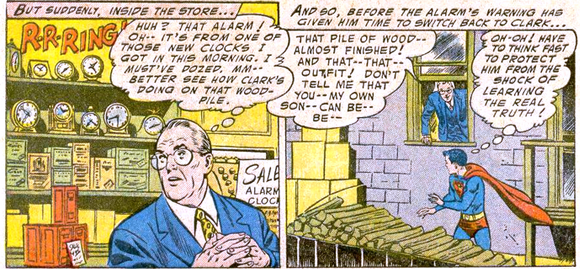
Okay, so his dad saw him as Superboy chopping wood at Superboy speed. It’s over. Wait, no. No. He can fix this! He can fix this!!!
Superboy thinks, “I dressed up to do my chores as a tribute to you!” and aims his X-ray vision at a nearby clock. I don’t want to get into all the time science behind this, but it heat-expands the clock spring to force the hour hand forward. “Aiiiieeeeee,” screamed the Adventure Comics writer, herding his mind centipedes onto the typewriter keys.
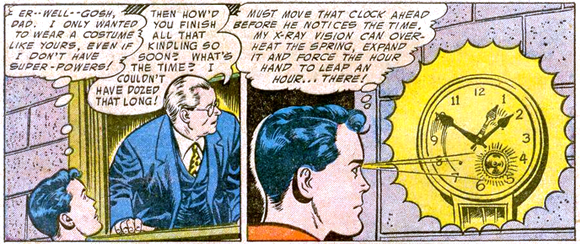
Wait, wait, fuck, hold on. Did I say thinks? Oh my god, I’m right. That’s a thought bubble, not a word bubble. So Superboy didn’t actually say anything to his dad. He silently looked at him. Which was enough? Pa Kent is fine thinking, “Well, I saw him being Superboy, but on the other hand, he did glare at a clock. I should give him the benefit of the doubt.”
We’re having fun, but this is obviously an unintended mistake by the letterer. Which is maybe worse than the regular absurdity because it means we now can’t trust the narrator, storyteller, characters, or the editorial staff. Someone might have accidentally translated and illustrated the assembly instructions of a German end table. Or Pa Kent might still be back in the costume salesman’s basement, where like the enduring Zack Snyder film Suckerpunch, all these events are taking place in the main character’s subconscious as they’re being molested. Hold on, that can’t be right. I better look that u– oh my god, I’m right again.
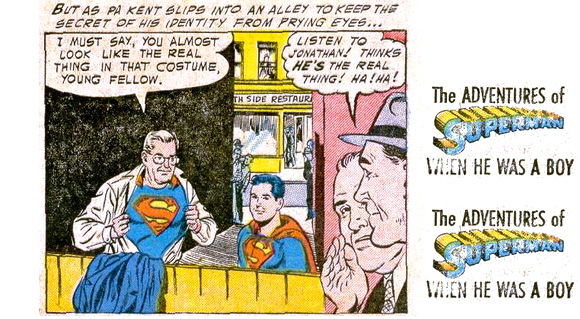
Superboy takes his dad outside so he can change his clothes in front of everyone because the entire community already knows about his derangement and they have gathered to laugh at him. Two men are several feet in front of him, laughing about it where he can see and hear them. The doctor, who I’m growing more and more certain was not a doctor, didn’t tell Superboy to include a public humiliation element in his father’s treatment. He came up with this all by himself.
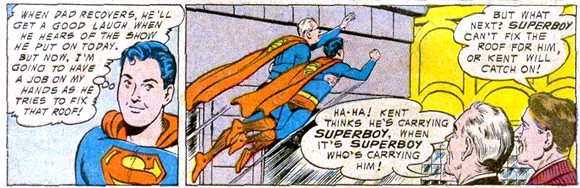
Pa Kent, more certain than ever he is the grown up Superboy and this young lad is merely a stranger who chops wood for him in similar clothes, suggests replacing the roof of a nearby building. “Sure, why not? This is funny,” thinks his son. More people gather to make fun of him as he has a full mental breakdown but far, far more dangerous than that sounds.
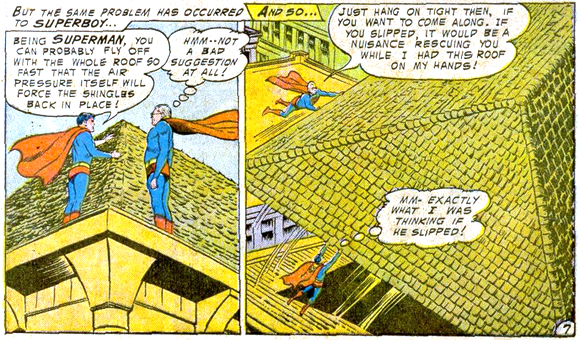
Superboy lets his father, who is now a condescending asshole, cling to a speeding roof with his ancient, arthritic fingers. Pa Kent has only “had super powers” for an afternoon and he already finds these mere mortals to be nuisances standing in the way of his mighty whims. So Superboy spends the day testing the limits of his arrogance by throwing him into fires and gunfights. Ha ha ha this time I’m actually kidding.
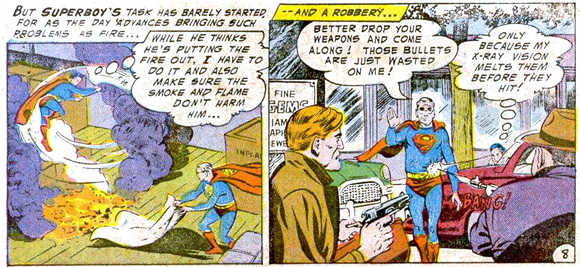
No I wasn’t.
Superboy lets his awful dad inhale a warehouse fire while he impotently flaps a blanket at it from a diaper. And everyone in the city knows what’s going on except him and the gunmen painting him in white-hot liquid bullets. Then Clark Kent dedicates another small portion of his cosmic abilities to replacing all of his father’s furniture with balsa wood replicas.
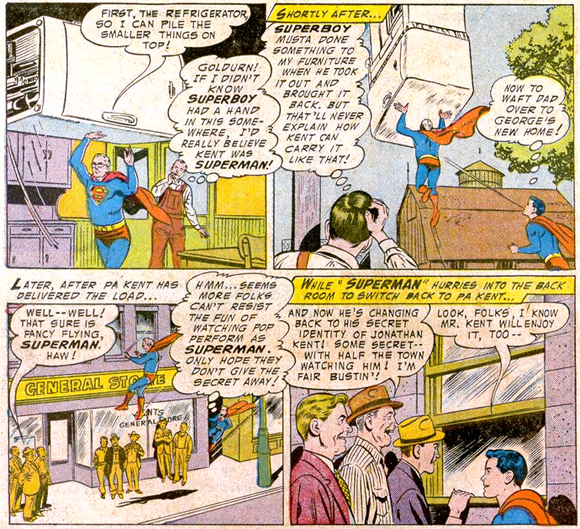
The humiliation never stops. He tosses his dad’s body between zany bits like a less respectful Weekend at Bernies. And this prank has become so widely known Superboy’s new concern is that the townspeople are such bad actors his dad is going to figure out he’s not actually Superboy from their sarcasm. Which is ultimately the goal, sure, but without such medically unsafe suddenness? Oh no, guys, I just realized THIS COMIC BOOK MIGHT BE CRAZY.
Okay, this illusion is being maintained by an entire city of performers and all of Superboy’s amazing powers, so it’d be a shame if someone blew it by just blurting out “this poor fool who isn’t Superman thinks he’s Superman.”
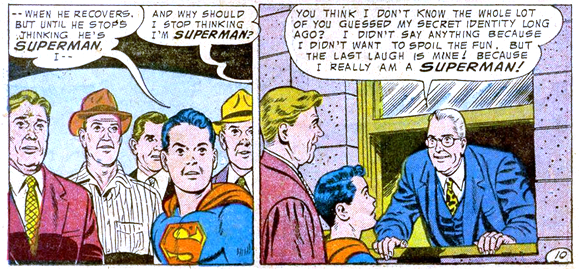
Superboy blurts this out right in front of him. Hours of effort and millions in property damage are wasted, but what’s this? Oh no, what? Instead of figuring it out, Pa Kent says, “While you guys are talking about how I think I’m Superman, this is the perfect time to reveal my secret identity: I’m Superman!” If my daughter was making this up I’d tell her, “No. Absolutely not. You’re fucking four now! That’s too old to string together random senseless bullshit and call it a goddamn story!!”
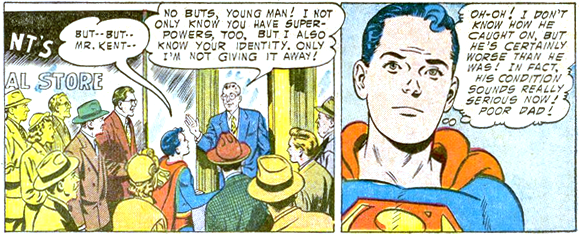
Pa Kent starts to tell the crowd who Superboy is, and reality sets in as Superboy remembers that somewhere in this man’s unraveling brain is an important secret. And maybe blowing this hallucinating “lightning strike victim” from crisis to crisis while his closest friends mock him has worsened his mental condition. Maybe none of this was a good id– oh, good, he’s jumping in front of another truck.
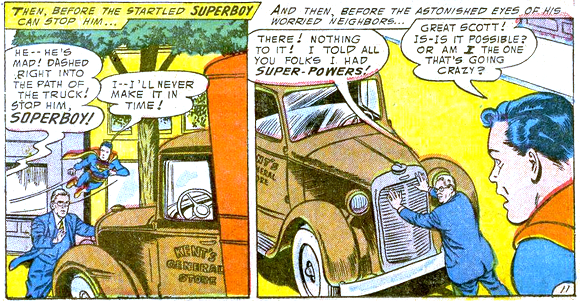
The theme of this comic is deceit and delusion. The reader and characters are all being lied to, intentionally or by mistake, so it’s worth considering Superboy was going to let Pa Kent die here. After all, it’s… suspicious… how he can x-ray bullets out of the air and instantly exhale a human-levitating updraft under someone falling off a roof, but when the guy revealing his secret identity is jogging into the path of this particular truck he’s all, “Oh no. No time to react. What a tragic fate for this chatty nuisance with all my secrets.”
B-but wait. Pa Kent… stops the truck? With his mighty super-strength? Are you telling us there’s a twelfth layer of deception in this ten page comic book!?
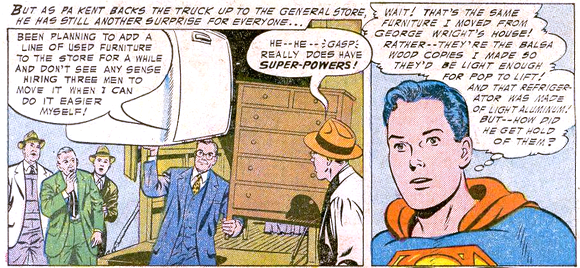
Wait, no… my mind. Pa Kent goes to the back of the runaway truck and starts… stealing furniture out of it? And it’s the same balsa wood furniture from earlier? How? Wait, I guess I know HOW someone could move extremely light furniture into a moving truck, but why? None of this makes sense, and Superboy agrees, but not for the reasons he or you think!
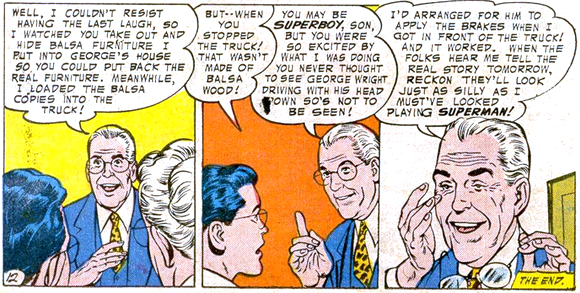
It was a reverse prank! Pa Kent had his friend hide under a steering wheel and drive into him with a truck full of Superboy’s prop furniture to confuse him! And it worked! “Fuck you, space lad! That’s how you super prank on Earth! Aaghhh! Hrrk! I’m still going through a lot, and some of it is your fault! THE END.”
So I would argue nobody handled that well, and the judgement of everyone involved was questionable. Pa took an unpaid modeling gig in a pervert’s basement and then he and his son took turns daring trucks, gravity, fire, bullets, and trucks to kill him. It was an entire day of dangerous dishonesty, the funniest kind of dishonesty, and it ended with everyone certain everyone else was humiliated. Now let’s jump ahead a year and see how Pa Kent deals with getting real superpowers.
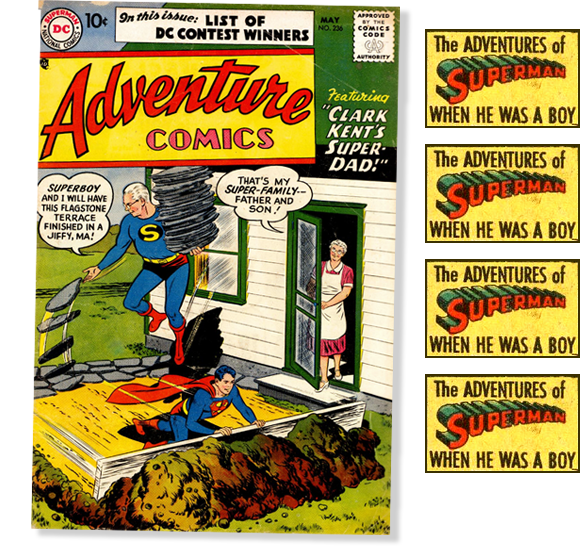
You might already be understanding the problem with Superboy as a concept. You can’t have this character engage in ordinary superhero adventures because Superboy is so powerful that anyone who can take him in a fight is, by definition, a galactic threat. Even the crazed comics writers of the ’50s understood you can’t create too many guys like that. The writers of Smallville solved this by making sure most villains died, but when every episode ended with them killing a child, that, in its own way, became a problem. The point is, Superboy stories were dumb fucking nonsense because what else would they be?
This story starts with two pretty egregious superhero mistakes. One, Superboy leaves out some unthinkable artifact from space on the dining room table. And two, Pa Kent starts screwing around with it.
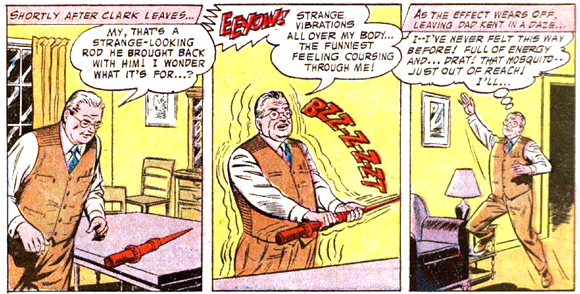
“Hmm… some kind of weapon or marital aid from the stars! I wish my boy with super speed and hearing were available to help make this decision, but I think I’ll grab it firmly with my ungloved hands EEYOW!”
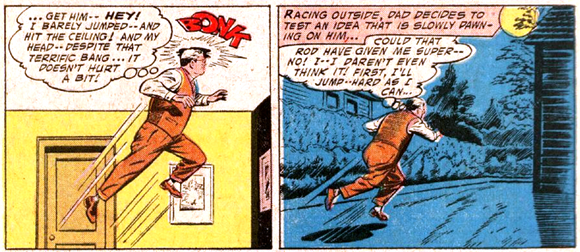
He handles it like you’d think. He immediately bashes into the ceiling diving for a mosquito, and heading straight outside to jump as hard as he can.
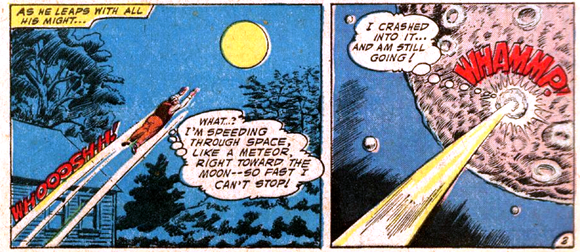
It goes perfectly. Pa Kent escapes Earth’s atmosphere and crashes into the moon. I’m not saying he makes poor decisions, but he has had superpowers for less than ten seconds and he was one micron to the left or right of plummeting forever through the empty void of space. This is the man who raised Superman from a baby. He watched his son’s powers develop over the course of dozens of shattered pets and accidental eye laser fires, and here he is accidentally abandoning his planet and family because he thought FULL FORCE was the best way to test his new star dildo legs.
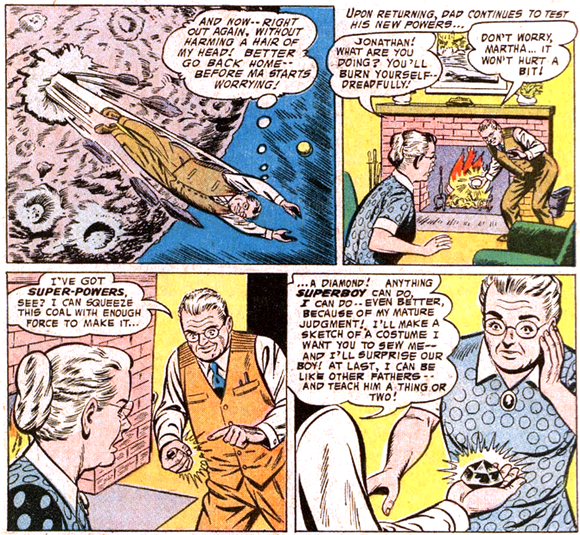
Pa Kent leaps back, because who cares? I think even a 1957 Superboy writer knew the Earth spins fast enough that hitting your own farm on reentry would be impossible on your second super jump. Pa Kent probably flattened some Mexican town and thought, “Luckily this crater of scorched skeletons broke my fall! Now to get home before Martha touches the artifact and overspins the salad!”
Pa pulls a piece of coal(!) from the fireplace and squeezes it into a diamond. “I have mature judgement!” he screams as more coal burns behind him in an unventilated room, his dildo-altered DNA writhing after an unintentional trip to the moon.
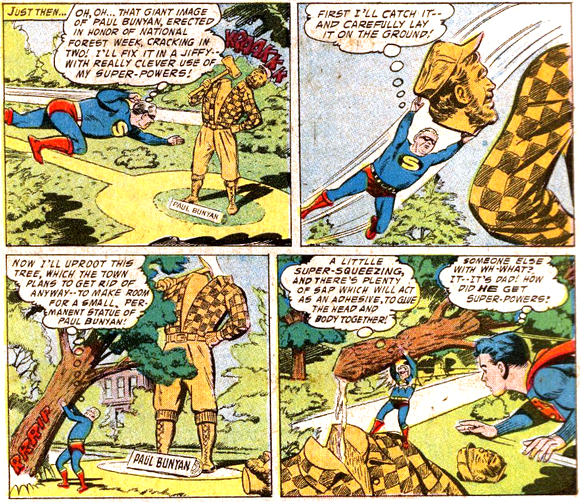
Pa Kent sets off to be a better superhero than his son, first by… seeing the head fall off a Paul Bunyan statue? He is weirdly confident this is a temporary Paul Bunyan statue, so he tears up a tree where he thinks will be the site of a smaller, permanent Paul Bunyan statue and squeezes it to glue the temporary statue’s head back on, at least until National Forest Week is done being honored. I’d argue every single one of these details is insane from the town’s statue decisions to Pa Kent’s knowledge of them to the timing of this spontaneous shattering to his solution. If I was Superboy and came upon a man milking a tree into a statue’s crevice, I would fully expect him to say, “Join us, Super! Boy! Gllggbbb! Sticky juice for the fucking! Glbllbbbbgggg!”
Instead, he says, “Hello, son. It’s me. Your father. Let me show you how a real mature superhero fixes a public park.”
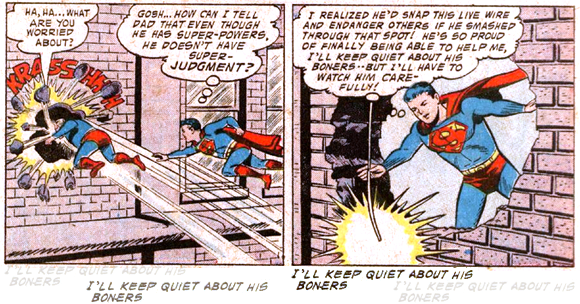
His father is a maniac. He is smashing through homes, ripping up trees… unleashing all manner of dangerous boners, Superboy’s words not mine.
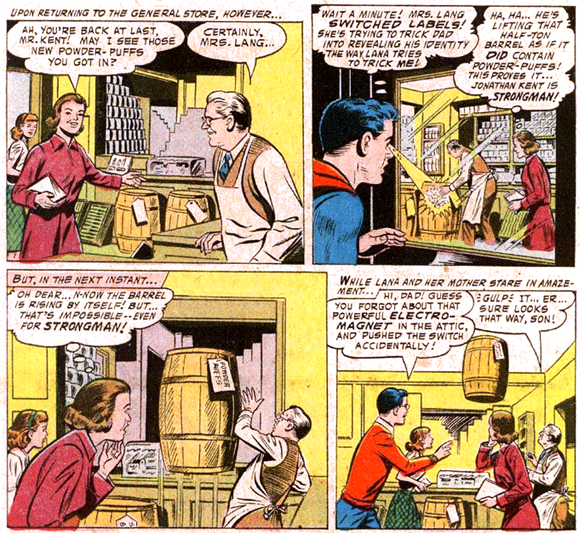
With the superman powers comes superman drama, which in the ’50s meant a nosy broad was always trying to reveal your secret identity (the man with your face operating out of the same town). So Lana Lang’s mom is staging tricks to get Pa Kent, full rampaging lunatic, to reveal he is Strongman. And he does. At the very first opportunity. He picks up a 1000 pound barrel in front of her. Case closed.
Except! Superboy saves it by levitating it and saying, “He could only lift that giant barrel because of our attic electromagnet which works only on barrels!” And since the Langs are women in the ’50s, they say, “Jeez, I guess you men are right.” Also, wait, I don’t think Superboy can levitate barrels. Let me look it up, and oh my god, Mrs. Lang was correct– men are always right.
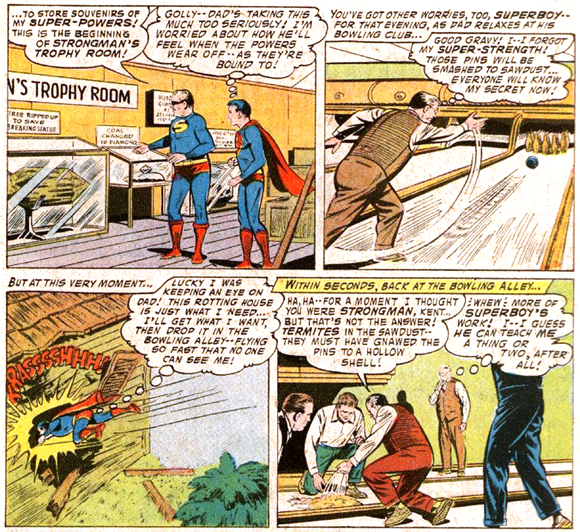
Pa Kent, mature hero with good judgement, reveals his secret identity again when he forgets his strength and obliterates a set of bowling pins. Luckily Superboy covers for him by… no, this can’t be right… fill the bowling alley with termites!? “Don’t worry, dad! I’ll simply get two buildings condemned because you’re too stupid for bowling!”
Watching his close friends try to make sense of this madness as termites devour their business equity, Pa Kent starts to realize he might have more to learn. But this does not make him humble. It makes him insecure and desperate. When the next crisis hits, a nearby falling plane, he orders his son to let him rescue it alone.
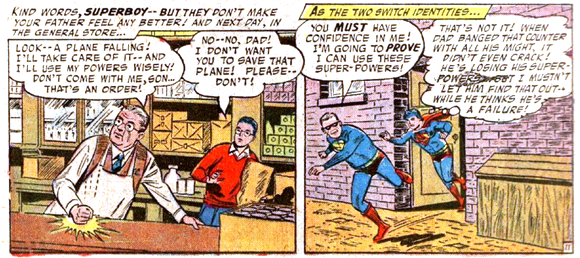
It’s worse than him being clumsy, stupid, and impuslive, though. Pa Kent doesn’t have powers anymore. And for the same reasons that made him a bad superhero, he has no idea. So he charges off to rescue a plane, alone, with the abilities of a middle-aged coal-huffing retailer.
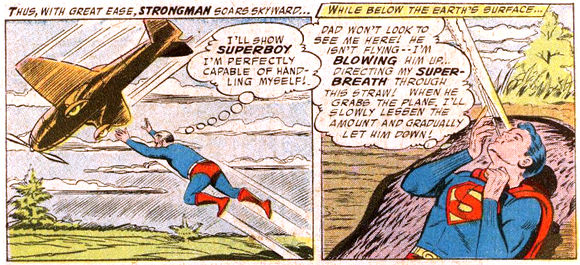
So secretly, Superboy buries himself in a hole and uses a straw to spurt his moron father into a plane crash. This shouldn’t have worked! But more importantly, Superboy shouldn’t be willing to put more lives at risk to protect his father’s fragile delusions and ego.
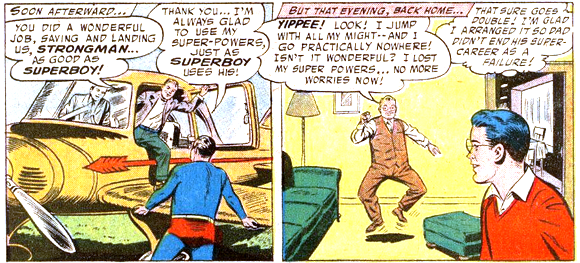
Speaking of delusions, after he no longer has powers, the precious abilities he bragged about and instantaneously transformed his life and personality around, Pa Kent put on a big show about how losing them was actually a good thing. Sure, Pa. We were there. You went from curious star-dildo toucher to “actually I’m a way BETTER superhero than Superboy” in five goddamn seconds.
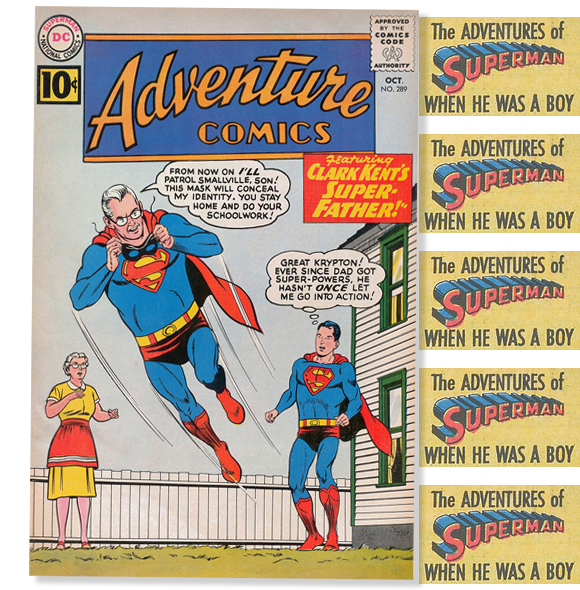
I hate Pa Kent so much. Let’s jump forward to 1961 to Adventure Comics (the ADVENTURES of Superman WHEN HE WAS A BOY) #289 to see his third take on Tertiary Superboy Character Gains Powers, and I’ll try to move it along since we’re 3200 words into this.
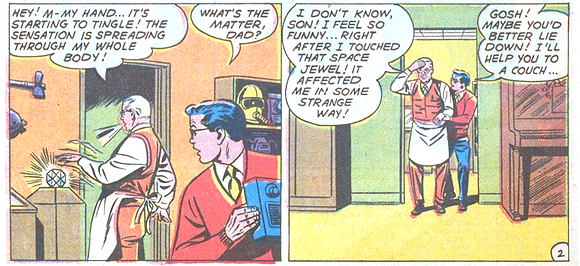
It starts with the standard Pa Kent wisdom. “What’s this strange space jewel? No time to ask my son! Got to touch i– ARRGH AN UNEARTHLY SENSATION!”
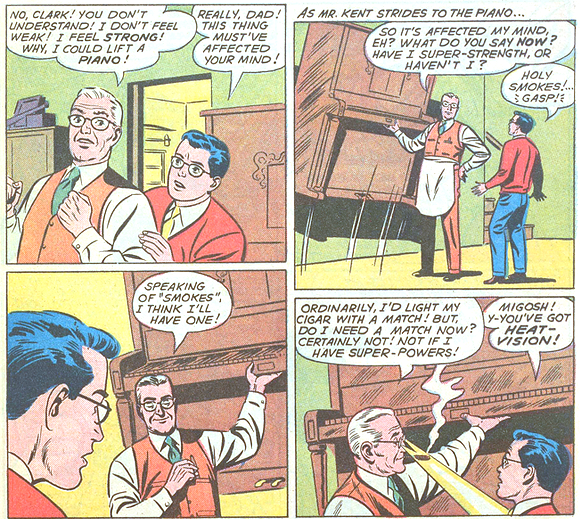
Setting a new record for space-jewel-touching-to-disaster, Pa Kent has already wrecked the family piano and heat-visioned a hole in the floor before he’s crossed the room. Time to jump onto a table saw, dick first.
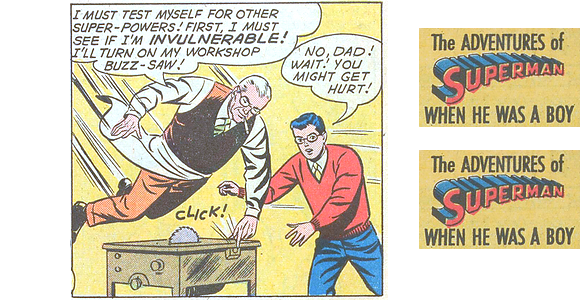
Ha ha ha I was going to say you thought I was kidding, but there’s no way I got you with that one. You knew the second he touched that space jewel Pa Kent was going to try to fuck a table saw.
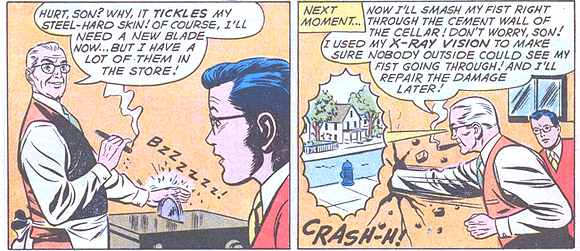
He wrecks the saw and punches a hole in the wall. “Fuck you, son. Fuck our house. Let’s break all the furniture– oh! Oh, let’s go smash your boy robots! If you’d have ever listened to me, this is the kind of shit we could have been doing with your powers this whole time! Pa! Kent!”
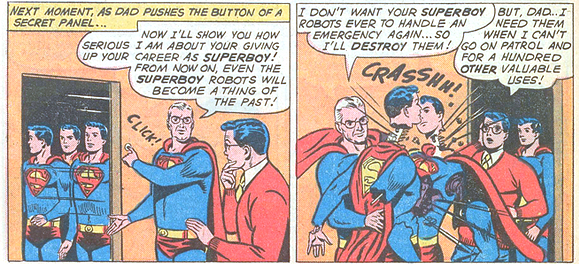
This rampage has a slightly different tone than the other times Pa Kent gained superpowers. Destroying the humanitarian robots and ordering Clark to stop being a superhero seem like red flags. And speaking of two red flags whistling right by Superboy…
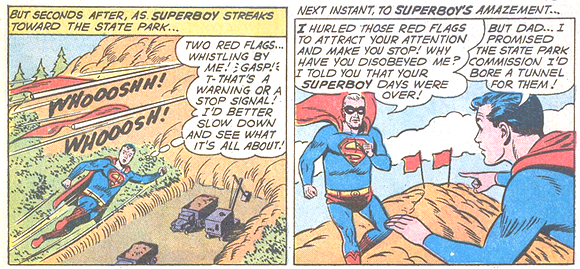
… two red flags whistle right by Superboy. It’s Pa Kent stopping him from helping others! Nothing suspicious there… let’s see what happens next.
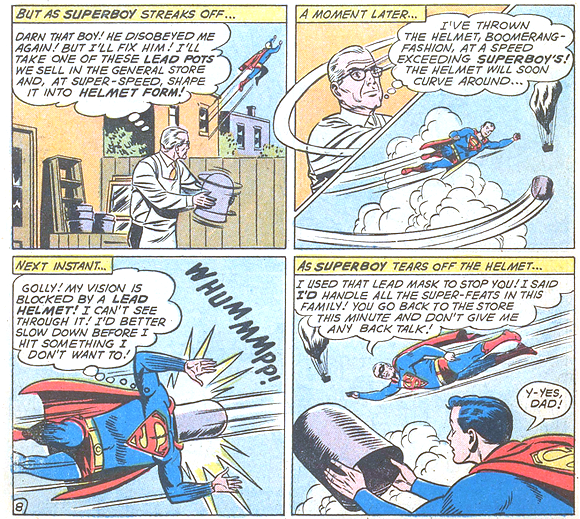
Okay, his dad throws a bucket on his head (boomerang-fashion) while he’s trying to rescue a falling balloon. If it was anyone else, this would seem strange, but this is totally Pa Kent’s idea of both good judgement and hilarious prank.
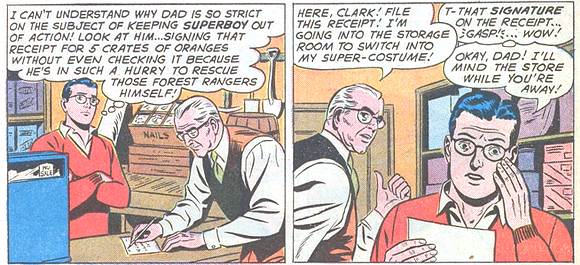
Hmm… something about the way Pa Kent signed for oranges while forbidding Superboy from rescuing forest rangers was unusual. Can you guess what it is!?
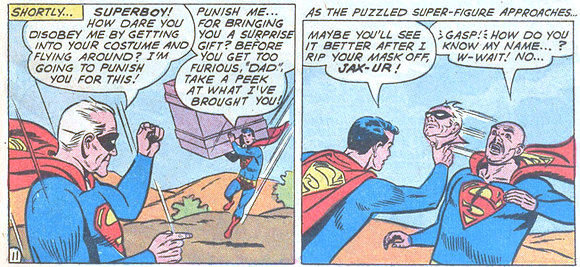
Gasp, it wasn’t his father at all! It was Kryptonian scientist Jax-Ur in a mask! Wait, assuming it was a really good mask and his impersonation was perfect, can’t Superboy see skeletons? Identify people by heartbeats? H-he should have known, right? I don’t need to look this one up; it doesn’t matter. If an alien in a rubber father face can walk into your home, break all your belongings, act like an alien in a rubber mask, and you don’t figure it out for a week, you and your father don’t have a good relationship. Pa Kent is such an unpredictable piece of shit and rewrites his DNA so often that everything Jax-Ur did short of writing, “MY NAME IS STAR CRIMINAL JAX-UR” on a produce receipt was seen as normal Pa Kent behavior. That’s not a cute joke, by the way. That’s how Superboy figured it out.
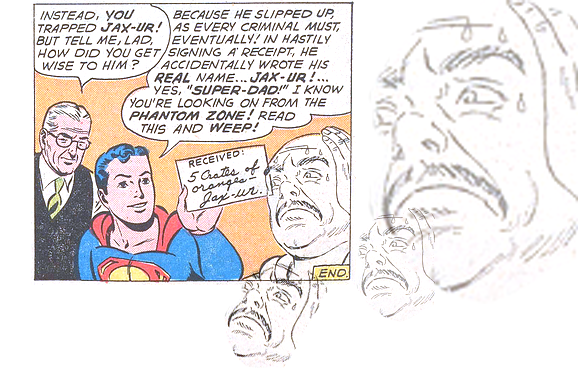
After catching this tiny slip-up, Superboy banished Jax-Ur to the Phantom Zone and we learn, dear God, every soul sent there can see Superboy. Jax-Ur is going to see him next time he’s blowing his senile father through the clouds. And when he lands and makes love to his wife Martha, careful not to crush her mortal bones, Jax-Ur will be looking on. “I know you’re there, Jax-Ur,” he’ll whisper. “Is that like a safe word?” Martha will ask. “No,” he’ll tell her. “It’s a lot to explain. Wait, right there. I’m! Hnngggg!! Do you see this, Jax-Ur! Look upon what I have done, Jax-Ur!” Whoa, holy shit, this article really got away from me.


 Unlock with Patreon