Category: NERDING DAY
 Unlock with Patreon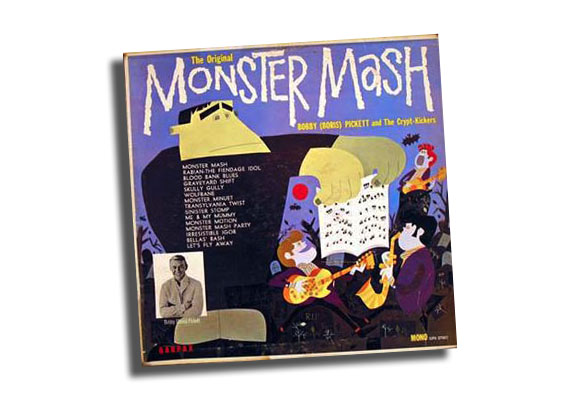
The Monster Mash is a work of genius. Christmas songs are a genre, but the “Monster Mash” stands alone. It’s the only Halloween song. Don’t come at me with your other vaguely spooky songs. Don’t say “Season Of The Witch” to me. Don’t be the “Ghostbusters” guy. Those are songs you can trot out at Halloween, but we all know they’re pretenders to the throne. If you ask someone to name a Halloween song, they’ll say “Monster Mash” first one hundred percent of the time.
Every year around Halloween, the Monster Mash discord begins. Is it a song about a dance, or is the song discussed within the song also called The Monster Mash? That’s a boring question, but I’ll answer it. The Monster Mash is a song and dance created by Boris, the mad scientist narrator of the song. How do I know this? Because I’ve Monster Mashed harder and longer than anyone.
I’ve listened to “The Monster Swim,” “The Monster Rap,” and the entire album The Original Monster Mash. They had to call the record The Original Monster Mash to distinguish it from a rival Monster Mash album released the same year. You see, nobody has a trademark on monsters mashing. That’s why there’s so much bigfoot erotica on amazon.
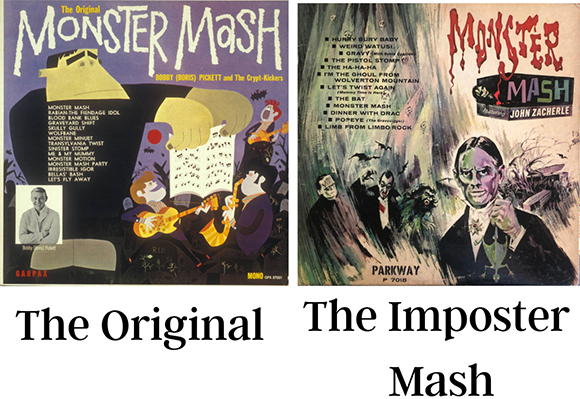
Bobby Pickett won the war of the Monster Mash’s not because his album was the most creative or the best produced. I think John Zacherle’s Monster Mash has much more to offer in terms of both musical composition and lyrical creativity as a whole, but he’s not the impressionist that Pickett is. Pickett also showed a commitment to the Monster Mash. He was still putting out Monster Mash content in 2004. That’s forty-two years of furiously Monster Mashing. In that amount of time most people would find a second, even a third passion.
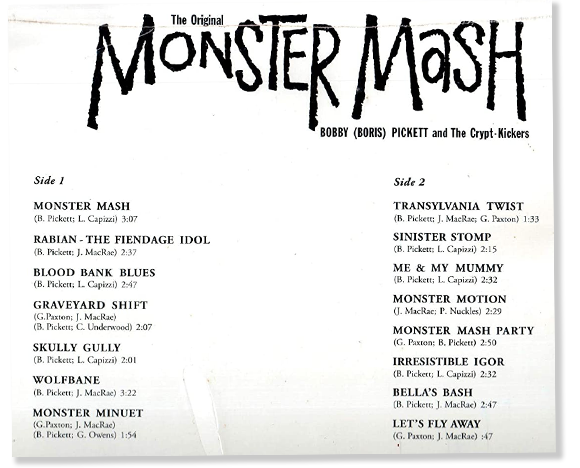
The most interesting thing about “Monster Mash” is the lore Pickett created for his characters. He was the original slash fiction writer. Monster Mash has a large cast of musical monsters and discusses the effect entering into the music industry has on their lives. The most deeply affected monster is Dracula, who plays the role of Turtle in Entourage to Boris the mad scientist’s Adrian Grenier. We first hear in the original Monster Mash that Dracula is disappointed to have his hit song “The Transylvania Twist” replaced by the “Monster Mash.”
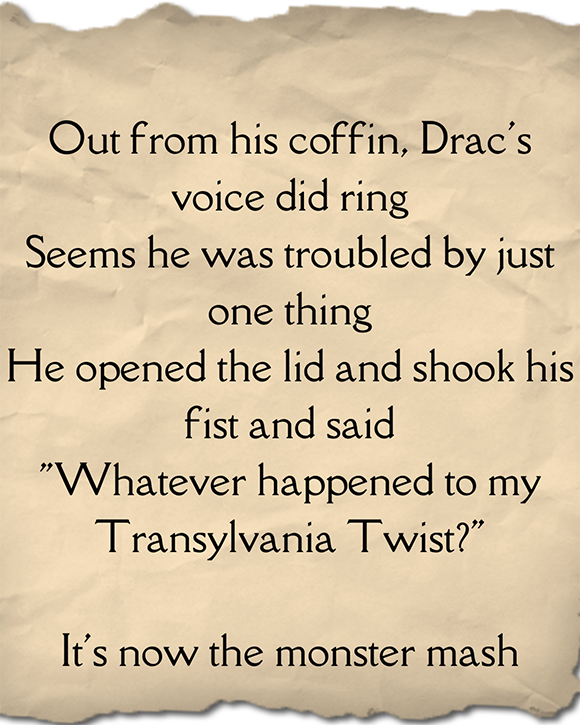
People have recently taken this line out of context and suggested that Boris stole “The Transylvania Twist” from Dracula to make the Monster Mash, but I’m familiar with both canonical versions of “The Transylvania Twist,” and neither sounds anything like “Monster Mash.” The Original Monster Mash has a version of “The Transylvania Twist” on it, and in 2004 a trio of musical melons sang a modernized take on the song in the film Spookley The Square Pumpkin. It’s…not great. It rhymes the word stomp with jomp. Jomp is not a word. If it was, it would be a Finnish Van Halen cover band or a sexually transmitted foot disease.
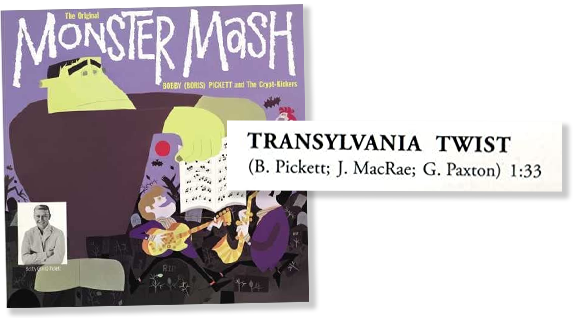
Coming in at the length of an average urinary catheter commercial, Dracula’s “Transylvania Twist” was never going to be the smash hit that “Monster Mash” was. Boris produced “Transylvania Twist” because he’s friends with Dracula and wanted to do him a favor. It might have been popular for a bit, and Dracula enjoyed his fame, but it was soon overshadowed by “Monster Mash.” The lyrics insinuate that people can’t resist doing the “Transylvania Twist,” but unfortunately for Dracula, it turns out they could! And did.
Boris then, out of the kindness of his heart, allows Dracula to join his now wildly successful band. I’m not sure what he’s bringing to the table there; I don’t think he plays any instruments. But by the end of “Monster Mash,” Boris and Dracula are on good terms again. Dracula is in a well paying job as a musician in a successful band. He should be thrilled. That should be the end of Boris and Dracula’s tension, but it’s only the beginning.
The first three songs on The Original Monster Mash are all about the deteriorating relationship between Boris and Dracula. After The Monster Mash opens the album, we go straight into “Rabian – The Fiendage Idol.”
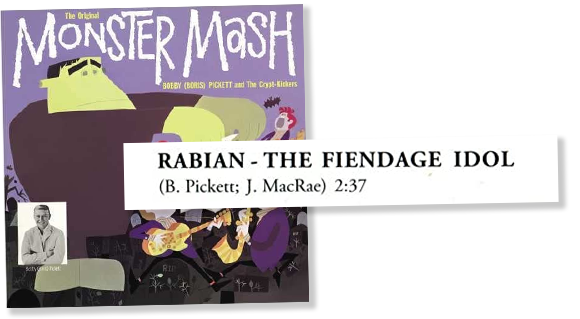
In this song, Dracula has come to Boris as the manager of Van Helsing, who has been transformed into a werewolf that wants to be a teenage idol. Sexy Teen Pop Star Van Helsing Werewolf is definitely something a fan-fiction writer came up with. I’m surprised I could type out that entire sentence without getting an offer to write it into season seventeen of Riverdale.
Rabian is a terrible singer, that’s the song’s punchline, but Boris blows Dracula off gently with the classic “don’t call us, we’ll call you” and “bring him around next week, will you?” We never hear about Rabian again.
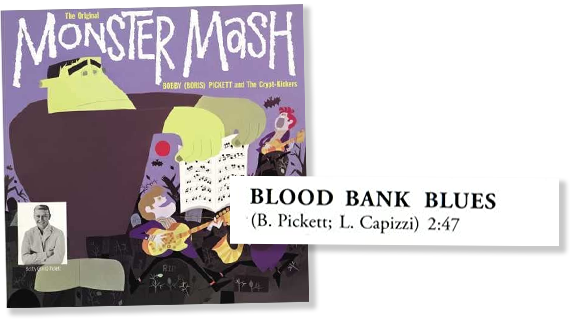
It’s Monster Mash canon that Dracula has a son. He attended the original Monster Mash when his father was the successful singer of “Transylvania Twist.” He never appears again, and it seems like it’s because Dracula lost custody. Otherwise, you would expect him to put forward his son as a potential teen idol before Van Helsing. The next time Dracula is mentioned in “Blood Bank Blues,” we see he’s in dire straits. His relationship with Boris has completely deteriorated, along with all of his money.
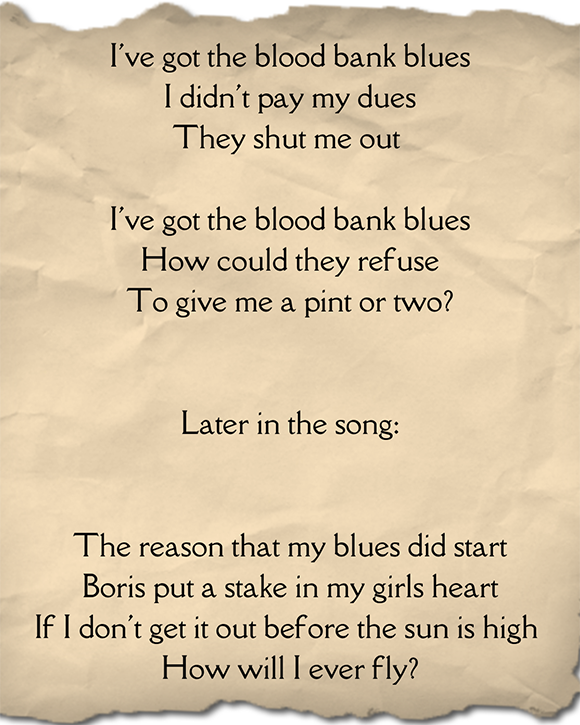
He couldn’t pay his bills, so he doesn’t have access to his usual blood bank. Toward the end of the song, which is mostly about how much fun drinking blood is, he completely switches gears and is like, “You know whose fault this is, BORIS!” Dracula accuses Boris of putting a stake in his girl’s heart. You might think this refers to Dracula’s wife, Vampyra Alucard, who is named in a later song because the Monster Mash lore is so endless.
I think Dracula was cheating and had both a wife and girlfriend at this time because my wife and my girl are the same amount of syllables. If Boris had staked his wife, that would be a much more upsetting statement for listeners here, but “girl’s” was an intentional lyrical choice to let us know how bad off Dracula is doing at this point. He’s broke, he’s cheating, he’s not making great music, and he’s blaming Boris for all of this. I feel bad for Dracula.
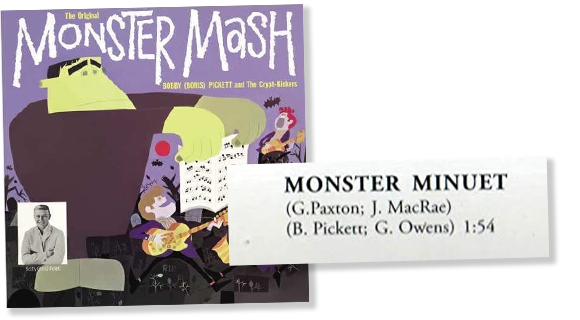
We then hear three songs with very little to no Dracula lore until we come to “Monster Minuet,” track seven of The Original Monster Mash, which is the craziest song in existence. It’s not even a song. It’s a spoken word poem where Dracula and Boris have a knockdown, drag-out fight at a party Boris is throwing. We learn Dracula’s full name is Count Dracula Alucard, and his wife is Countess Vampyra Alucard. They enter the party together, and Dracula immediately starts complimenting all of the beautiful ladies in waiting at the party, which pisses Boris right off. Things devolve into full wrestling kayfabe from there.
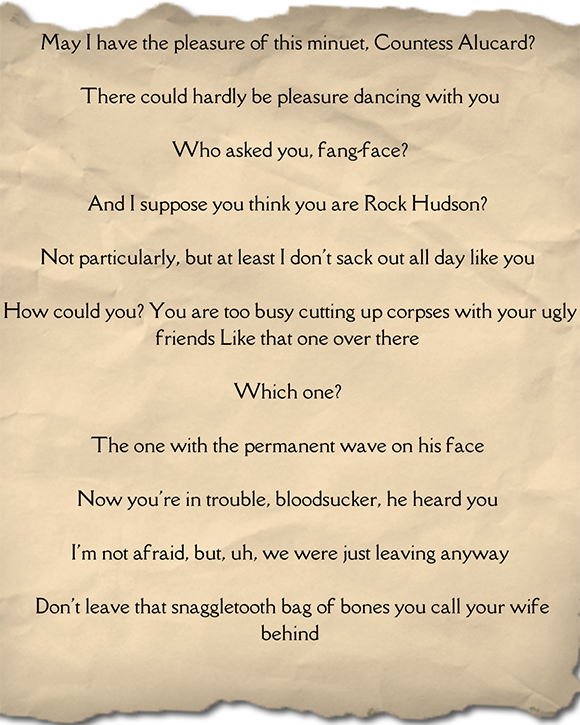
Bobby Pickett got so into his story he went full soap opera and forgot to write a song. It doesn’t rhyme. There’s no beat. You can’t go around your house singing, “Don’t leave that snaggletooth bag of bones you call your wife behind.” It isn’t even an attempt at a jam. It is nonsense. It is something you’d say to your husband if he came back from the bathroom during Riverdale and asked what he missed.
Then Boris meets and falls in love with a Mummy in “Me and My Mummy.” He’s ready to leave the record industry behind and settle down together in her ancient tomb. The relationship doesn’t last long, though and the song after that, “Monster Motion,” features Dracula doing a mental health check on his toxic friend Boris.
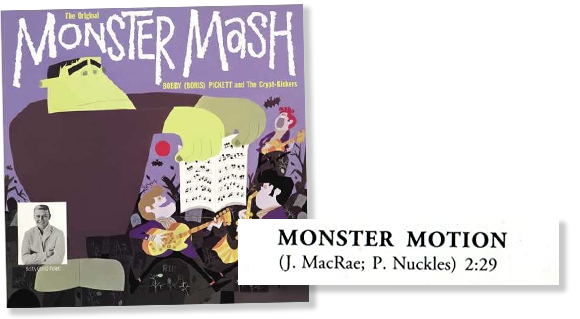
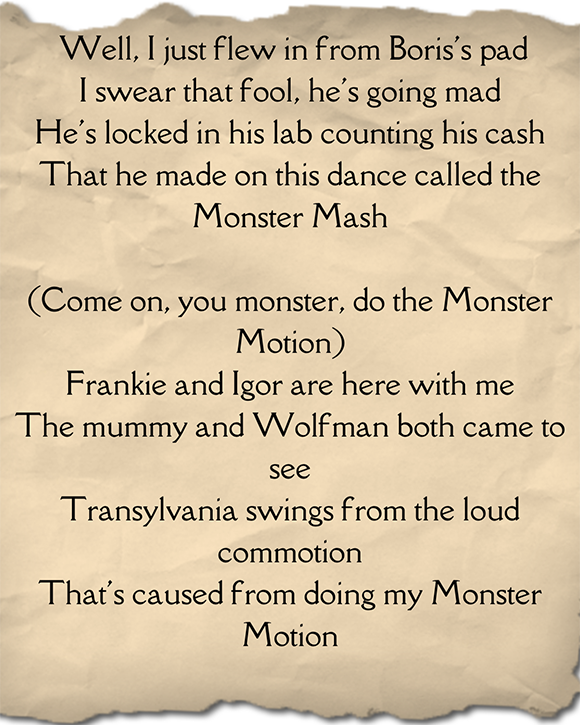
Dracula uses Boris’ depression to try and get a new dance craze going called the Monster Motion. It’s a blatant rip off of The Monster Mash, utilizing all of the same monsters in Boris’s Monster Mash now doing an unspecified motion that certainly isn’t mashing for copyright reasons.
There are a few other interesting pieces of Monster Mash lore scattered throughout the album. Igor is fucking Frankenstein’s wife. There’s a whole song devoted to what a sad loser Wolfman is, but the story of Dracula and Boris’ on-again, off-again friendship is by far the most compelling thing on the record. Dracula and Boris end the album on fairly good terms, celebrating Christmas together with all of their other friends by plotting to kidnap Santa Claus.
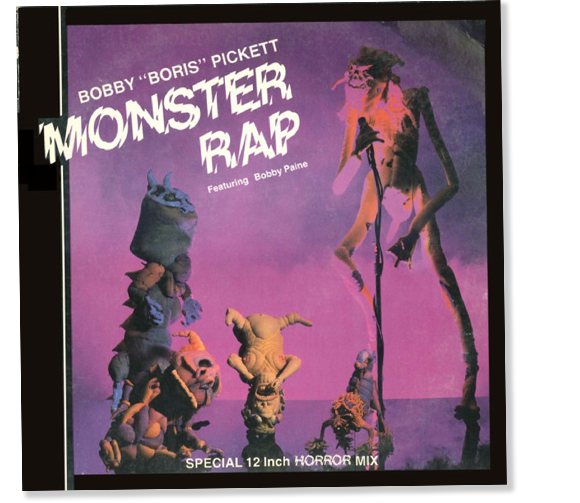
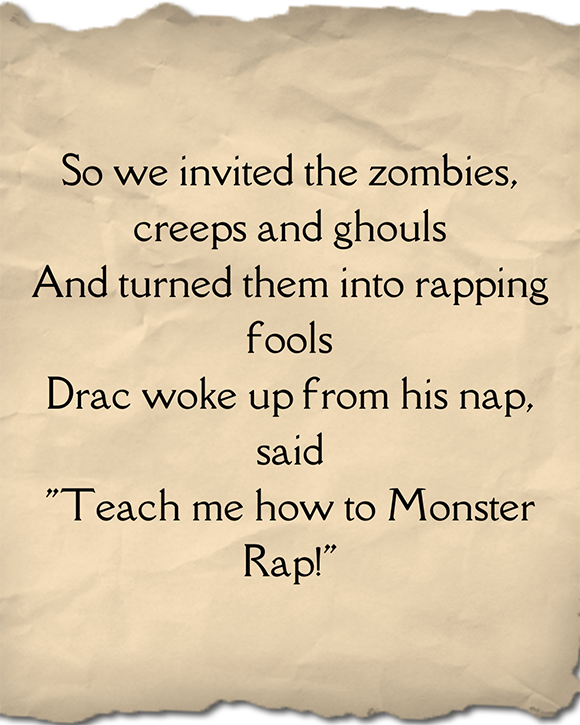
In 1984, when Bobby Pickett released “The Monster Rap,” he again included Dracula as the same sad, needy, failed musician character. This time Dracula hopes Boris can make him relevant again by teaching him how to rap. And it worked! Everyone remembers “The Monster Rap!”
So, if anyone ever asks you, “what’s the deal with Monster Mash” now you can tell them. It’s the beginning of a fascinating VH1’s Behind the Music episode about a failed musician named Count Dracula Alucard, and his producer friend, Boris. Discussing “Monster Mash” in any other context divests it from the full value of the total work.

…
This article was brought to you in remembrance of our fine sponsor and Hot Dog Supreme:Thomas Cavazos, who died of inverted feet. Fuck Jomp.
Categories
Nerding Day: Incarnate 🌭
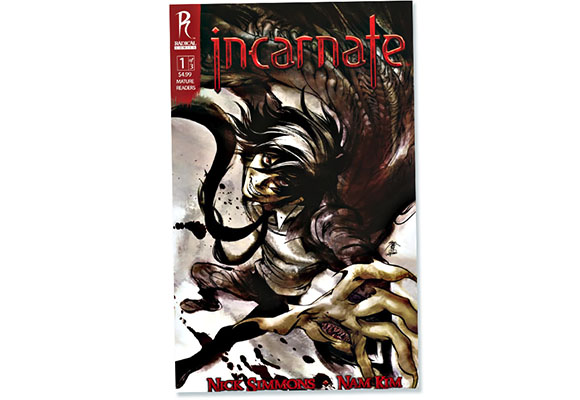
If you love your kids, consider failing. Superstars’ children put out comics like Incarnate.
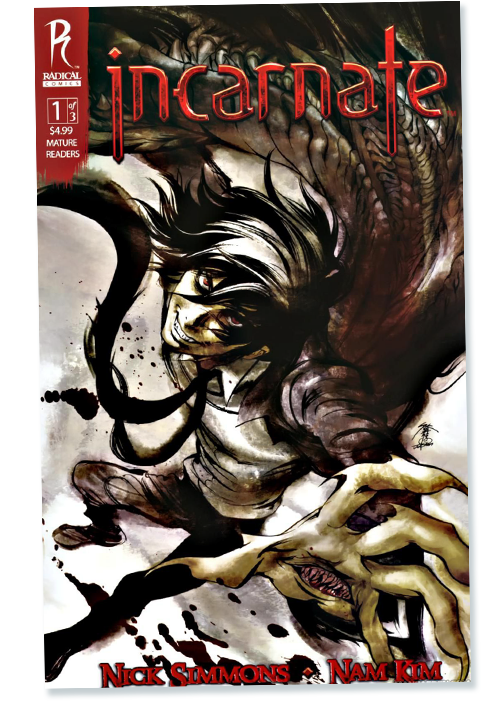
Incarnate is the literary premiere of Nick Simmons, son of Hollywood’s longest tongue. If you don’t know Gene Simmons, he was the frontman for Kiss and patient zero for treatment-resistant gonorrhea. As for Kiss, they made the Spotify suggestions your dad skips after Van Halen II. Presentation-wise, they walked so that Violent J could run.
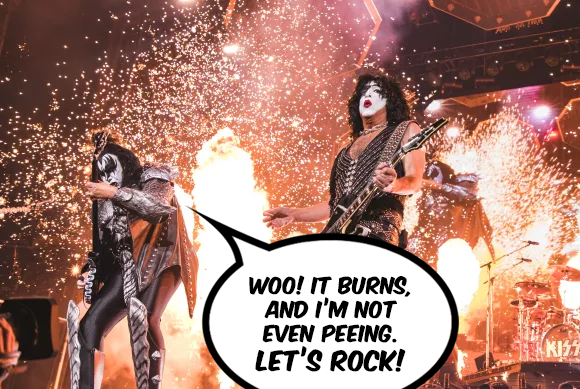
I’m not saying that glam rock, pop metal, or other rock for people that smile sucks. I’m saying that Kiss, specifically, sucks. When “Strutter” makes your Top 3, you’re in deep shit. Kurt Cobain was a Terminator sent back to destroy the Resistance’s worst music. To survive, Kiss turned the enemy’s own weapon against them:

It didn’t work out. Grunge was like the ring: you could try to wield it, but it only obeyed the depressed.
Incarnate emerged in 2009, two VH1 humiliations later. Nick Simmons took on script and pencil duties, debuting as a double threat. He seized a chance to sprint out of his father’s short creative shadow and spread his own breed of crabs. Challenging commercially, less so critically.
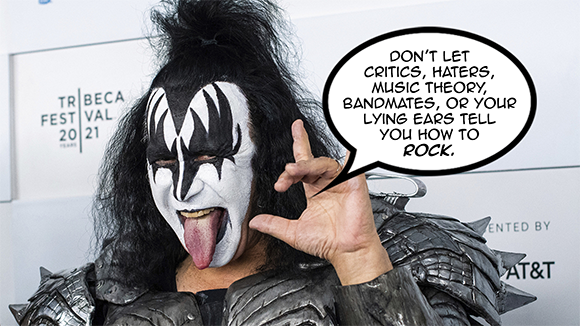
Shame that the result’s stitched together from Hellsing, Bleach, and everything else on Zumiez tank tops. Allegedly. You can’t believe everything you read. For example, the media claims water is a human right, but Nestle says to kneel. Nick might be another victim of U.N. misinformation.
Let’s give Incarnate a fair shake. It starts in an unnamed city haunted by shadowy predators– presumably Jersey City and developers, respectively. One slumlord laments his ways:
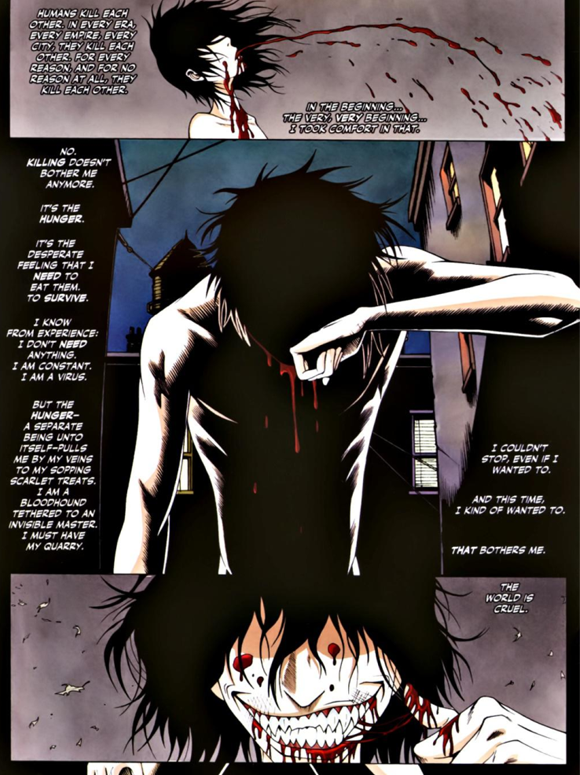
That’s Mot. He likes blood and talking about blood. Mot’s named after/is the Canaanite god of death, which doesn’t count towards today’s plagiarism charge. Tolkein reinvented a genre by swiping Beowulf’s wallet. This could be the next Return of the King! Or one of those bleak novellas edited by his son, where broken heroes overdose in elven alleyways.
The weebiest among you may feel an itch of familiarity. Ignore it, and focus on the horrorcore slam poetry above. “Sopping scarlet treats” is a sentence you get to read once in life (twice counting brilliant recaps). Soak that in, and bury any memories of better sequential art. Nick deserves a chance to be the least shameful Simmons.
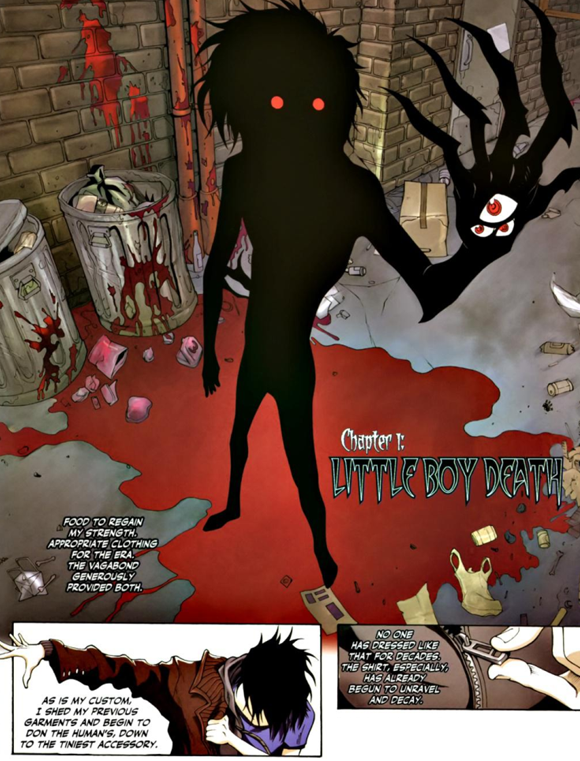
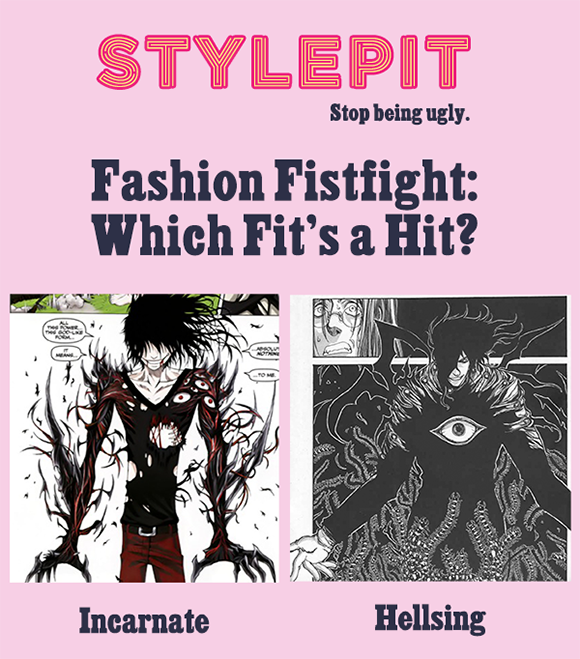
“Wait,” say the other attendees of the anime event hidden behind Comic-Con like a malformed/predatory/black royal. “Isn’t that Hellsing’s Alucard, the character I dressed like until the second amendment ruined trench coats?”
No. That’s a serious accusation. Alucard’s much harder to draw:
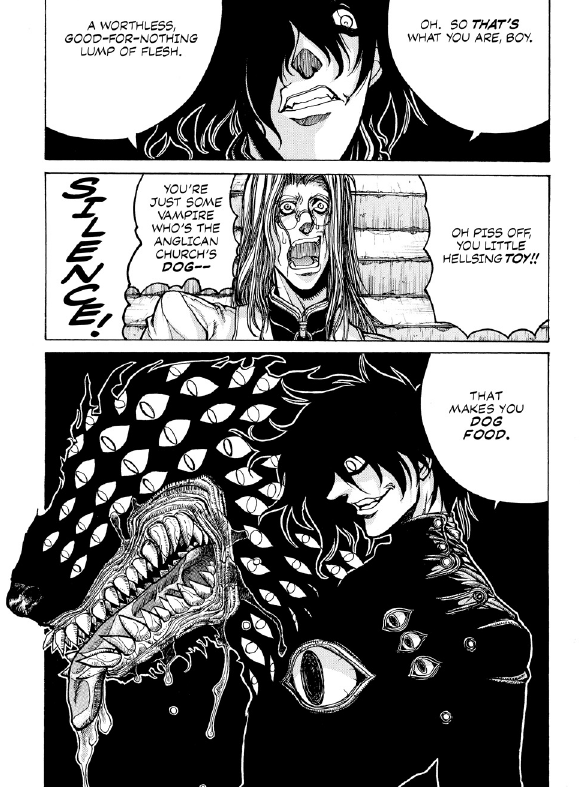
See? Incarnate’s design is simply Dracula backwards. I should know the name for that, but Columbia’s been demoted to a preppy kindergarten. Now I teach finger painting, and keep rainbow stickers away from clichés like smiley-face suns. It sounds harsh, but they usually stop crying by naptime. When you nurture hackwork, you end up with a Simmons.
I’ll grant that Nick took a few design cues. But he put his own spin on it.
Narrative spin. Mot’s not a vampire forced to hunt other vampires. More specifically, he’s not trapped in a vampire-hunting organization, alongside a louder and less experienced vampire, under the bondage-y control of a blonde heiress with attitude. New character, new IP, new profit margins. Nick can still get this shit into theaters before executives remember that they hate nerds.
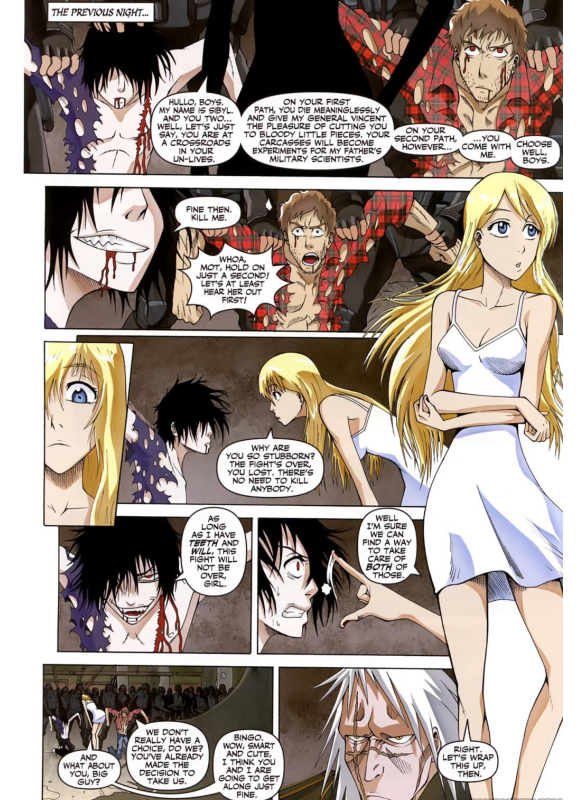
I cave. We’re in a place beyond plagiarism. Most of these panels look like webcomic drafts, and those are the forgivable ones. The rest are photocopied from the Little Free Library outside a GameStop.
For example, the dominatrix above:

That’s a direct lift from Bleach, which was a hit among conscientious prom objectors. I’ve broken the Great Anime Week Detente for good reason: Incarnate cribbed from the era’s most visible train wreck and hoped obsessives wouldn’t notice. That’s like saying you came up with trafficking migrants for votes. Someone in Texas with endless ammunition and impotent rage now knows you by name.
Perhaps I seem paranoid.

As you can see, Incarnate also has shades of a troubled relationship. While my demon brain does spawn jokes about domestic violence, I’m not publishing them. Otherwise, I’d be writing about Mötley Crüe instead.
Alright, so our faces come from the “Ctrl+C, Ctrl+V” school of art. Maybe Nick has more passion for his heels. After all, he’s drawn to darkness. Let’s check in on the ancient vampire cult that runs the world or some shit.
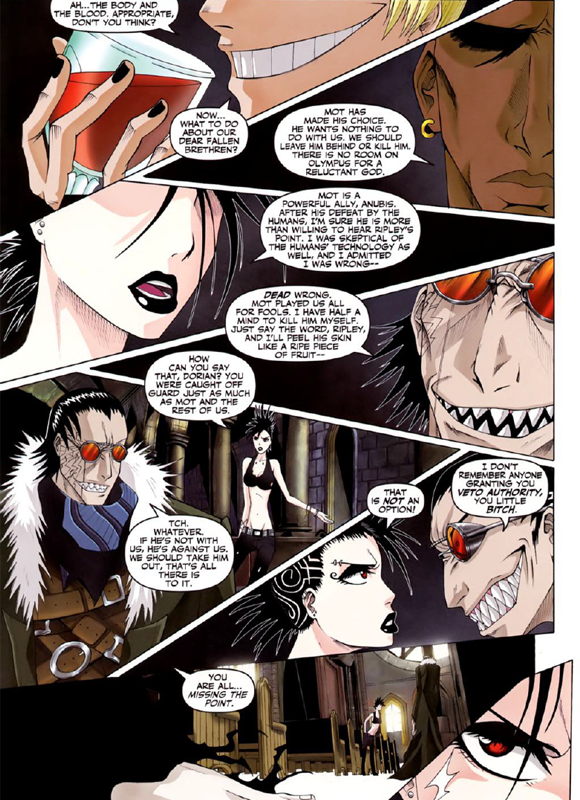
“There is no room on Olympus for a reluctant god.” That’s a dungeon master’s first draft, and I love it. I don’t think a meaningless line has ever meant so much to me. If Incarnate had two original panels, I’d call it mandatory reading.
This dialogue gives me a mile-wide nostalgia grin. Certain strains of garbage are contained to an era, like Kiss. It’s not just trash: it’s trash that can only exist at a specific cocaine-to-edge ratio. Incarnate is a perfect fossil, preserved in another fossil’s stolen amber. This cutscene just needs a final boss describing the main character’s girth to make me forget I’m on a melting planet.
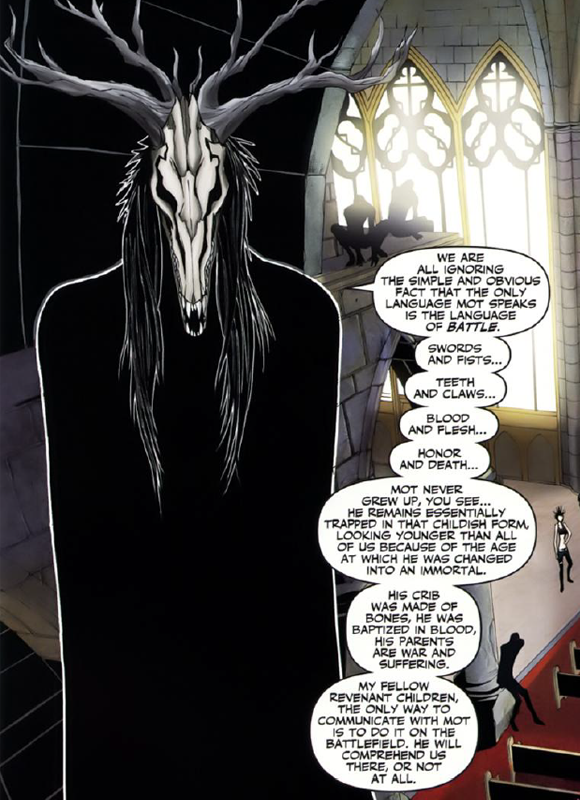
Thank you, Nick. I couldn’t ask for a better birthday gift. “The language of battle” is everything pop culture lost when nothing happened over six perfect years.
I see my best years in every poorly-colored panel. The first time I flirted with alcohol poisoning, writing like this was acceptable. The first time someone accepted an IHOP date with an unpublished satirist, only half of these lines were clichés. I could even say “vampire urban fantasy” without an editor groaning or an IHOP date leaving me with the check. If Nick didn’t have creative kleptomania, we’d be friends.
Anyway, all these designs are traced. Check it:
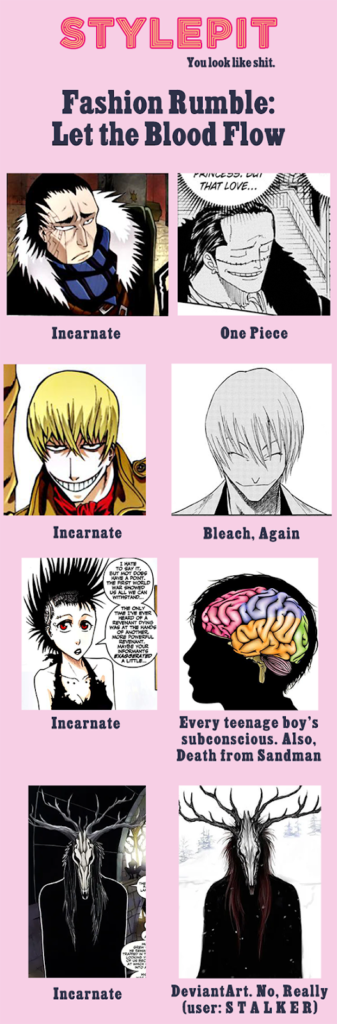
Yes, even antelope-head. I’m at least a third as disappointed as Gene. Maybe half. My tongue hangs at half-length in mourning.
I don’t know Gene Simmons, or what he’s like as a father. Maybe horny sobriety helped him raise a kid right, and this is all Nick. But it’s fun to cast this desperate plagiarism as the result of eighteen years of rockin’ neglect. Gene’s take on file sharing was, and I quote: “Sue everybody. Take their homes, their cars.” Making open theft the perfect rebellion.
Consider this nonsense:
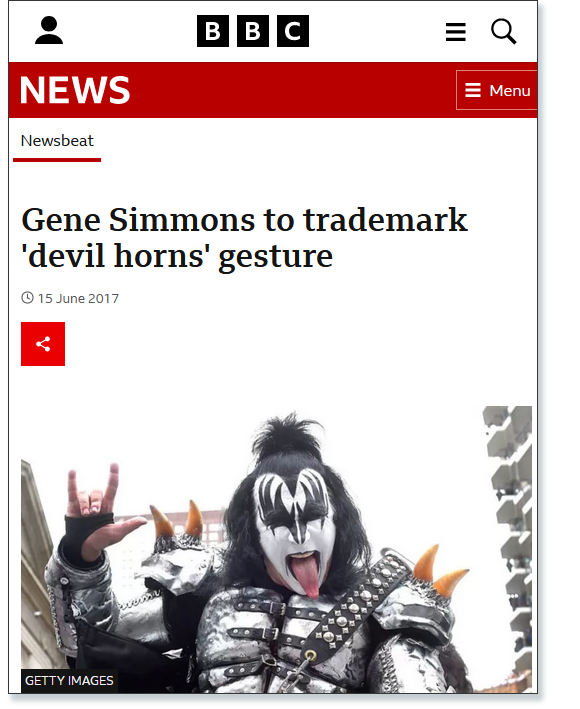
That’s history’s least metal filing. Metal has a spotty court record after all the Napster hunting, attempted spousal murders, and crispy churches. Gene topped it all by hunting for quarters under Ronnie James Dio’s casket. Incarnate may be a biblical curse for patent trolling.
Either way, the Xerox Illuminati battle the not-Hellsing Foundation, while Mot and his domme/victim battle puberty. But that doesn’t matter. Delete that data from your mind. What matters is my favorite trace. I’ve been holding out on you: Mot’s stock rival is a direct lift of Bleach’s only good idea. Kenpachi, the face that launched a thousand t-shirts.
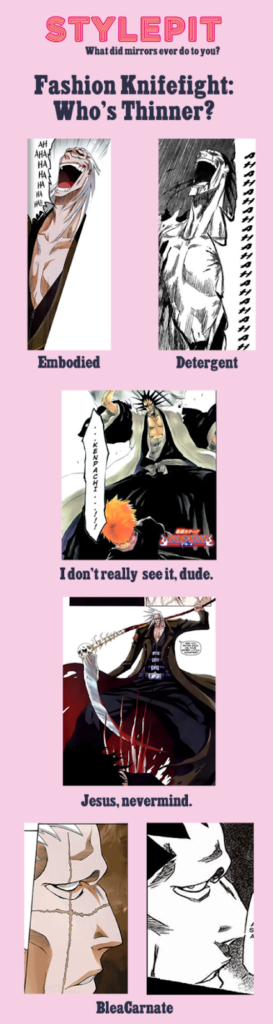
Context matters. Follow me into the mind of an anime club survivor.
Pretend, for a moment, that you don’t know who Dave Bautista is. The HOTDOG defense system would detonate your device if that were true, but let’s make-believe. You live through hollow, Batista Bomb-less days, searching for something to fill the Animal-shaped hole in your heart. As if anything could.

Then, CSI introduces a man in a rubber Bautista mask named Bave Dautista. Bave dominates criminals with the Dautista Dunk, argues with his sergeant Double H, and ditches the show to star in a James Gunn flick. And you clap along like a seal with cable.
That’s what it would take for the audience to miss this trace. In simpler terms, it’s like making a comedy sketch about a blind black klansman: we all know Clarence Thomas.
Anime fans are a meticulous bunch. I mispronounced a ninja clan on one podcast, and my inbox still gets slurs in kanji. They didn’t take long to unearth Bave Dautista.
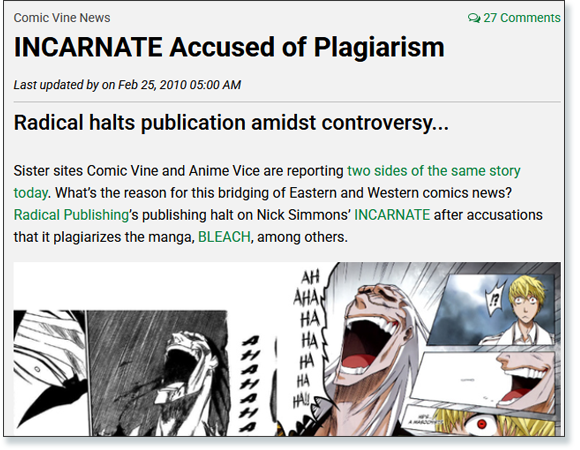
Embarrassing. More importantly to a Simmons, financially abortive. The publisher, Radical Comics, specialized in stealth movie pitches. Oblivion became a film without ever even making it to print. Nick didn’t have to make great art to win, or even art that sold well. It just had to exist, and he cocked it up.
Nick Simmons apologized, once the lawyers and pitchforks got intense enough. Sort of.
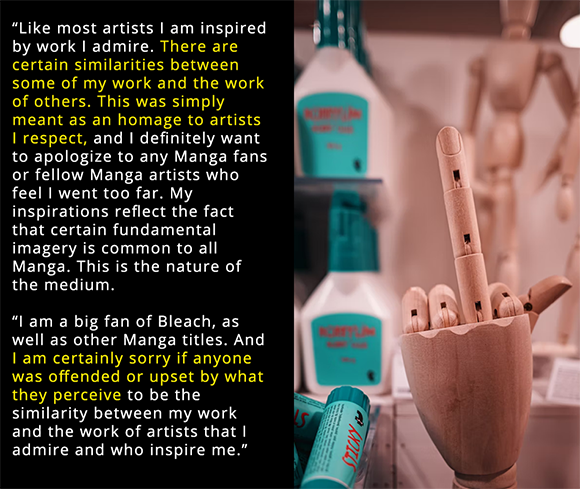
This was 2010, making Nick an early innovator in non-apologies. We hadn’t quite mastered the “I’m sorry you’re a mitch-bade pussy, and hope you suck less in the future” press release. In fact, this tone may be his best original thought. It’s quite the legacy. Creators as diffuse as Ted Nugent and Roseanne Barr have paid homage to Nick Simmons.
Bleach’s author had a more surprising reaction. After learning a sentient being willingly plagiarized Bleach, Tite Kubo tweeted the following:
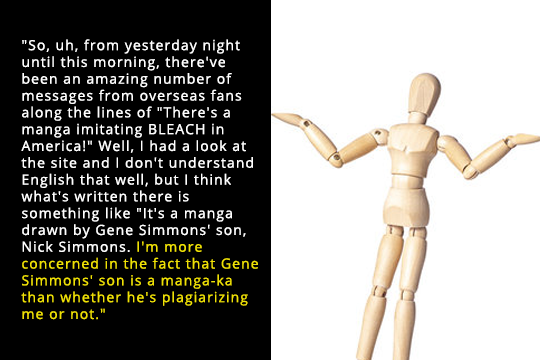
That’s a professional. He looked past the low-hanging fruit of anger, right into the absurd vortex of Gene Simmons’s son publishing comic books. After mocking him twice, I can confirm that Kubo has more Hotdog spirit in his sunglasses than I do in my soul. I’d cover his glorious spiral into madness, but the Great Anime Week Detente says I’d have to smother myself with a body pillow.
Incarnate lasted three issues, two longer than any breathing lawyer should’ve allowed. Gene’s personal Saul Goodman slipped up. When your client claims to have fucked six Civil War regiments, you spend the rest of your career on high alert.

Two genres of people burn polaroids: future defendants and current defendants. Legitimate perverts dump them in the recycling, to rest comfortably in a local landfill or become 1/25th of a handbag. This is legal malpractice.
Recall Rambo in First Blood: a desperate man hiding in the frozen wild, knife in hand, waiting for the first unlucky cop to inherit his trauma. One false move, and they’ll kill him faster than a Jamaican teenager minding his business. Every day as a Simmons family lawyer should be that tense.
Don’t confuse that for an accusation, defense, or even hyperbole. It’s the simple reality of working for someone the rest of a glam rock band called a sex addict. That’s insane. That’s like getting kicked out of early Metallica for drinking.
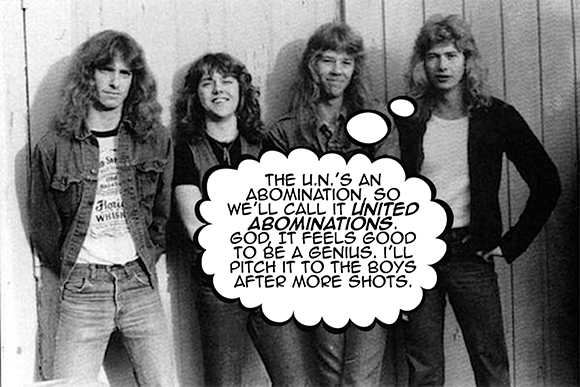
Nick deserves a break. Armchair generals can criticize, but he’s the man in the arena. In fact, Nick should take that speech from Roosevelt. He has an inspiring ability to take inspiration, and it’s the spark I’ve been missing. I’m excited to take my next book in a new direction. Here’s a preview:
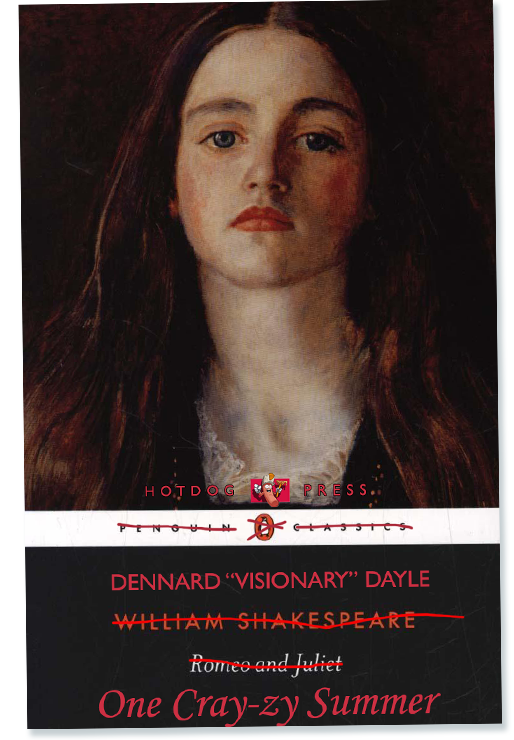
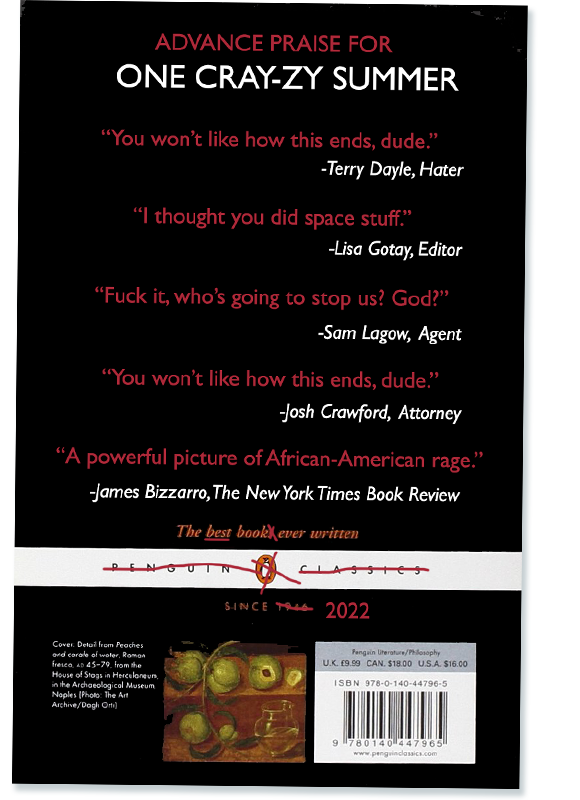
One Cray-zy Summer is a young adult romcom with a killer ending. It features a new writing style I call “ten-steppin’,” and should be a movie by 2024. Keep an eye out for it.

…
This article was brought to you by our fine sponsor and Hot Dog Supreme: Jeff Orasky, who was shamelessly traced from Boris Vallejo art.
Categories
Nerding Day: Blips! 🌭
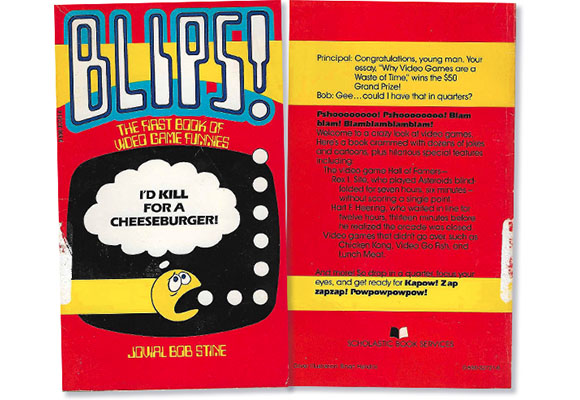
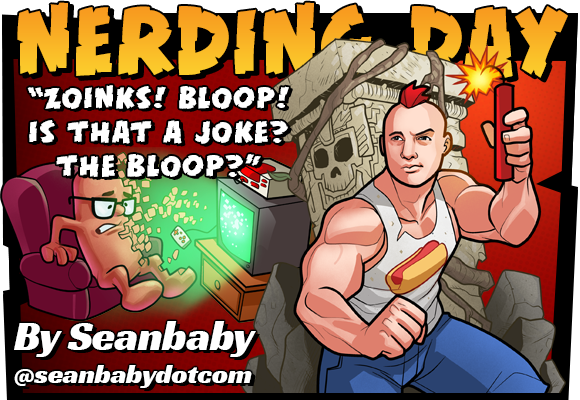
“Pshoooooooo! Pshooooooo! Blam blam! Blamblamblamblam,” said the desperate man who agreed to write an entire book of video game jokes while only knowing only two things about them: arcades do the bloop, and Pac-Man does the eat. If this book screamed for help for 80 pages, it would be twice as honest and three times as funny:
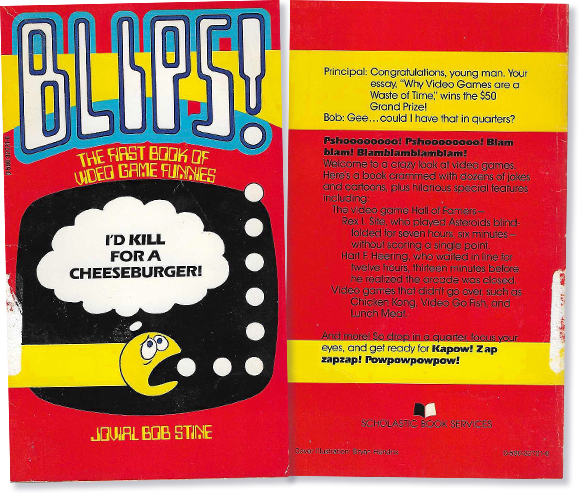
Blips! by Jovial Bob Stine (1983) claims to be “THE FIRST BOOK OF VIDEO GAME FUNNIES,” which I can prove to be a lie four different times by walking across my office…
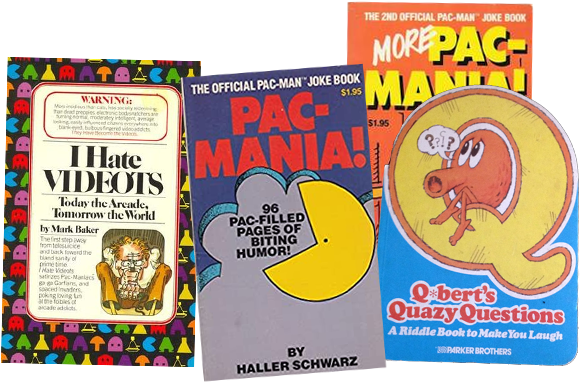
…or fucking five if you count how it’s not funny.
So not only did Blips! fail to be first-to-market, it fundamentally misunderstood how comedy, video games, and even books worked. Let me give you an example of it doing all of this at once. The book opens by telling you to put a quarter on the page because that’s how video game fanatics think all objects work, and then Bob explains the joke, because that’s how comedy fanatics think jokes work.
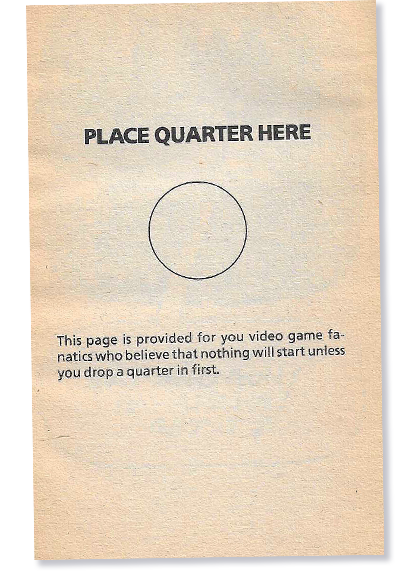
Besides explaining jokes, one of the best things you can do as a writer is invent your own mental disorders and then make fun of your reader for having them. You know, the same way you think cats can’t pee unless you hook them up to an air pump. But maybe stop pumping your cat, that’s a fish by the way, and listen: This shitty idiot doing everything wrong? Jovial Bob Stine? That’s one of the pen names of R.L. Stine, who is one of the most successful authors of all time. Nine years before he wrote the first Goosebumps novel, he was blindly mashing words together to make this trash.
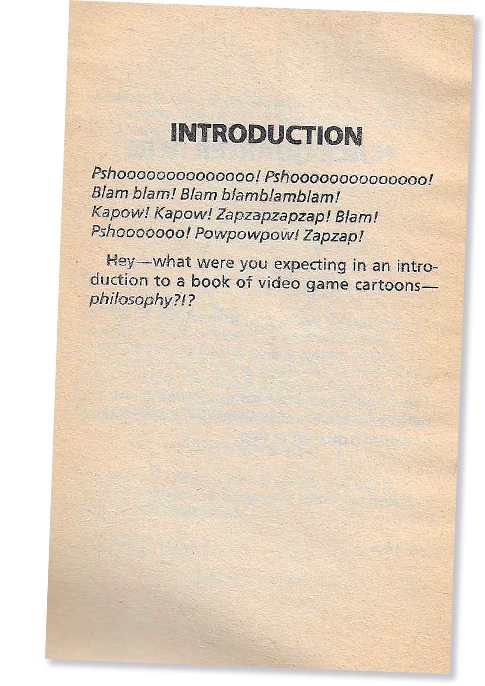
For his introduction, Jovial Bob reuses the same idea he had for the title and book jacket– random sound effects and nothing else. Then he reuses the same idea he had for the quarter thing– blaming it on the dumb reader. He is already pumping air into a peeless cat, and it’s still the intro. This fucking blows. Do you want to know what I was expecting here, Bob? Donkey Kong puns that suck shit. And you didn’t live up to that. This is like worrying the drive-thru was going to screw up your order and opening the bag to find your wife’s head. It’s like expecting an apology from Arby’s for killing your wife but getting a note that says, “Pshoooooooooooo! Pshoooooooooo! Blam blam! Blam blamblamblam!”
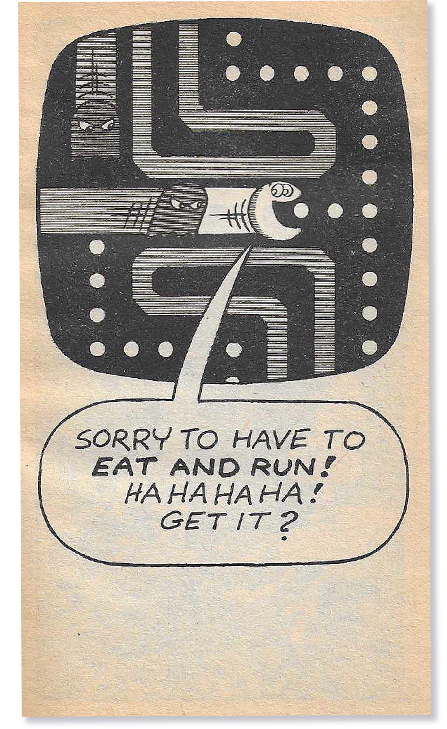
This is the first cartoon in Blips!. It’s a Pac-Man pun you’d expect any popsicle stick manufacturer to land on two to five seconds after beginning the Pac-Man pun-writing process. But the fact that he’s laughing at his own joke and then calling attention to it reveals a crippling insecurity. Bob has fucked up every single thing so far, exhausted his video game knowledge, and now realizes he’s in trouble. In other words, what did Bob Stine’s wife say to Pac-Man? My husband doesn’t have a dick either! HA HA HA HA! GET IT?
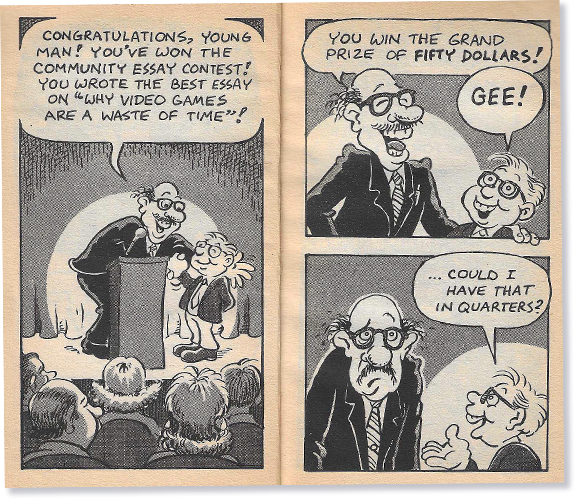
The next cartoon is a fully illustrated version of the joke on the book jacket. It’s about a boy on the stage of a well-attended community anti-video game essay contest awards ceremony, which is already a very long walk, but then the kid wants the $50 prize in quarters? From the context of this book, but not this cartoon, we have to assume these quarters are to play arcade games which means Bob either botched the joke’s premise, or the joke is how this kid tricked the essay judges, a group of people who are both inconceivable and not pictured. It is a wrongness casserole baked by a beast with diarrhea hands. If I was Satan, these two pages are how I would let a dead cartoonist know he was in hell.
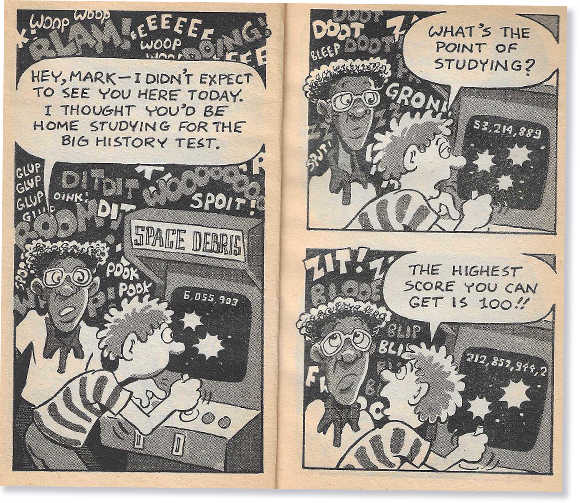
In another relatable, conceivable setup, two children run into each other at the arcade to talk about an upcoming history test. “I use quarters to start all things and I believe the points in video games directly translate to non-video game numbers,” thinks one of them, expressing it in an even dumber way. It’s another long journey off a cliff, but it’s not like it would work if it was punchier. This is a faulty conceit squeezed from a brain stuck on the vague concept of “points.” That “100” on the history test is a percentage, you dumb fuck. You shovel-beaten ape. You keep constructing these mazes of impossible stupidity and walking into your own walls. God damn it, Bob, did you give this kid a score of 212,857,944,2? That’s not even where you put commas, Bob. Jesus Christ.
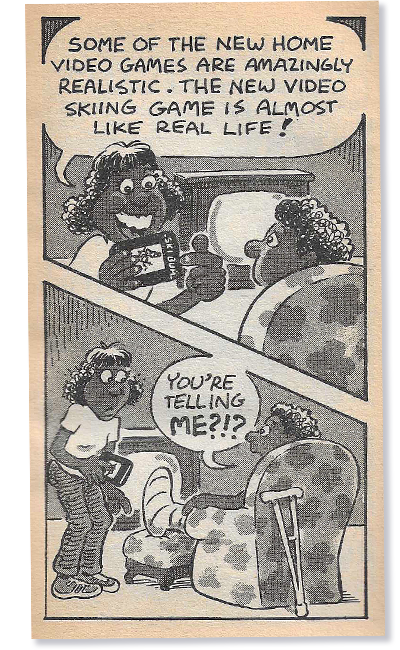
Okay, this one works. If you assume home video games in 1983 could be mistaken for realism and also that hearing about this would instantly convince a person that the game would create a second source of the physical pain they’re already feeling. To be fair, maybe the joke is how this kid’s broken leg was from a recent skiing accident and the realistic new video skiing game would retraumatize him. And yes, that’d be hilarious, but at the risk of exposing some personal biases, is a black 9-year-old with no visible ski equipment the best way to communicate “skiing accident survivor?” This punchline only really had a shot if the girl ran into the room saying, “This personal home arcade game is about how silly it would be if crutches only went up to your knees!!” In your face again, Blips! illustrator.
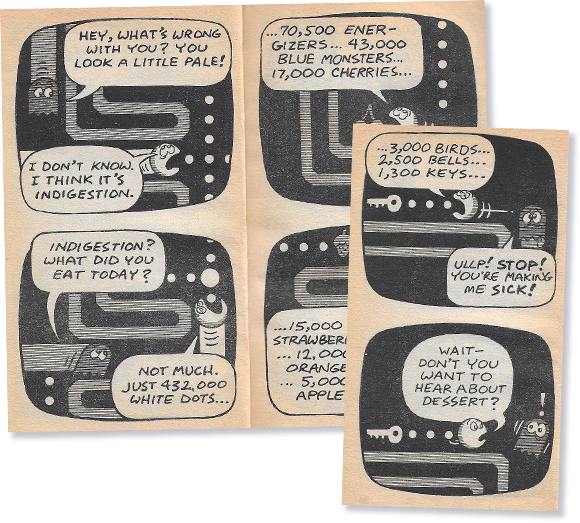
So far, Bob has covered Pac-Man eating, sound effects, quarters, sound effects, Pac-Man eating, quarters, points, and skiing. I’m not leaving anything out or being unfair to him in any way. Those things are, without exaggeration, the end of his expertise on this subject. So it shouldn’t surprise anyone that his next bit was about Pac-Man eating. The nicest way to put it is that this is all premise and no punchline. What if Pac-Man’s physiology was governed by the same rules as a human digestive system? Fine. Now imagine fucking that idea up worse than this. Bob literally spelled it out for the reader across three pages and then kind of gave up before anything funny happened. He had a ghost from the game Pac-Man get sick from hearing about Pac-Man’s diet, but they share the same maze, Bob. He’s a many-times-over dead spirit cursed to watch Pac-Man devour these things forever. He knows what he fucking ate today. This has all the whimsy of a toxicology report for a bachelorette who died of alcohol poisoning.
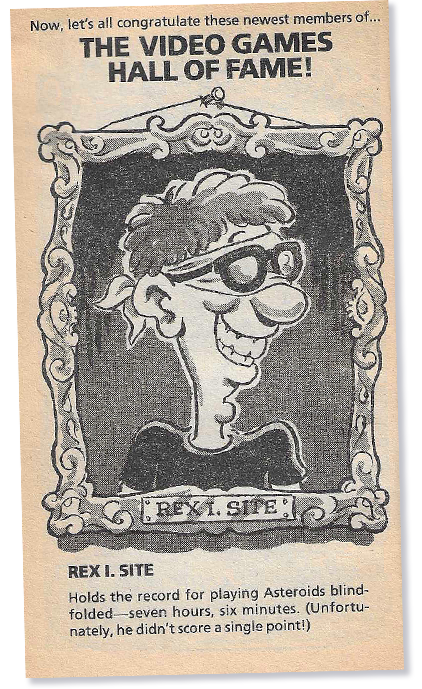
I’m not kidding when I say Bob bailed on his main concept after 14 pages, four of which were about Pac-Man eating, to start an entire new thing. The next third of the book is THE VIDEO GAMES HALL OF FAME, a collection of nonsense characters who have played video games, a thing he was not prepared to write jokes about. This allowed him to explore hilarious ideas like Rex I. Site, a boy who isn’t good at Asteroids when he’s blindfolded, and get thi– oh, Bob is done. That’s the whole bit. Well, I’m sure the next one will be better…
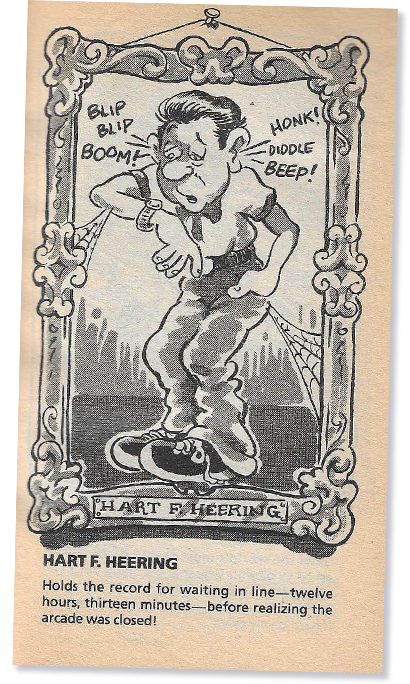
… it’s not. In fact, Hart F. Heering is basically the same bit– what if someone was in an arcade and had a disability, but didn’t know they had a disability? Maybe these are references to some short-lived medical panic only Bob fell for? “Makes you blind and deaf” might be a fourth thing Bob thinks he knows about video games.
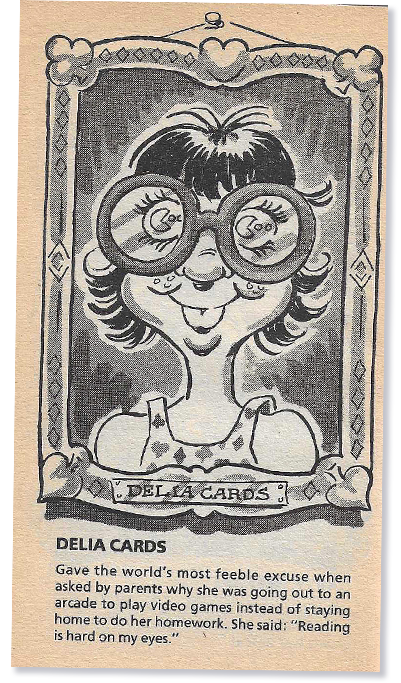
So this girl’s name is Delia Cards, which is a red herring. Forget about it, there’s no joke about cards anywhere. Delia is in the book because she claimed an arcade was easier on her eyes than reading, which is either nothing if you’re normal, or one of the looser types of ironies if you believe arcades make you blind. So now I know the code. You have to think like a dumb, wrong person writing for their idea of a stupid person. Now make someone blind, and there’s your joke.
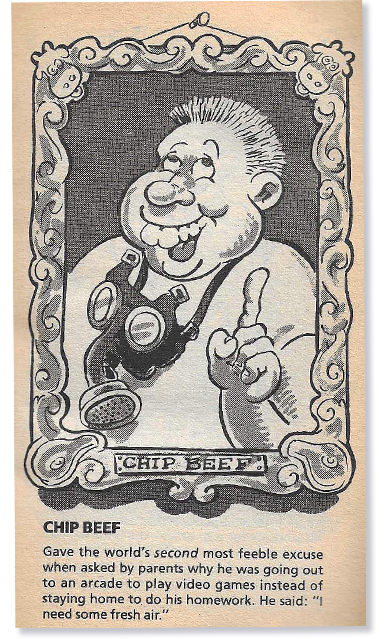
Chip Beef, again, think nothing of it; it’s not a reference to anything, is also in The Video Games Hall Of Fame for a dubious claim. He says he was going to the arcade to get fresh air, but arcades are where people fart? Maybe smoke? It’s unclear. The gas mask seems to be doing a lot of the heavy lifting as far as storytelling goes, and this is the only reference to (maybe) arcade smog in all of Blips!. The most generous explanation is this is 70 typos in a row under an unrelated drawing printed in the wrong book. This is gibberish. It’s a joke you’d tell a bored fish during your final moments of asphyxiation.
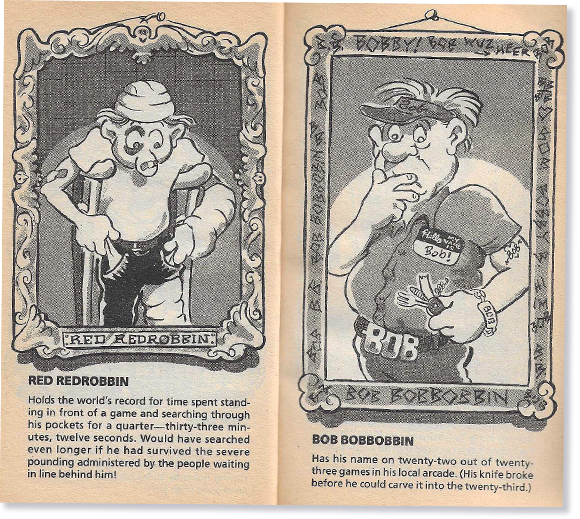
Bob is starting to learn he’s not great at coming up with funny situations or funny names. He stares at the blank page and takes a wild guess at comedy. “Red Redrobbin? And he is out of quarters, like a red robin would be?” Bob is now panicking. You don’t write something like Red Redrobbin the Guy With No Pocket Change if there’s anything left in you. But Bob has so, so much more to space to fill. So Bob summons the last bit of his imagination.
“Uhh… w-what about a guy named Bob B-bob bob bin? And he writes his name Bob, he writes his name Bob! Bob Bob Bobbin. Bobby Bob! His hat says Bob, the belt is BOB. Bob!” Bob nods to himself. It’s a good one. He’s still got it. He rewards himself with a seventy minute scream into a mirror.
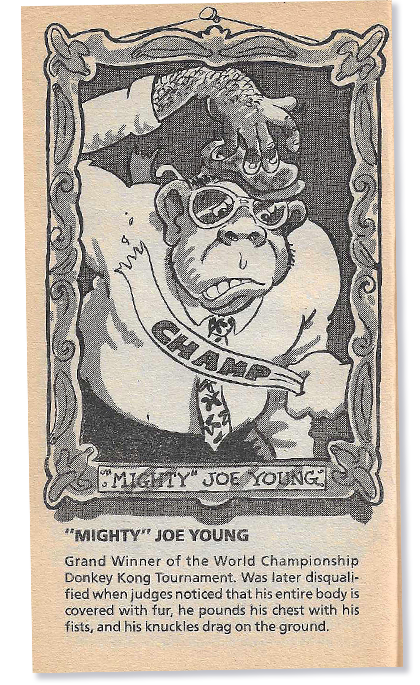
I don’t know why I included this one. It’s a gorilla who cheated at Donkey Kong by being a gorilla, and then got his championship sash taken away when they tested him for gorilla. It’s a perfect comedy bit, executed by a writer at the top of his game.
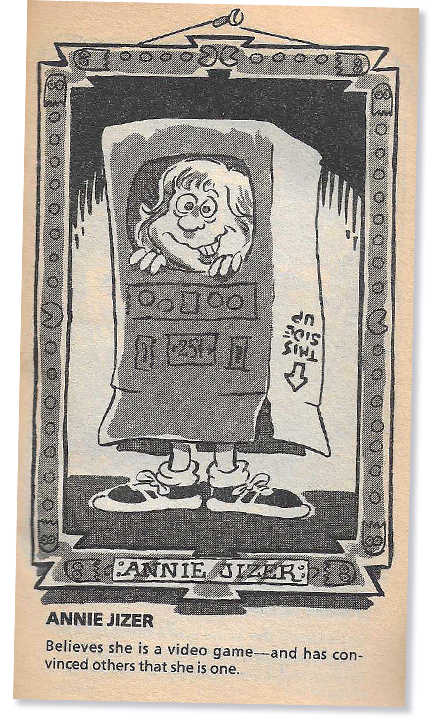
Is an arcade cabinet still a person if she and everyone else thinks she is a video game? How many video games out there are people who have simply forgotten who they are? What great writing. This is a half-formed Robot Chicken pitch Seth Green would type into his Notes app to confuse himself the next morning, but to Jovial Bob Stine, it’s a full page of his book. If this was meant to be a joke, you’re not done, buddy. All you did was put a mentally ill child in terrible danger.
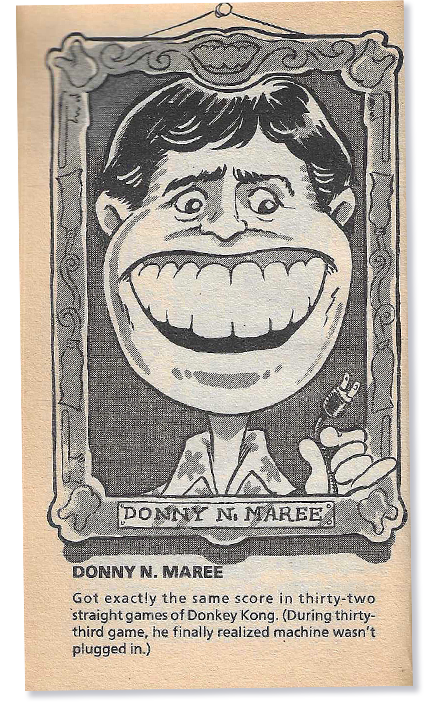
Ha ha, that Mormon ass Donny Osmond doesn’t even know how electricity works. Eat shit, Donny Osmond. Okay, where were we? Oh, right. Video game jokes! Brrzzt! Bloop! Hold on, is that one?
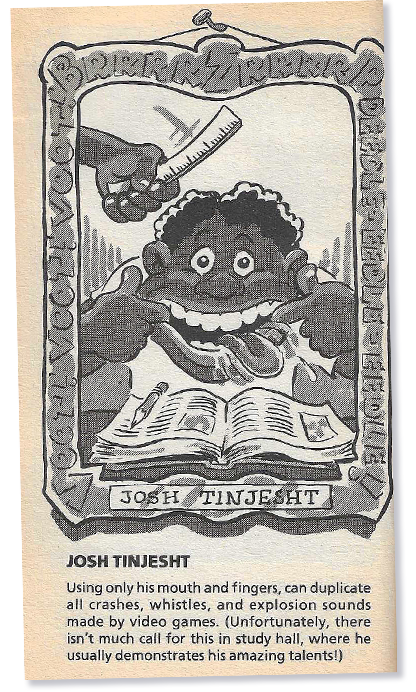
It’s nice to see Bob has given up the pretense of video game comedy and embraced the forbidden un-language of his madness gods. “This boy makes sound effects, like one of the pillars of arcade game jokes. Blorp, blam blam, if you insist on the telling of one. It shall be the last sanity you know before your ears suffer the formless mouth of TINJESHT.”
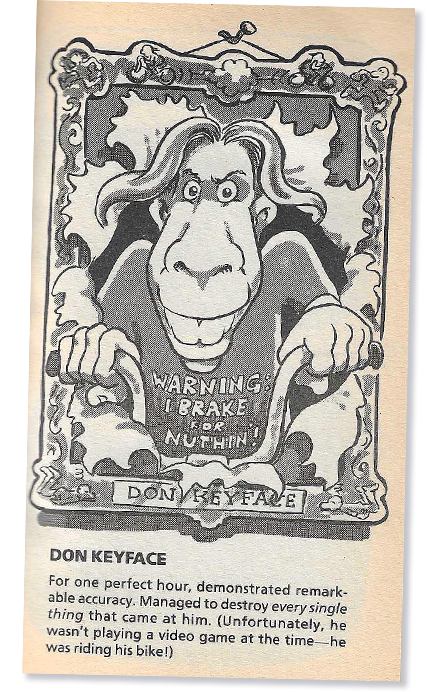
Holy shit, this one is just a donkey-faced monster on a bicycle rampage. No, listen: R. L. Stine wrote a book of arcade game funnies and one of them was “Ha ha, here’s a donkey-headed murderer, the end.” Which means, and I know how this is going to sound, I think this book rules? He’s somehow so wrong with every instinct he’s managed to steer into genius. Imagine if you were in a brainstorming meeting for Donkey Kong puns and some guy suggested DON KEYFACE, a non-gorilla beast who runs things over on its bike. You would stand up and applaud as your face melted off your fucking skull. This is sincere insanity. You can’t fake DON KEYFACE. And Bob knew it was his masterpiece. He ended the whole The Video Games Hall of Fame bit here and got back to regular cartoons.
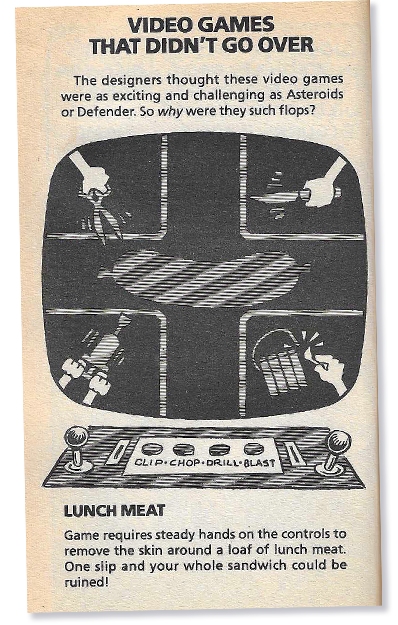
Well, not regular cartoons. He started a section where he made up his own outrageously zany video games. For instance, um, LUNCH MEAT!? But, and I don’t think I’m the world’s greatest thinker to point this out, this was 1983– games were about lunch meat. Doing an inexplicably silly thing in an arcade game was as ordinary as losing it to a DON KEYFACE attack. You fucking Normal Al Yankovic’ed Burger Time, Bob.
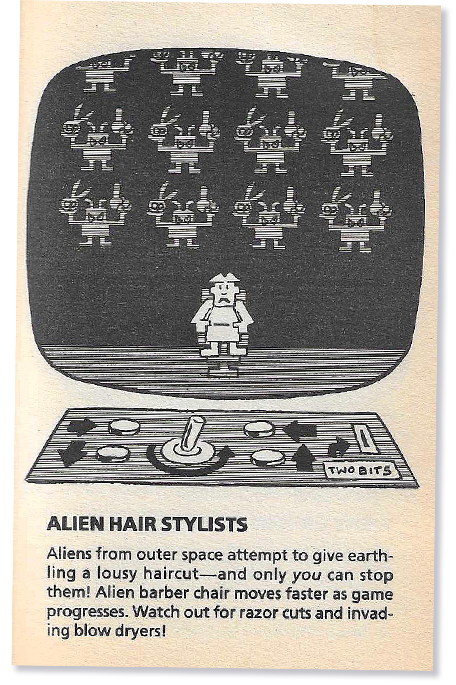
Ha ha ha, what if Space Invaders was haircuts, you fucking kids?
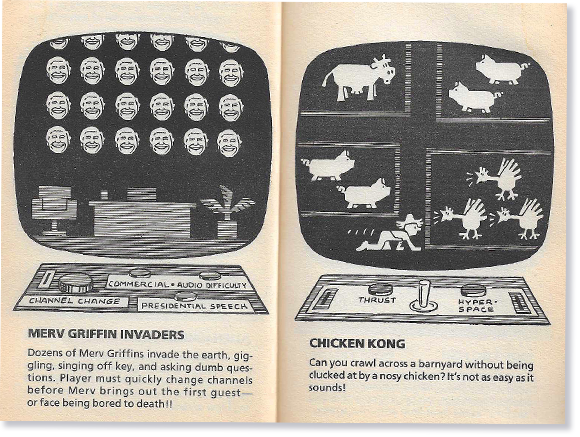
No no, kids! Kids! You goddamn pieces of shit. Ha ha ha what if Space Invaders was ha ha Merv Griffin!?
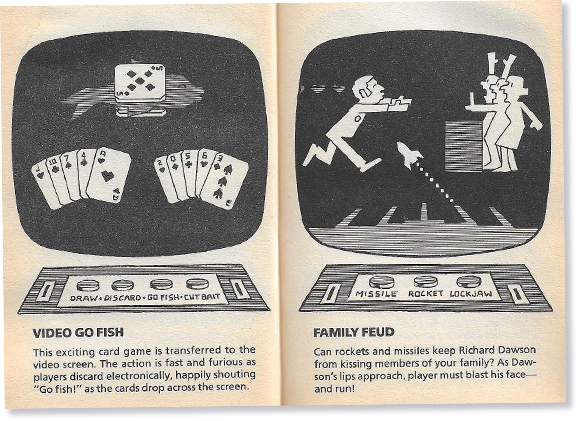
Both of these preposterous, batty ideas are real games, so again: great work, Bob. But Bob does make a good point about Richard Dawson. He put his mouth on a lot of families. And while it seemed friendly, those mothers and sisters must have felt a lot of social pressure to do it. Maybe a Richard Dawson interceptor missile is the kind of satire that leads to meaningful discussions of consent. Wow, y– oh my god, I hope this doesn’t mean DON KEYFACE was about ugly women’s voting rights or something.
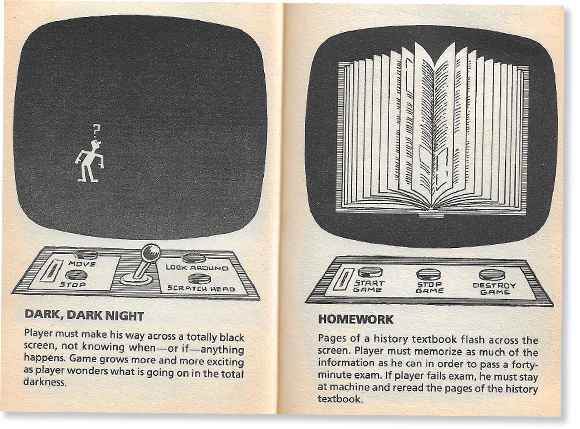
Bob’s ideas for fake video games went from games that exist to games that exist (with pop culture references), and now he’s reached the same place he gets to with all his bits– mirthless suffering. “Fuck the jokes,” thought Bob, and not for the first time. “I’ll just write down something unpleasant. Homework. A lonely nothingness,” he decided. And then he typed those ideas, exactly as they were, into his book with no twist or irreverence. “Something about nuclear holocaust,” he thought. Ha. He knew he had the start of something…
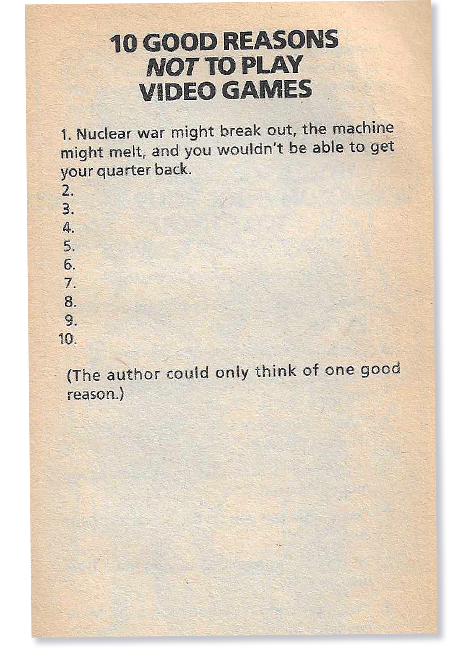
… it turns out it was the entirety of something.
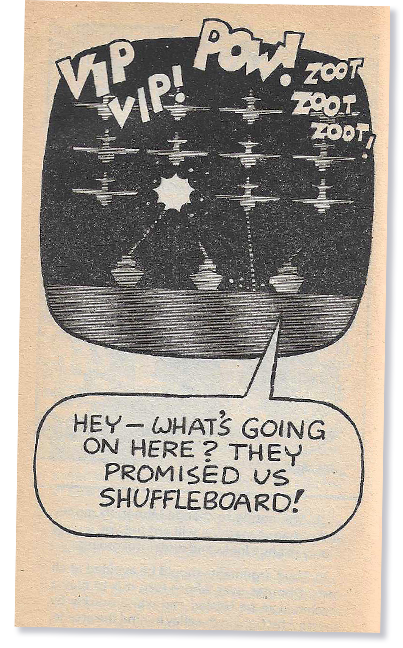
The best jokes are the ones where Bob takes an ordinary scene from a game and then spices it up with the perfect word balloon. “What’s all this fighting!?” asks the soldier stationed on a battleship. That’s enough already, but he also screams, “THEY PROMISED US SHUFFLEBOARD!” It’s a reference, of course, to the famous catchphrase, “I promise you shuffleboard.” It’s funny because think how many things had to go wrong in Bob’s brain and life to place words in this order and mistake that for doing something. Ha ha ha it’s fucking absurd.
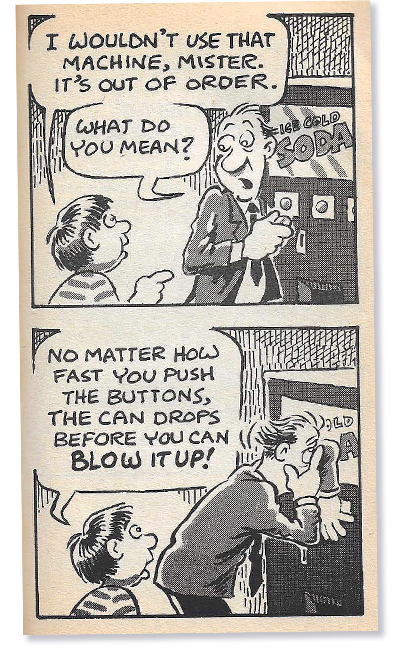
Bob has made it as clear as he can: he does not know what he’s doing. This is another joke about a kid who can’t tell the difference between video games and the other parts of the universe. It’s beyond a mere contempt for the subject matter and his readers. What has Bob seen that made him like this? When he’s waiting for his pizza, does he scream, “YOU’RE NOT REAL, MS. PAC-MAN! AND I’M THE ONLY ONE WHO SEES IT!” It is batshit nuts. It’s like writing a baseball riddle book and having 40% of the jokes be, “Take a bite. Because I bet you think you’re supposed to eat baseballs, you trash. Yum yum, fuck you.”
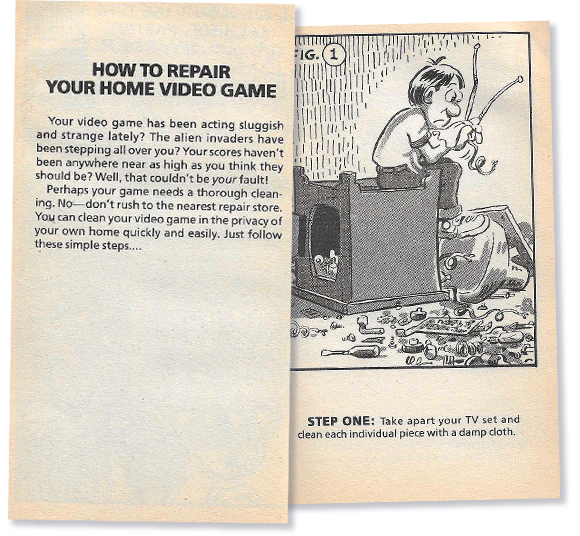
Oh, this should be good. A how-to guide, only intentionally wrong. Wet electronics? That wouldn’t work at all. What a card. Let’s see where he goes with this…
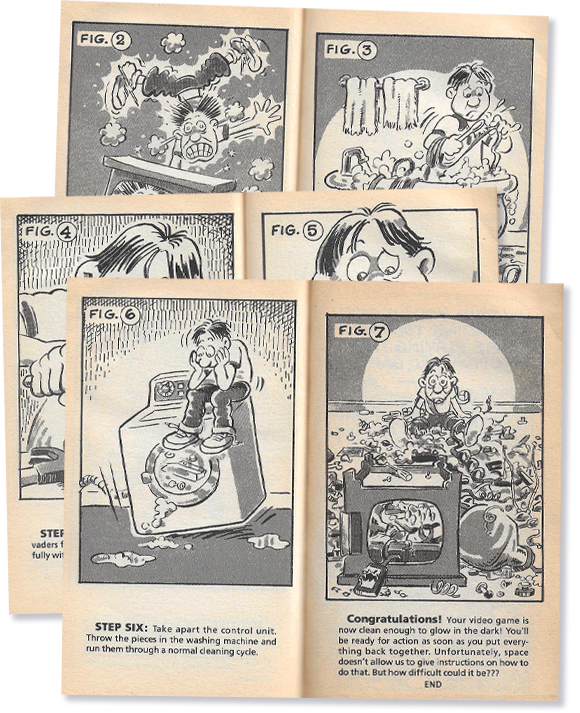
… and for seven pages Bob reworded “take apart your electronics and wash them in water.” Blips! is the story of a writer shattering against the smallest obstacle. These are the thoughts a veal cow would have if you carried a Nintendo past it once.
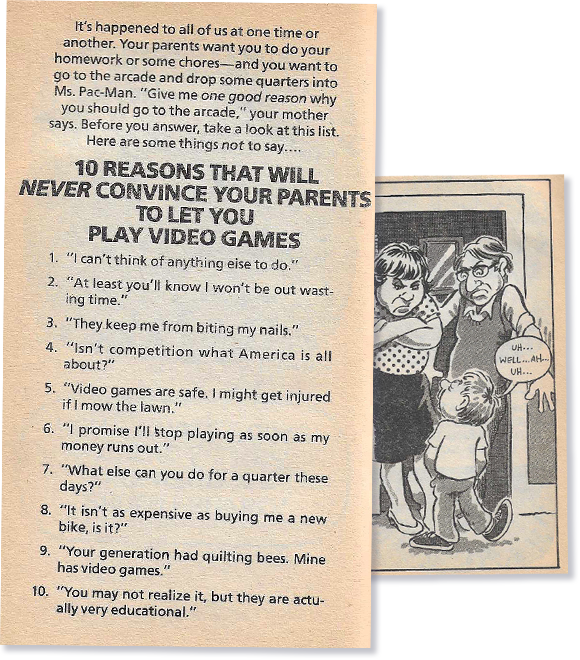
This is stunning. It seems almost impossible to write this many words and not accidentally make a joke at least once. These are genuinely childlike answers to the question, “Can any of you first graders help me finish my book? It’s supposed to be funny, but don’t worry about that. We gave up on that a long time ago.”
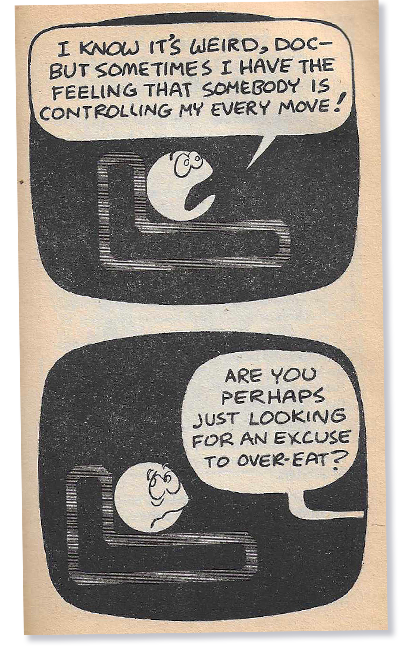
When a cartoonist is running low on inspiration, they can put a character in a therapy session. It’s hack, but it’s a classic way to re-frame everyone’s perspective. Yet even there, Bob’s only Pac-Man joke is EAT.
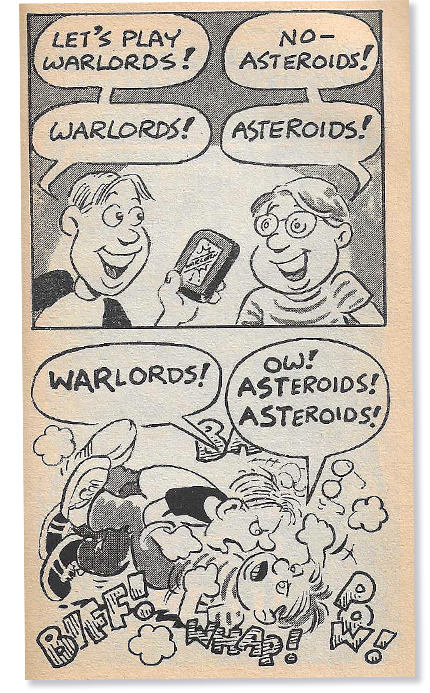
Wait, is that the end? A fist fight over Warlords and Asteroids? Huh. I think I like this one.
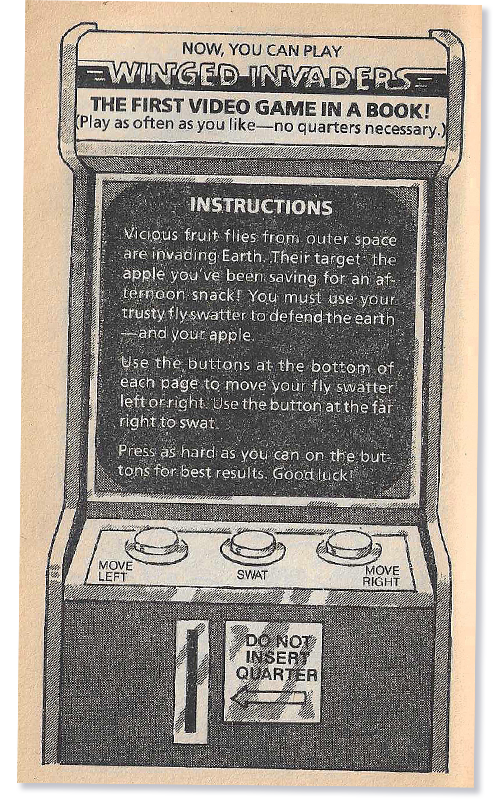
Bob is doing some kind of paper arcade game. So is this going to be, like, a Choose Your Own Adventure thing?
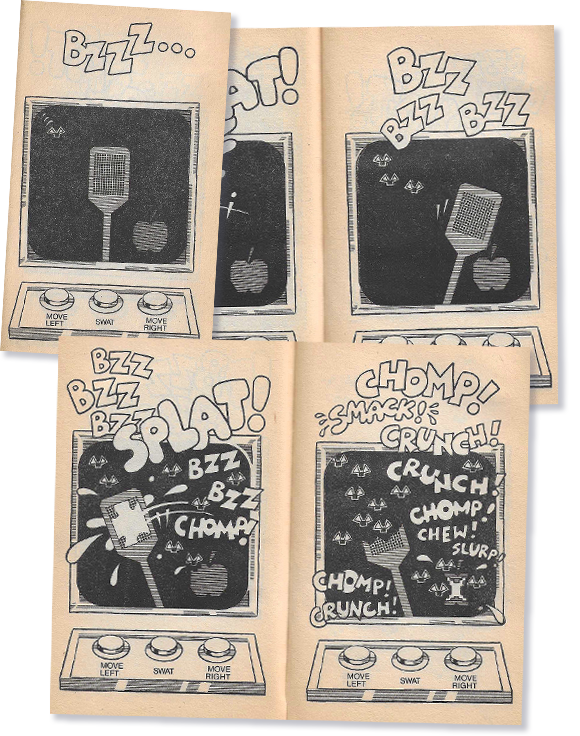
No… it’s much less. It’s five pages of a make-believe fly swatting game with no jokes. I honestly don’t know what to make of it. What could you even call it? Arcade fan fiction? How a child thinks game design works?
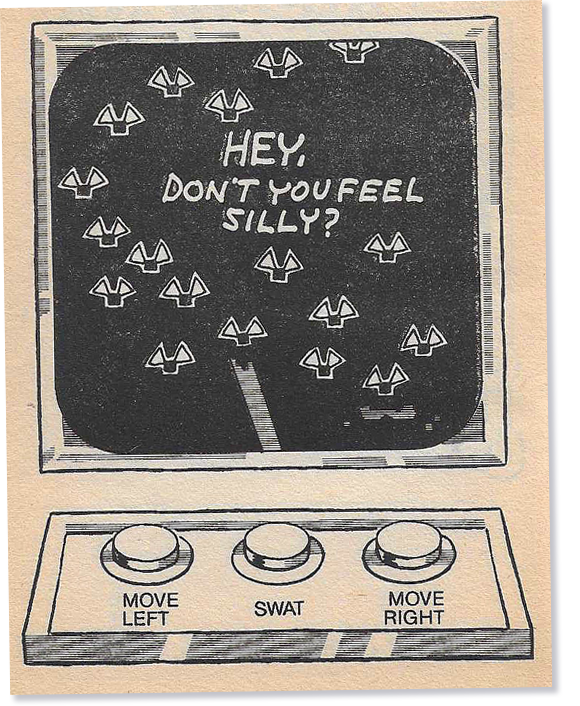
Do I feel silly? I guess, Bob. This is stupid as shit. What are you doing?
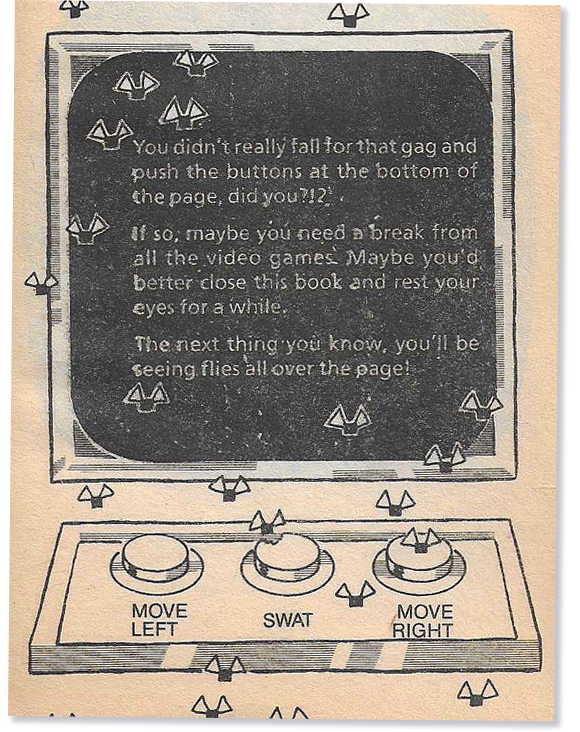
Wait, so the seven pages of you pretending your book was a video game was a prank? On the reader!? This is like writing FREE CANDY on a chemical toilet and locking yourself inside. It’s like tricking a map by wandering into the woods to starve. Bob opened and closed his book by mocking the reader, a person literally reading a book, for not understanding books. If it was anyone else, I’d think they were joking, but if there’s one thing I know about Bob Stine, it’s that he never jokes.

…
This article was brought to you by our fine sponsor and Hot Dog Supreme: Benjamin Sairanen, who plays every Hot Dog article like a video game and is undefeated with a score of 000,000,00,1,7.
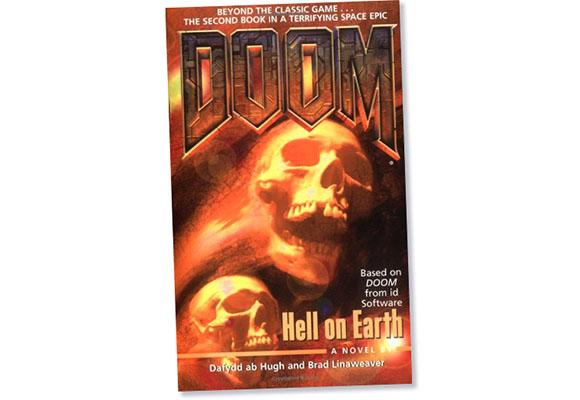
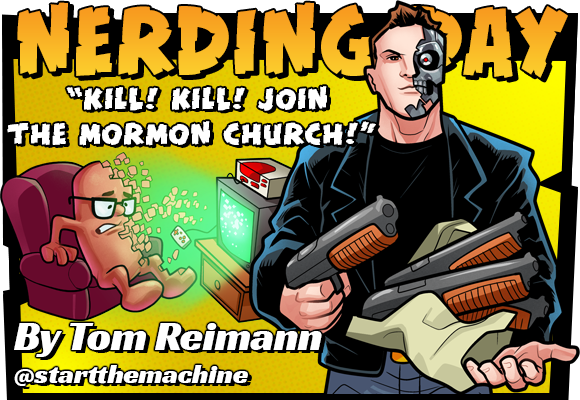
“Hey kids! Doomguy here. We talk a lot about ripping and tearing in this action-packed computer game, but what I really want to rip and tear are your secular prejudices, to make room for the wisdom of the Church of Latter-Day Saints!”
That passage doesn’t actually appear anywhere in the 1995 novel DOOM: Hell on Earth by Dafydd ab Hugh and Brad Linaweaver. But it should be plastered on the cover like a Surgeon General’s Warning. It should be stenciled all over a bulletproof layer of shrink wrap that fully encases this grimy sci-fi paperback like the heat shield on a space shuttle. This book should come with an exit interview by a CIA deprogrammer.
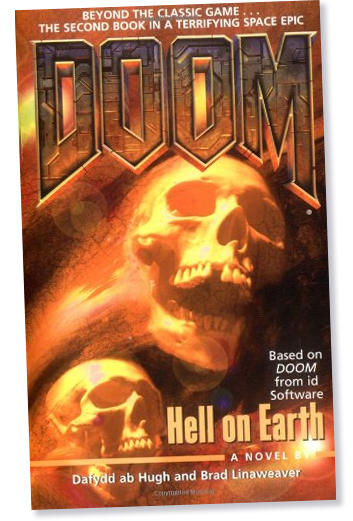
You stalwart HOTDOGGERS may remember that a few months back, I spent entirely too much time picking apart the first book in the DOOM series, which took the popular video game DOOM – an action shooter about a space marine’s violent wind sprint through the armies of Christian Hell – and deleted every word from that description except for “Christian.” The authors boldly transformed the game’s mute protagonist Doomguy, a relentless engine of gratuitous destruction, into Flynn “Fly” Taggart, a repressed ghoul who seamlessly weaves alarming tirades about religion and the military together with ham-handed anti-drug messages that would embarrass McGruff the Crime Dog. He does this while nursing excruciating erections about every single female he encounters, including the dead ones. However, the primary target of his silent turgidity is his BFF and squad mate Arlene Sanders. At least twice every chapter he struggles with the concept of being friends with a woman, a paradox that thunderously confounds him at every turn. He is neither the hero we needed, nor the one we deserved. But he was the one foisted upon every unsuspecting DOOM fan who picked up these books thinking they’d be fun sci-fi horror adventures.
I won’t recap every weirdly Christian moment or uncomfortable burst of sexual frustration from the first novel, Knee Deep in the Dead, because I already did that, and that’s what the internet is for. Suffice to say that the book lays the groundwork for transforming DOOM into something closer to Kirk Cameron’s The Road Warrior than the gonzo heavy metal bone circus that is the video game.
So, when I kicked in Brockway and Seanbaby’s door and threw my badge and gun into their faces, screaming, “Kick me off the force if you must, but I’m going through the rest of these books and there’s not a goddamned thing you can do about it,” I thought I knew what to expect. (Please note that if “Fly” Taggart had been present, he would have immediately chastised me for my blasphemy.)
But what I didn’t expect – what I could not know – is that the second DOOM novel is a fully unmasked tome of Mormon propaganda. Specifically, a Christo-fascist apocalypse fantasy that dabbles in right wing conspiracy theories and white supremacist talking points. In other words, it’s a page-turner in the worst possible application of that phrase. Where Knee Deep in the Dead was a cheap sci-fi horror novel full of PG-13 horniness and confusing diatribes about Catholic school and whether it is immoral to inject yourself with liquid cocaine to kill scores of monsters more successfully, Hell on Earth is 230 pages of patronizing monologues defending the Mormon church. Occasionally, a monster shows up.
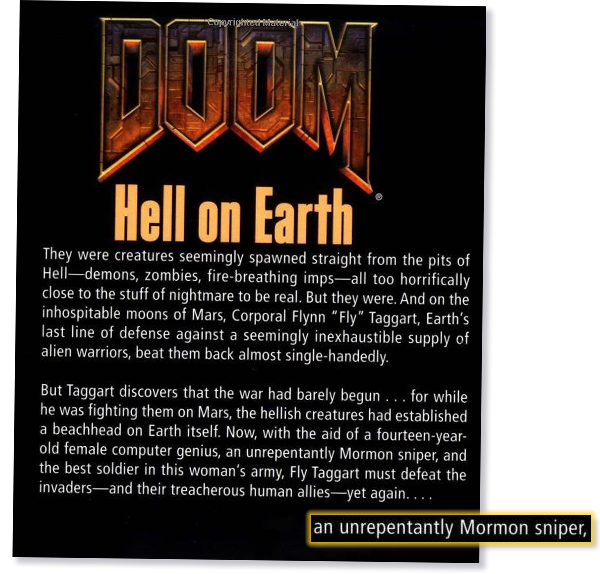
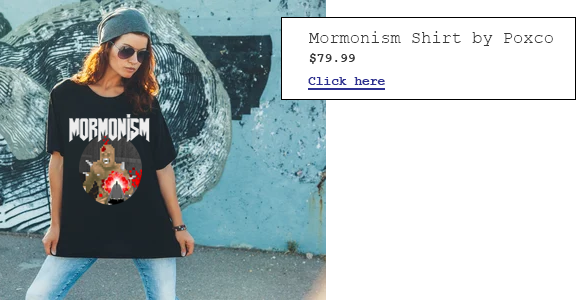
I cannot stress this enough – most of this book is entirely devoted to Mormonism; more specifically, to attempts at convincing the reader that Mormonism is the coolest. It has the exact energy of a youth pastor spinning a chair around backwards to sit down and tell you about how Christ was the original MC. MC JC, probably. This book has real rappin’ Jesus vibes, is my point.
Fly and Arlene crash-land on Earth after the events of the first novel to find the planet overrun by demons that aren’t actually demons but are really aliens pretending to be demons, because that way the authors won’t get in trouble with their parents. The two marines make their way to the Mormon stronghold of Salt Lake City. There, they team up with a sniper named Albert who engages Fly and Arlene in at least fifteen theological debates every chapter; and a fourteen-year-old computer hacker named Jill, who Fly simply cannot wait to fuck. I wish that was a joke. I truly do.
The four are sent on a mission to Los Angeles to do some fucking thing, deactivate a shield I think, so they can escape to Hawaii and do some other fucking thing. Listen, I tried to follow the plot, but the book devotes about ten percent to the actual events of the story and ninety percent to delivering an entry-level course on the core tenets of the Mormon church. They get to LAX and manage to steal a plane, but are forced to separate, leaving Albert and Jill skybound for Hawaii, and Fly and Arlene on the ground trying to figure out what to do next.
It sounds like a bad story that sucks, because it is, and it does. Not even the authors were terribly concerned with the plot. I know this because Fly and Arlene do nothing but quiz each other about the Mormon church for the first sixty pages.
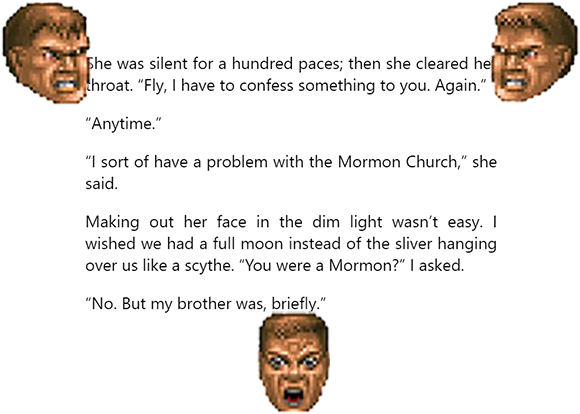
It goes on…
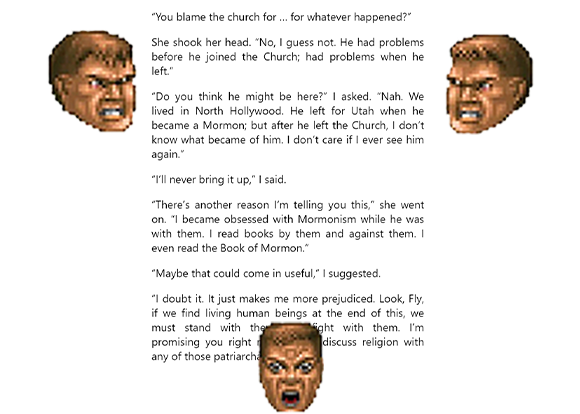
“You see, Fly, after learning everything I could about Mormonism, I became convinced it was bad. And my prejudice is the real problem.”
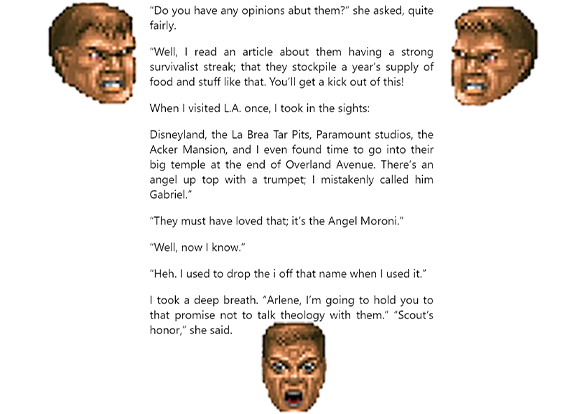
Nothing says “bad-ass space marine” like scolding your friend for making fun of a make-believe angel.
Although Fly admits to not knowing much about Mormons, he constantly corrects and scolds Arlene about them. Again, even though the book quickly establishes that she has studied the Mormon Church exhaustively, whereas he read a magazine article about them one time.
It continues…
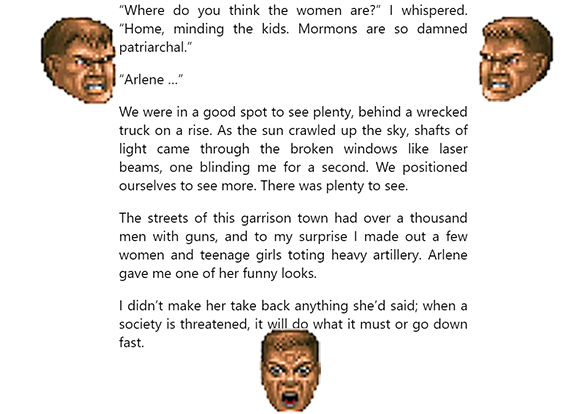
“How dare you call Mormons patriarchal?! I count three women right there! TAKE IT BACK!!”
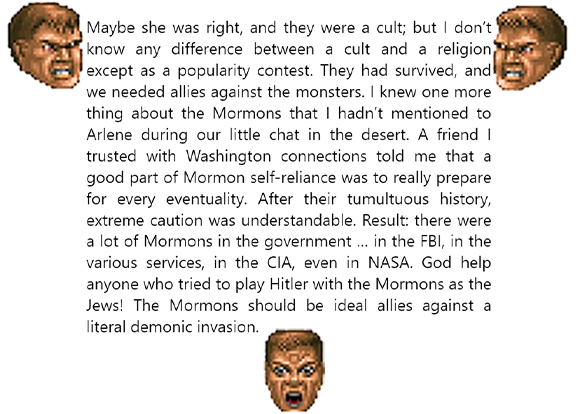
This is not the last time the book will wistfully invoke the Holocaust.

Suggesting the Jews would’ve “won” the Holocaust if they’d only fought harder is a classic white supremacist argument!
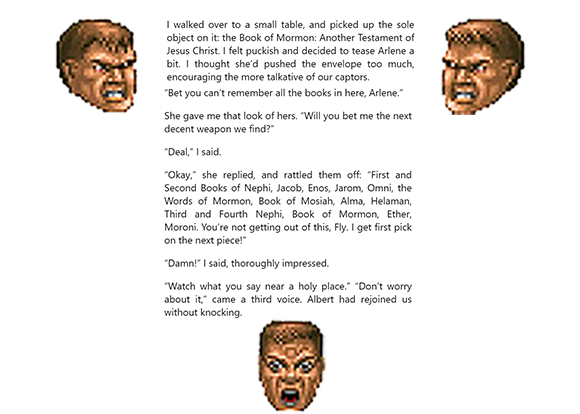
“Bet you can’t name all the books of the Book of Mormon, kids!”
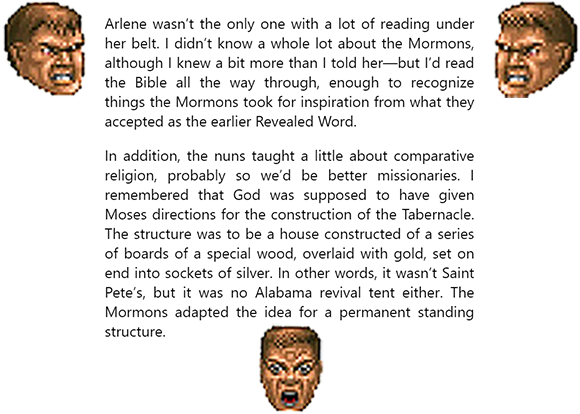
If the first level of DOOM the game had been Doomguy in a deep V-neck t-shirt bragging about how much Bible he’d read, I would have done much better in school.
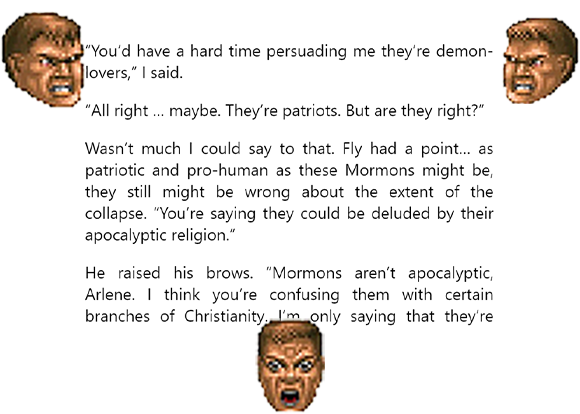
“They’re not apocalyptic, you ridiculous woman! They’re patriots!” Incidentally, the book almost immediately contradicts this argument when Albert shows up:
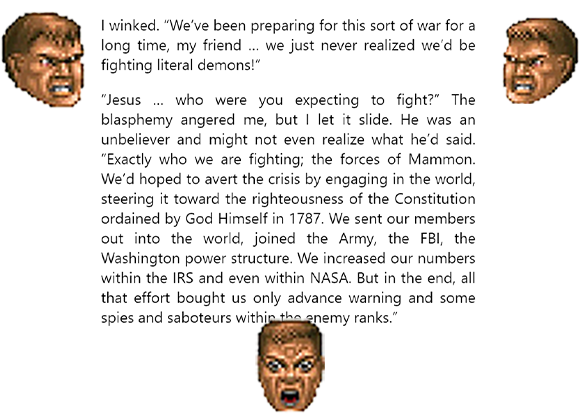
“We’re not apocalyptic, we’ve just spent the last several decades preparing for a doomsday war against the vague concept of evil.”
At one point, Fly tucks in for the night by doing some casual reading of the Book of Mormon, just in case you thought I was overstating how much of this sci-fi horror yarn is devoted to teaching adolescent DOOM fans about the benefits of the Church of Latter-Day Saints:
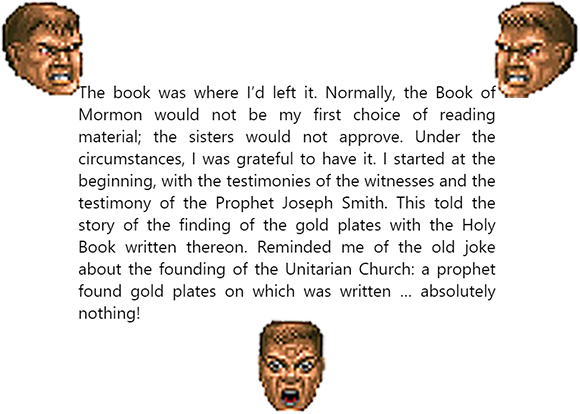
It goes on…
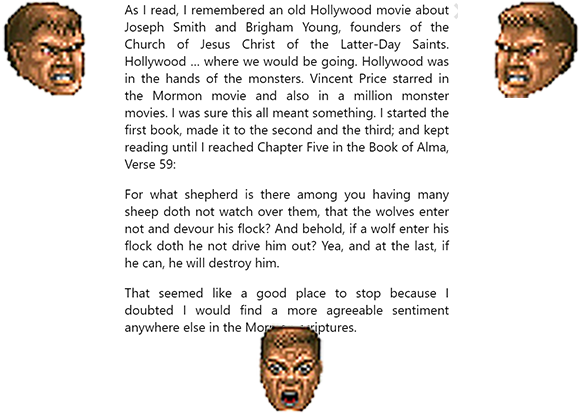
These excerpts may seem tedious, because they are. But they grow even more tiresome when the pair finally meet Albert. The book desperately wants you to think Albert is a stone-cold badass with a heart of gold, the savior of humanity, the kind of person we should all aspire to become. A literal angel, and I’m not making that up.

(Note: This is Doomguy talking.)
How do they convince us Albert is cool? By telling us more than once that he was a decorated sniper in the drug wars.
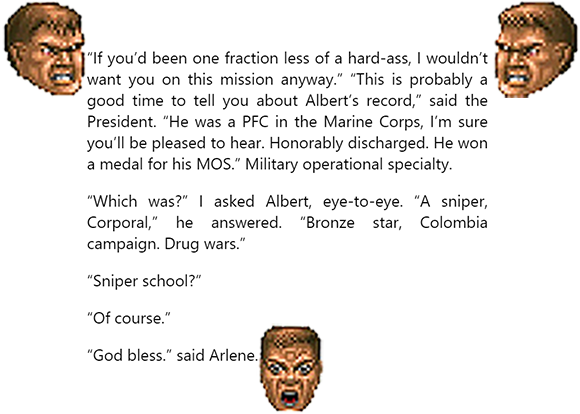
At one point, Albert admits that he flat-out murdered people for the CIA:
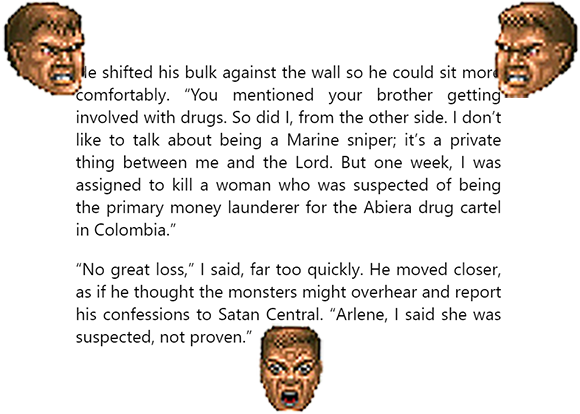
“Headshoot boom, in Jesus’s name, Amen.”
Albert also inherits Fly’s disturbingly chaste horniness and manages to make it even more uncomfortable by immediately fantasizing about impregnating Arlene:
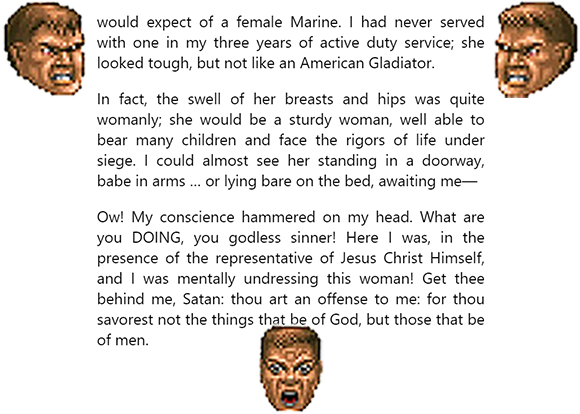
Don’t worry – he pauses this sinister daydream just long enough to admire how sexily Arlene kills monsters:
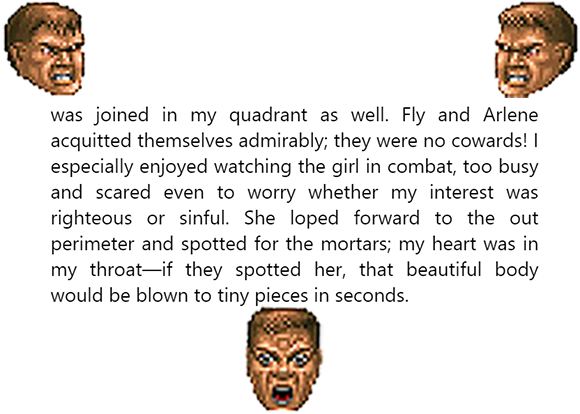
But if you thought Albert was just some god-bothering burgeoning serial killer, think again! Not only does he constantly fantasize about “taming” Arlene, but he also engages in pages upon pages of bad faith arguments designed to make Arlene’s extremely correct and pointed criticisms seem like “female hysteria.” Because the other thing this book wants you to believe is that women are dumb shrews, and men are level-headed slabs of logic and reason.
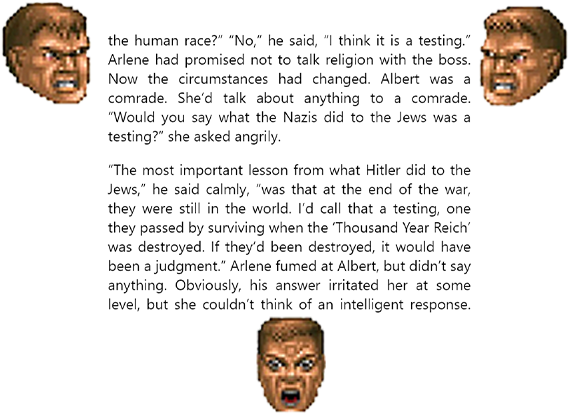
I promised you the Holocaust would come up again, and unlike the authors of DOOM: Hell on Earth, I keep my promises. Although I suppose the novel does technically live up to the promise of its title.

Referring to the Holocaust as a “divine test” is also a white supremacist talking point!
Speaking of white supremacy, Albert also makes sure to explain Dispensationalism to his new friends:
In short, Dispensationalists believe that the Bible is literally true, and that a biblical apocalypse must and will occur before the second coming of Christ. Some modern dispensationalists like Ronald Reagan believe that the apocalypse will be nuclear (that’s probably true), but that it will be a good thing, because it will wipe out all the nonbelievers and leave only the pure, noble Christians.

Dispensationalism frequently overlaps with white supremacism!
The book also really wants you to understand that it’s actually heroic and selfless to take multiple wives:
The experience of reading this DOOM novel is one of constantly having to remind yourself that you’re reading a DOOM novel.
I mentioned earlier that a fourteen-year-old computer hacker named Jill is unjustly thrown into the group, and that Fly immediately starts drooling over her in an oblique but no less felonious way. By now you should have learned that while I am prone to exaggeration in every other area of my life, when I’m speaking about the DOOM novels, I speak only the unvarnished truth:
A “foxy little item” who is in the eighth grade.
It continues…
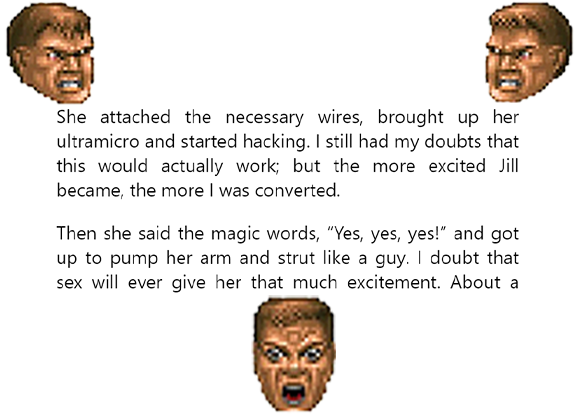
Relentlessly, it continues…
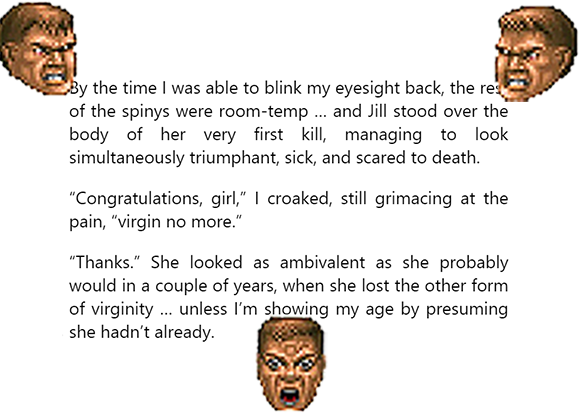
Sweet mormon jesus, it continues…
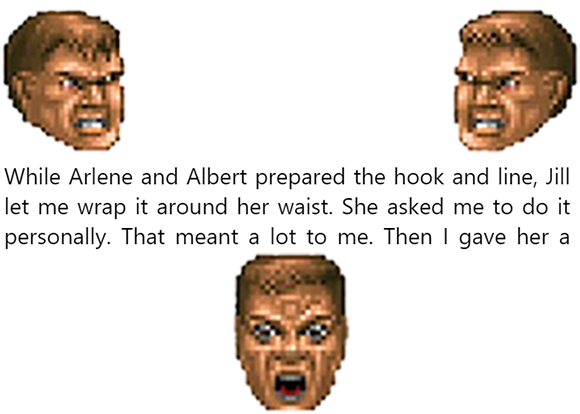
For the love of everything I have ever cherished, it continues…
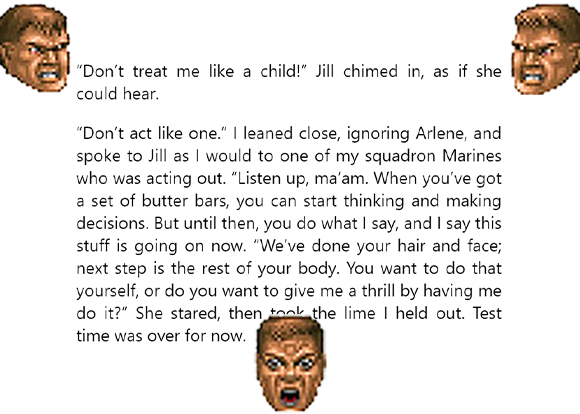
The book does great pains to convince us that Jill is an adult, and both demands and deserves to be treated like one.
Hm, I wonder why this book keeps vaguely sexualizing the teenage girl while simultaneously insisting she be considered as adult as her warrior companions?

At least one sect of Mormonism marries underage girls to much older, adult men!
Arlene tries to share the above Doomguy Fun Fact™ with Fly, but is immediately shouted down:
“I’m not even going to address the teen marriage, because what’s really disturbing is your prejudice, Arlene.”
But it’s all okay, because Fly decides he’s the safest person to befriend Jill because his brain will allow him to completely dehumanize her at any moment:
This is actually a powerful argument as to why she shouldn’t be anywhere near you, Fly. This book is so unhinged, I can’t understand how the pages remain glued to the spine.
I made nearly 100 screen grabs of different excerpts of full-hoot lunacy, which, had I included them all, would’ve ballooned this column to well over 100 pages. So in the interest of saving valuable internet space and not requesting another extension on this deadline, I made the final stretch of this column a potpourri of some of my favorite moments of fig-shitting derangement.
Did you think this DOOM novel was going to contain a mini-rant about how Linus, the Peanuts character, is a filthy Communist? Because I didn’t!
Hey. Hey. Listen – fuck calendars. Wristwatches are where it’s at.
…what.
…what.
Authentic teen speak!
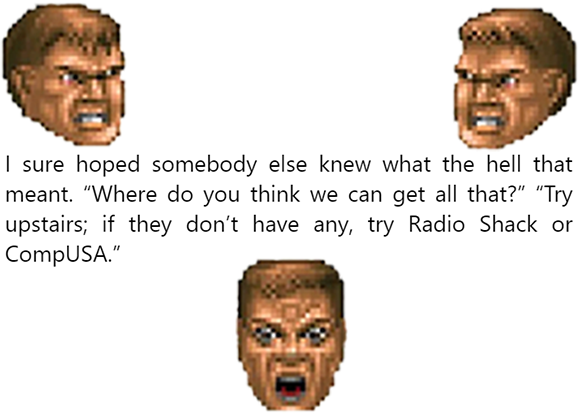
Predicting CompUSA would survive into the 22nd century might be the most irresponsible thing this novel does.
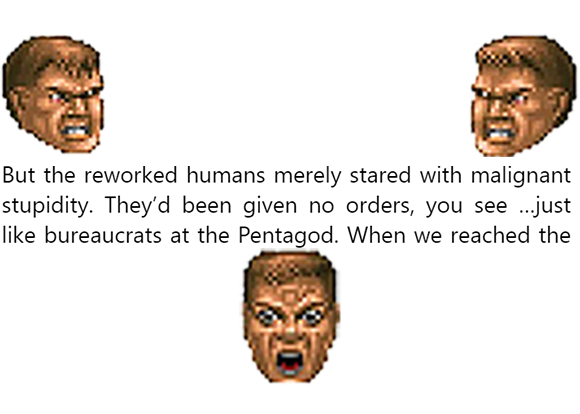
I genuinely do not know whether that’s a typo.
Tom Reimann is the co-founder of the podcast and streaming network Gamefully Unemployed, where he is writing feverish anti-Linus propaganda while smiling like the whale who ate the shrimp library.
…
This article is brought to you by our fine sponsor and Hot Dog Supreme: Sean Chase, who holds the record high score in Jehovah’s Witness Quake II.
Categories
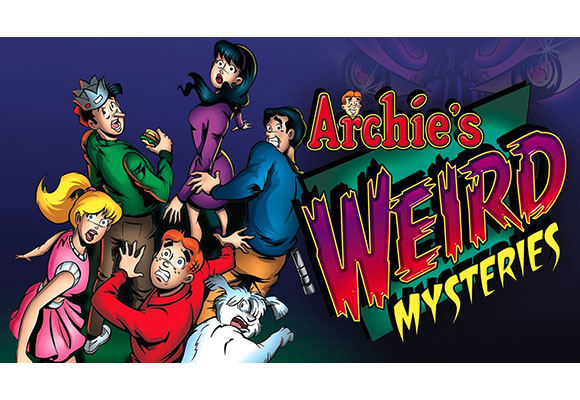
Nerding Day: Archie’s Weird Mysteries